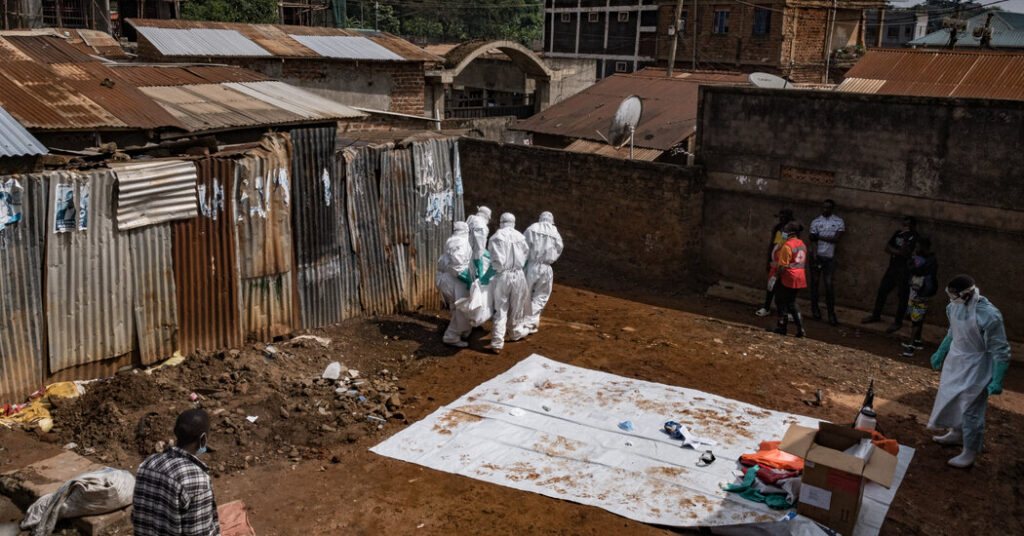
Uganda closed its border with the Democratic Republic of Congo on Wednesday, citing growing concerns about the possible spread of the Ebola virus, the country’s health ministry said.
The outbreak is centered in Congo’s Ituri province, which is on Uganda’s western border. Seven confirmed cases of the virus have already been reported in Kampala, the Ugandan capital.
Dr. Diana Atwine, the top official in Uganda’s ministry of health, said the border would be closed temporarily. “The only exceptions are for authorized Ebola response teams, the humanitarian operations, food and cargo transportation and security, but all this still will be under a strict health screening and monitoring protocols across the border,” Dr. Atwine said at a news conference in Kampala on Wednesday.
“All authorized entrants shall be subjected to strict health screening,” she said, adding that Uganda planned to send Ebola response teams to Congo.
Given that the border between the two countries is more than 500 miles long, banning all migration will be difficult.
More than 1,000 cases and more than 200 deaths have been recorded in the outbreak, largely in the Democratic Republic of Congo, according to the World Health Organization, which declared the outbreak a global health emergency on May 17.
The current outbreak is the 17th in Congo and the third largest overall. But health experts say that they are particularly concerned about this outbreak because there is not yet a vaccine to treat Bundibugyo Ebola, the species that is spreading.
Cuts by the Trump administration to disease surveillance networks and the closure of the United States Agency for International Development have impeded the response to the outbreak, according to health experts.
Uganda has been at pains to demonstrate that it is better prepared to respond to the virus than eastern Congo. Ugandan authorities have argued that there is robust disease surveillance and many more public health officials in Uganda than in Congo.
Last week, the Ugandan government stopped flights in and out of Congo and postponed an annual Catholic festival that had been planned for June 3. Each year, thousands of worshipers from Congo cross the border for the festival.
Ugandan officials have said that all of its Ebola cases are in quarantine and under medical supervision. “Because of the measures put in place earlier, we have actually prevented many patients from coming in. Many were stopped at the border and advised to seek treatment at referral facilities within D.R.C.,” Dr. Atwine said.
Reports emerged on Tuesday that the Trump administration planned to send American Ebola patients to Kenya for treatment, rather than bringing them back to specialized medical units in the United States.
Kenya’s government has not confirmed the agreement, but on Wednesday the health ministry said in a statement that it was in talks with the United States and other global partners about Ebola preparedness.
News of the U.S. plan sparked some backlash in Kenya among critics of President William Ruto, who is under pressure ahead of an election next year.
“Bringing Americans who are exposed to Ebola to Kenya for whatever reasons is an act of high treason as it exposes everyone to extinction,” said Miguna Miguna, a prominent opposition lawyer, in a post on social media on Wednesday.
The African Union’s public health agency last week identified Kenya as one of 10 African countries at high risk from the outbreak.
Brian O. Otieno contributed reporting from Nairobi.
Matthew Mpoke Bigg is the East Africa bureau chief for The New York Times, based in Nairobi, Kenya.
The post Uganda Closes Border With Congo as Ebola Fears Rise appeared first on New York Times.