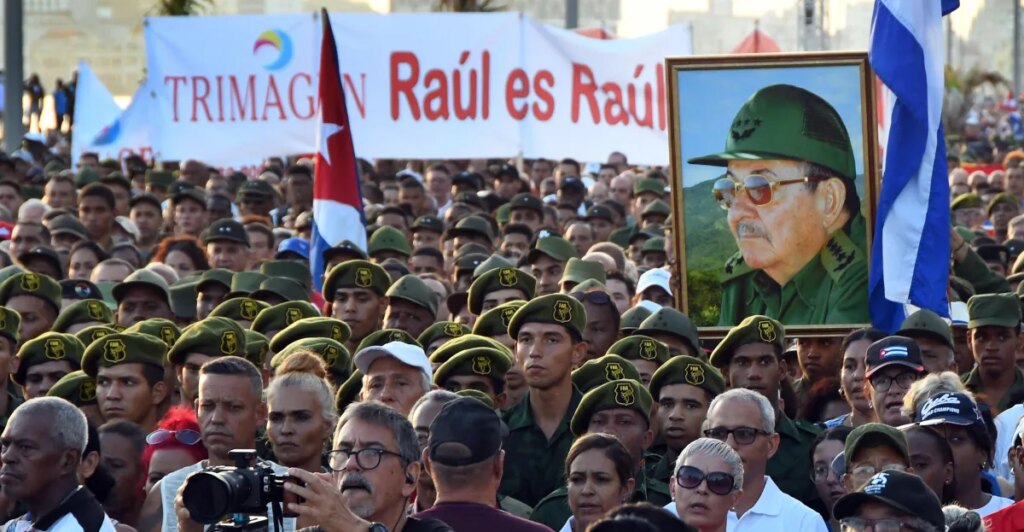
The United States indicted former Cuban President Raúl Castro in federal court last week, one of its most aggressive actions against the island since the end of the Cold War.
The unsealed indictment charges Castro, the 94-year-old brother of deceased Cuban leader Fidel Castro, and five others for alleged involvement in the shooting down of two small planes over Cuba in 1996. Four people, three of them US citizens, were killed.
The indictment is the most recent in a string of US moves that have left the island in a tough spot. The US embargo on Venezuelan oil to the country has plunged Cuba into a massive energy crisis, with blackouts affecting everything from homes to hospitals. The crisis is so acute that Cuba has cut the work-week to four days for state-owned companies; school days have also been shortened, and universities have waived in-person attendance requirements.
“For the last 50 years or so, the US has ensured that no country — other than a couple that the US didn’t hold sway with, such as Venezuela — [would] export oil to Cuba,” Cécile Shea, a Cuba expert and nonresident senior fellow at the Chicago Council on Global Affairs, told Today, Explained co-host Sean Rameswaram. “Now that Venezuela is also not exporting oil to Cuba, it means that they’re out of oil, and that’s completely on us.”
With Cuba already in a vulnerable spot, the Castro indictment has resulted in a fresh round of speculation: Is the US about to invade Cuba? Is this the same playbook the Trump administration used to oust former Venezuelan President Nicolás Maduro and usher in new leadership in Venezuela?
Sean spoke with Shea to get a better sense of how the Cuban government and everyday Cubans are thinking about the US, as well as what could come next.
Below is an excerpt of their conversation, edited for length and clarity. There’s much more in the full podcast, so listen to Today, Explained wherever you get your podcasts, including Apple Podcasts, Pandora, and Spotify.
Secretary of State Marco Rubio posted a video last week about Cuba. What did he say?
He spoke Spanish; of course, he’s a Cuban American. And he said, Listen, Cuban people, it’s not the United States’ fault that you don’t have any energy, that your electricity grid is down. It’s the fault of mismanagement by your government. Don’t blame us. It’s not because of our embargo. It’s because you are badly led, and it’s time for you to pressure your government to step down.
That’s a paraphrase, but that’s generally what he said.
Is that generally true?
No. It is not generally true.
There is truth to it in that the government has not always been a great government. But the reason that Cuba is in the current crisis — which is that there is no oil at all for consumers or businesses; they’ve reserved some for hospitals and the like — is the US is forcing Venezuela not to ship oil to Cuba.
For the last 50 years or so, the US has ensured that no country — other than a couple that the US didn’t hold sway with, such as Venezuela — [would] export oil to Cuba. Now that Venezuela is also not exporting oil to Cuba, it means that they’re out of oil, and that’s completely on us, and anyone in Cuba listening to Marco Rubio’s speech would have known that.
What makes this moment different? Is it that this administration is willing to go further than previous ones?
What could be interesting about this moment is that Cuba seems ready to deal.
If we believe the press reports, Cuba has offered to release political prisoners, which would be huge because it would create a political opposition in the country. Cuba has agreed to open its economy. Cuba has agreed to allow Cuban exiles back into Cuba. Things that we have been asking for for decades, it now appears that Cuba is willing to do. And I wish we would take the win. I wish we would accept these things and then add something to it: Promise to have a free and fair election two years from now. That would just make so much sense, and we wouldn’t be talking about the military, and we wouldn’t be talking about going in and kidnapping 94-year-old men. And President Trump could finally be what he wants to be. He wants to do what every president since Eisenhower has wanted to do, which is to end the communist-oriented regime that we have in Cuba.
Eisenhower tried; JFK tried. Trump was alive during the Cuban Missile Crisis, he was an adult. So was Biden. This is all very real personal history to them.
And I do think that part of what is going on is Trump wants to be the president who can accomplish what no other president has done. And I happen to think he could be, but I don’t think it’s going to be through a military method.
He has the attention of the people in charge of Cuba. We have a lot of leverage there. The government of Cuba these days seems willing to listen to us and to do some of the things that would keep us happy. And that’s particularly true of the younger generation in Cuba: I think they would like to see the government open up relations with the US and move beyond revolutionary Cuba.
So the Cuban government is willing to concede in a way we haven’t seen in decades. Young Cubans want there to be an opening-up of Cuban society. They want the government to play ball. And yet it sounds like you’re saying it’s more than likely the Trump administration will not go for it?
Unless there’s a lot going on behind the scenes that nobody sees, it seems like there would be a lot more talking and taking the win right now, especially if the Cubans actually did offer the things that the press has been reporting.
I don’t understand, for instance, the indictment against Raúl Castro. He wouldn’t still be alive by the time that the trial would start. He and his family are still heroes in Cuba, particularly with the older generation. So why mess with the Castros?
Can I offer a theory?
Yeah, please do.
Is it what the diaspora wants?
That’s a good question, and is it in particular what the older diaspora wants?
In part because of pressure from us, Cuba began allowing more people to emigrate from Cuba over the last 20 years, and a lot of them came to the US. There’s some evidence that among that million and half or so émigrés, they really want to move forward. They’re really not interested in fighting the wars of the 1960s anymore.
I think we’ve heard your best-case scenario, Cécile — that the United States takes concessions from Cuba and allows the country, on its own terms, to transition to free elections that organically replaces the Castro regime. What’s the worst-case scenario here?
The short-term worst-case scenario is that we end up with something worse than we have now.
The long-term worst-case scenario is that we further alienate the Cuban people who have already suffered from our sanctions and our embargoes for the last 60-some years, and it harms our ability to create a close relationship with a country 90 miles away over the next 20, 30, 40 years.
It’s hard for politicians to look past the next election. It’s one of the weaknesses in our government. But we should also be thinking about what kind of relationship we want with Cuba 15 years from now. Invading the country is not a way to make the odds of having a good relationship in the future strong.
You keep talking about this tension between the United States and Cuba as something from another generation — a holdover from, from the ’60s and ’70s, the Cold War. I feel like most Americans right now are not thinking about Venezuela nor Iran nor Cuba. They’re thinking about their gas prices and interest rates. How should Americans be feeling about this intervention that we may soon be executing on this island?
Here’s what I would say to some of those Americans: Imagine we could go two routes right now. Imagine we could start selling spare parts that Cuba desperately needs to keep their machines running. Imagine we could make an agreement with them that would allow them to begin importing American vehicles again, tariff-free. Imagine that you could take vacations to Cuba again, which are fairly inexpensive.
Would you choose all of those things, or would you choose sending more young people into harm’s way 90 miles away from Florida? Being even more of a pariah in the world than we already are? Because if you’ve been to Europe lately or Canada lately, you know that Americans are very unpopular right now. And just imagine what will happen if we take military action in Cuba.
I think we should also talk about the morality of the situation. There are people who can’t get kidney dialysis right now because the hospitals are running out of oil. There are people who can’t get to work and therefore can’t get paid because they can’t put gas in their vehicles.
These people are just 90 miles away from us. Are we really going to let this kind of pain and suffering continue through the hottest part of the year? What will be the long-term harm not just to them and their health but to their view of the United States? We should not just be sitting by and watching this happen.
The post Two ways Trump’s Cuba standoff could end appeared first on Vox.