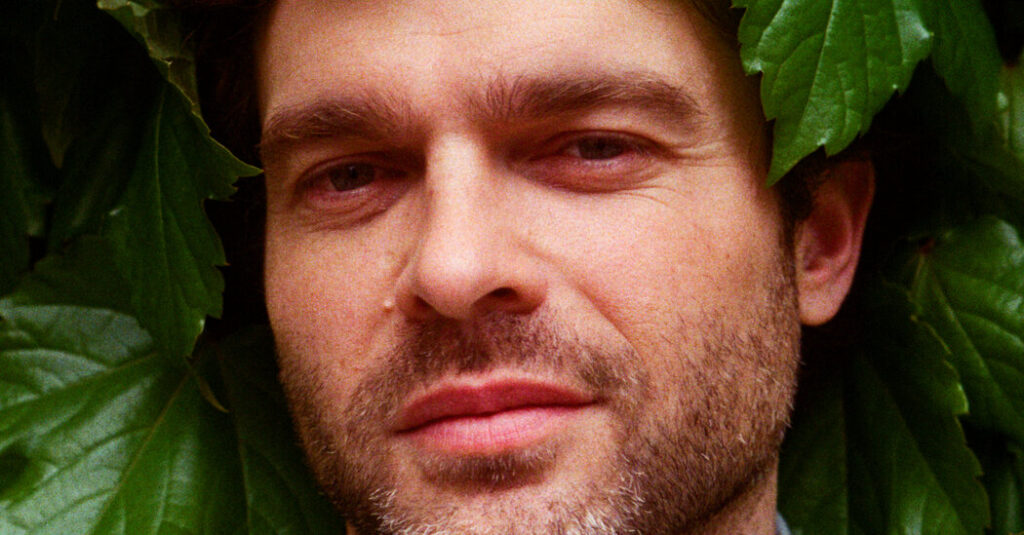
Alden Ehrenreich is — was?— a romantic, not that you would know it from his Broadway debut in the morally twisty comedy “Becky Shaw.” As Max, a verbal spear of a money manager, he became the talk of the spring theater season, and earned a Tony nomination for best featured actor in a play, portraying a character who, as he understatedly put it, “does horrible things.”
Ehrenreich, to be clear, is not nearly so down on the guy, and even finds a strain of innocence in Max’s manipulation of the interlaced family and romantic triangles that propel “Becky Shaw,” also a Tony nominee for best revival of a play. In Gina Gionfriddo’s script, Max has the punchiest lines — “Don’t pray,” he declares. “Or if you do, don’t squander it. Pray for money.” — and in this production, an emotional turn that reveals his own lacerations. The tease of the role is “the fun pyrotechnic stuff,” Ehrenreich said during an interview over breakfast, “and then also that you get to see what’s behind it.”
The way reality lashes into romanticism: that’s something Ehrenreich, 36, has been thinking about a lot lately, as he veers off the usual Hollywood path and establishes a nonprofit theater, Huron Station Playhouse, in his hometown, Los Angeles. “The grandest dream I ever had,” he said of buying a landmark former trolley substation to put on new plays.
As he and his small staff navigate running a 6,500-square-foot space, his hope is that it will become an artist enclave and refuge in a place, where, he said, “it can be very hard to protect yourself against a lot of commercial thinking.”
He has formidable boosters. “He wants to make his life an adventure; a work of art,” said Francis Ford Coppola, whom Ehrenreich has adopted as a mentor. “How can one not applaud that?”
Ehrenreich’s idealism, especially about theater and cinema, community and connection, was percolating even before he set off on his retro-charmed career path: discovered as a teenager by Steven Spielberg, he made his big screen debut at 19 as a lead in an arty Coppola film, “Tetro,” from 2009; wowed critics with a turn as a dopey singing cowboy in the Coen Brothers’ “Hail, Caesar!”; jetted into the Star Wars universe as the young Han Solo; and, as a Senate aide parrying with Robert Downey Jr., had one of the most memorable moments in “Oppenheimer.” He is a scene stealer with the charisma — and the combustible, malleable good looks — of an everlasting star, like Jack Nicholson or Meryl Streep, his collaborators said.
“He is able to draw you fully in while doing almost nothing,” said Zach Cregger, the writer and director of “Weapons,” in which Ehrenreich starred last year as a troubled, notably mustachioed cop. “In the editing room you’re never ever cutting around a false beat with Alden. It’s all there, every take.”
And this spring that’s been true onstage, too, where Ehrenreich, as Max, barely has to raise an eyebrow to get a laugh, or a stunned gasp. “Alden can convey whole worlds in just the sideways glance,” said Trip Cullman, the director of “Becky Shaw.” “It’s an entirely embodied characterization.”
In one climactic scene, Cullman noted, “his bottom lip starts quivering and does not stop until the end of the play. It is a full 15 minutes of someone trying to hold back.”
As the artistic director of the Huron Station Playhouse, Ehrenreich had reached out to Cullman for guidance, and then Cullman, who already considered him “one of the great underrated actors,” suggested him for the role, despite his lack of formal stage experience. Though Ehrenreich helped run a loose theater collective in college, at New York University, “Becky Shaw” is his first professional production.
Max, Ehrenreich said, reminded him of other blustery but magnetic characters: Ricky Roma in David Mamet’s “Glengarry Glen Ross” (Al Pacino in the film version); Dennis, the slick narcissist, in Kenneth Lonergan’s “This Is Our Youth”; an office bully in Neil LaBute’s “Fat Pig.” “You’re like, ‘This is not a great guy,’ but you are, moment to moment, pulled in by them,” he said. “It’s a role I’ve always wanted play.”
From their first interactions, Gionfriddo, the “Becky Shaw” playwright, was impressed with how serious-minded he was about a show that is mainly very funny. The plot builds around a disastrous blind date between Becky (played by Madeline Brewer, of “The Handmaid’s Tale”) and Max, who has had a turbulent childhood. As soon as Ehrenreich was cast, Gionfriddo said, he called her to ask for granular details about his character’s life. “I’ve never had that before,” she said. “He had this very studious approach, really wanting to nail down the facts of the story.”
And he found inspiration in the 18th- and 19th-century novels that Gionfriddo evoked while writing the play. “Basically, it’s ‘Wuthering Heights,’” he said. His character may declare himself a cad, “but the whole thing is an epic, grand love story of an orphan in love with the only place he’s ever found a home.”
Ehrenreich is an avid reader, equally liable to quote David Foster Wallace or a biography of Frank Capra. Over eggs at a cafe in the West Village, where he is living with his girlfriend, Elissa Mielke, a Canadian musician, during his Broadway run, he was eager to illuminate his cultural touchstones — which lean heavily to auteurist and classic Hollywood — and more unexpectedly, to ask me about mine. (“What were you into when you were a teen?”)
The only child of an interior designer mother and an accountant father, who died when his son was 8 — his stepfather, an orthodontist, also helped raise him — Ehrenreich spent a lot of time with his maternal grandmother, a retired educator, who took him to see theater and helped orient his throwback tastes. (At 10, he was watching Dean Martin’s celebrity roasts. “Hugely problematic,” he said, laughing. But it made show business seem fun.)
His own high school experience was rarefied: as a student at the private Crossroads School, in Santa Monica, Calif., both Mamet, the “Glengarry” playwright, and David Milch, the veteran TV writer and producer, came to speak to students there. “I remember those talks and other ones just reshaping my point of view,” Ehrenreich said. It was also in those years that a bat mitzvah changed his life, after a silly video he made with a friend was screened at the celebration, and piqued the interest of Spielberg, who was a guest. An agent soon followed.
He and Spielberg have never worked together, but he recounted with awe a phone call in which the director told him about how, as a teen, he’d encountered other film legends. “Seventeen-year-old Steven Spielberg went to John Cassavetes’s and Gena Rowland’s house during reshoots for ‘A Woman Under the Influence’ and had spaghetti dinner! It blew my mind.”
Ehrenreich didn’t take the typical child actor path, auditioning for commercials or sitcom walk-ons; he wanted to wait for something substantial. At 17, he went off to Argentina to screen test with Coppola. “He made such a huge impact on me at such a young age,” he said, “it’s kind of hard for me to parse exactly what I got from him and what’s native to myself.”
If our conversation was artistically eggheady (and it was), it also flowed from his sincere interest and delight. Ehrenreich told me he makes a point of seeing Capra’s “It’s a Wonderful Life” in a theater every year. “Because the audience that leaves is a different audience than came in,” he said. “They’ve gotten in touch with a part of themselves that maybe they had to protect from the day-to-day tough [expletive] they have to deal with.”
That feeling informs the contemporary work he’s planning to program at the 99-seat, brick-walled Huron Station Playhouse — “plays that make us feel more alive to our own emotional life, our vulnerability, our humanity,” he said. The inaugural season this fall consists of two plays, including one by the Pulitzer-winner Annie Baker. A courtyard with a firepit serves as a post-show hangout; audience members linger late, over s’mores.
The vibes impressed Cullman, the “Becky Shaw” director. “Theater is such an uncool art form,” he said. “The more people who are giving their imprimatur of coolness to it, the better.” For now, Huron is offering workshops and staged readings (and being rented as a wedding venue to make ends meet).
As he’s matured in the industry, Ehrenreich says his ambitions have changed, too — which “has been a hindrance, in a way, to me being more famous, frankly.”
And the performative aspects of his career have lost their glisten. “I don’t revel in just the ‘look at me’ in the same way,” he said. “The strike zone is a little smaller in terms of what work ‘ I do that feels meaningful.”
A short film he wrote and directed in 2023, “Shadow Brother Sunday,” for which he gained weight to star as the doughy, downbeat brother of a movie star, got him the “Weapons” gig. “He played it with such compassion and honesty, but it was also just utterly hysterical,” said Cregger, the “Weapons” filmmaker, who got his start in sketch comedy. “To find a dramatic actor who can smell out the comedy instinctively and never push the joke too hard is my favorite thing. Alden is miraculous in that way.”
(Coppola produced the short. What he witnessed as Ehrenreich did so, he wrote: “Endless curiosity — creative promiscuity — something my own children demonstrate, and I hope, me too.”)
After we met, Ehrenreich emailed me to offer a counterweight to his youthful romanticism. His current guiding philosophy — in performance and in life — is, he wrote, “trying to give myself as wholly as possible to the present moment. This very one.”
But that seemed looped into who he’s always been: a patient dreamer, diligently, as he put it, “falling in love with the real.”
Melena Ryzik is a roving culture reporter at The Times, covering the personalities, projects and ideas that drive the creative world.
The post The ‘Becky Shaw’ Star Who ‘Does Horrible Things’ Oh So Well appeared first on New York Times.