For 88 days, they could not chat with family or friends online. Their access to independent news, or to the websites they needed to run their businesses, was blocked. Simple pleasures, like streaming their favorite television shows, were denied them.
Now, after what activists say was the longest nationwide internet shutdown in history, Iran’s government seems to be restoring access. Many Iranians are reconnecting to the world, eager to resume the online habits most people take for granted.
“I have mixed feelings. I am happy, but at the same time, I feel kind of stupid that I am happy about such a simple thing,” Hamid, a 29-year old tech worker in Tehran, said in a voice message, sent minutes after he discovered he was able to reconnect. Like many people interviewed for this article, he asked that his last name be withheld, fearing retaliation for speaking to a foreign news outlet.
As someone who used the internet for both private communications and his job, Hamid said, “my entire life and work had been at a standstill.”
Iran’s authorities justified the shutdown on national security grounds after the United States and Israel began their war with the country on Feb. 28. A population of roughly 90 million was plunged into a near-total communication and information blackout.
For many Iranians, it was not only an economic disaster, one whose impact on businesses was estimated at up to $80 million a day. It was also psychological torment.
Most people could connect only to what was available in a walled-off “domestic internet,” made up of a limited number of apps or websites subject to censorship by their authoritarian clerical rulers.
The only news most Iranians could access was on websites authorized by the state. The only online platforms they could use to communicate with loved ones across the country were surveilled by the state.
“The worst part was reading all this news you don’t trust, with a controlled narrative, and being in a complete information black hole,” said Maryam, a 39-year-old who works at an advertising company in Tehran.
For months, Maryam felt she did not really know what was happening in the world, or even with her own friends and family outside the city.
“I feel like I’ve just come out of prison and I’m in shock,” she said in an interview. “I have nothing to say — I’m just listening to the sounds outside.”
Not all Iranians were cut off from the world. For months, many officials and select elites were granted an open connection through what critics call “whitelisting.” Activists who campaign for internet freedom in Iran use that term to describe state efforts to essentially offer different levels of connectivity, based on people’s political loyalties, their ability to pay and the need for academics and journalists to conduct research.
Even as some Iranians felt excitement about the spreading connectivity, it was marred by a sense of anxiety that it might not last. In part, that is because government officials seem to be at odds over whether to let it go forward.
Last month, as the shutdown generated a massive backlash even among some state supporters, President Masoud Pezeshkian created a working group to determine a new internet policy for Iran. That group decided on Tuesday to start restoring access, a move that was announced by a government spokeswoman.
But soon afterward, a court declared that the process should be halted as it dealt with what it said were complaints filed against the restoration of access, according to Mizan, the judiciary’s official media outlet. Nevertheless, the president’s working group seemed to press ahead.
“Different legal bodies are making contradictory decisions, and it’s not really clear who the final decision maker is,” said Fereidoon Bashar, the director of ASL19, a Toronto-based tech group focused on supporting internet freedom in Iran.
This shutdown was the third in a year. The first took hold for weeks after Israel, briefly joined by U.S. forces, began a 12-day war on Iran last June. A second was imposed in January, amid the eruption of nationwide anti-government protests, which were crushed by a bloody crackdown.
The current restoration of access is still limited, Mr. Bashar said. It has not even reached the level that the state allowed between that January crackdown and the start of the war in February.
Large swathes of the population, particularly poorer and less tech-savvy people, have probably seen no benefits, Mr. Bashar said: “I would say the majority of the population can’t get online.”
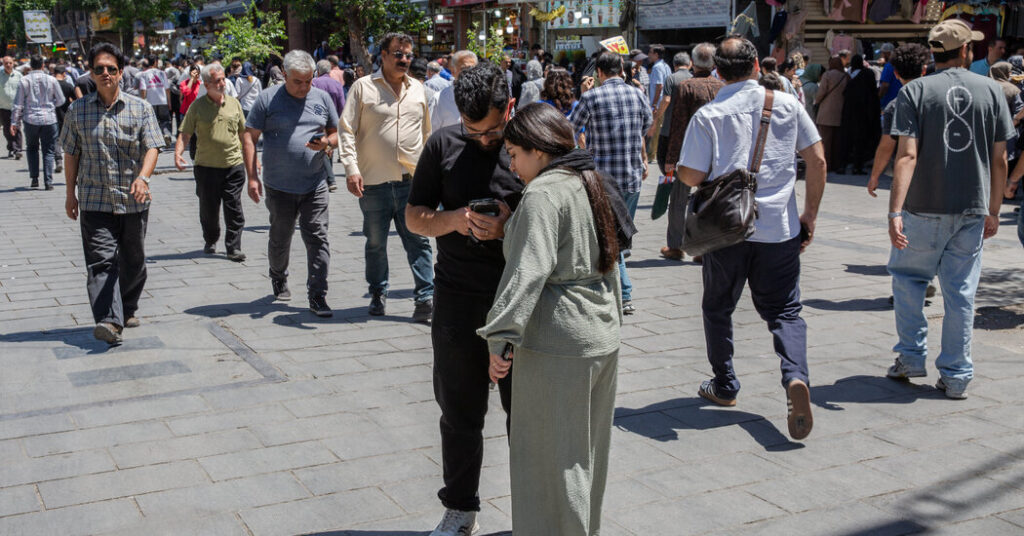
Still, many Iranians who can are catching up on messages and emails missed during a quarter of a year without regular access. Some hoped that connectivity would soon be good enough to watch a plethora of movies and television shows they had been unable to stream for months.
Others described just wanting a chance to socialize with friends online, for free, at a time when the war’s dire effects on an already-battered economy had made going out impossible for many.
Maryam, the advertising company employee, said she felt deep resentment that a state shutdown had left her with such simple aspirations.
“That sense of humiliation is what really bothers people. They feel like hostages in this country,” she said. “The sad part is that we were starting to get used to it.”
Erika Solomon is The Times’s bureau chief for Iran and Iraq.
The post Iranians Emerge From a ‘Black Hole’ as Internet Shutdown Eases appeared first on New York Times.