Subscribe here: Apple Podcasts | Spotify | YouTube
On this week’s episode of The David Frum Show, The Atlantic’s David Frum opens with his thoughts about the recently reported peace talks between the United States and Iran. David argues that these reported talks indicate the United States is losing the war in Iran, and that the loss highlights what has always been true: The presidency is too big a job for Donald Trump.
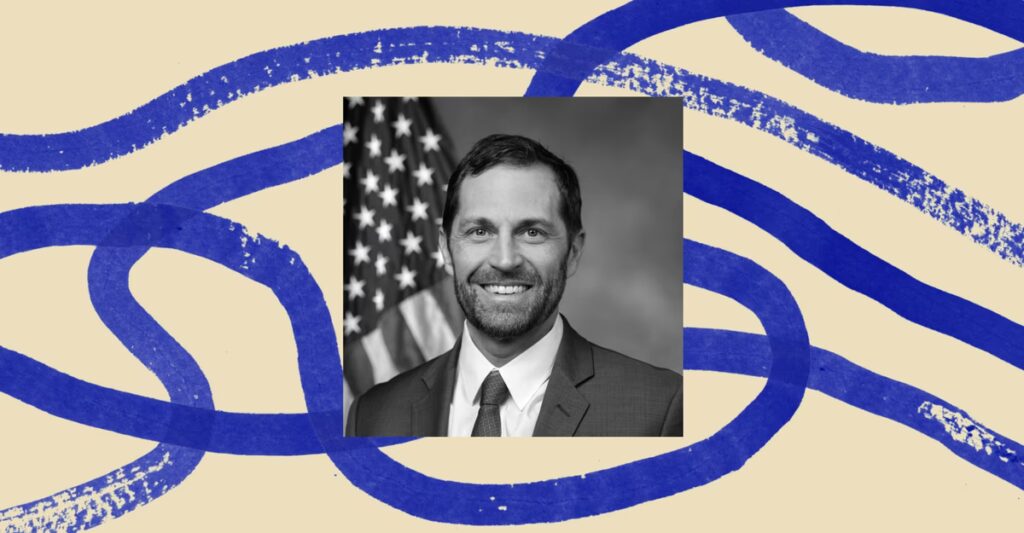
Then David is joined by Representative Jason Crow of Colorado to discuss Trump’s politicization of the American military, lessons from the war in Iran, and the chaos at Pete Hegseth’s so-called Department of War.
David ends with a discussion of James Boswell’s classic biography, The Life of Samuel Johnson.
The following is a transcript of the episode:
David Frum: Hello, and welcome to The David Frum Show. I’m David Frum, a staff writer at The Atlantic. My guest this week will be Jason Crow, who represents the Sixth District of Colorado in the United States House of Representatives. The book for discussion this week will be James Boswell’s [The] Life of Samuel Johnson, a classic of English biography and English literature.
But before either the dialogue with Congressman Crow or the book discussion, some opening thoughts on news that is arriving this weekend that the United States and the Trump administration may have reached some kind of resolution in the war with Iran that began on February 28 of this year.
Now, this news is very much in flux. That accounts for the unfamiliar look of this podcast, if you are watching. I am not recording from my usual recording place in Washington, D.C. I’m in Ontario for the Memorial Day weekend and am improvising a recording studio here. If the news is accurate, what we hear, what has been reported so far, is the United States is reaching a settlement based on the idea that the Strait of Hormuz will be reopened, that oil will resume flowing out of the Persian Gulf, in return for which the United States will offer some kind of compensation to Iran. Maybe there’ll be some kind of release of frozen Iranian assets. But the United States will get access to oil. The United States and the world will get access to oil. Iran will get money, and there’ll be some kind of cease-fire and some kind of down-the-road-later return to the problem of the Iranian nuclear program.
If these reports are accurate, this is a pretty humbling defeat of America’s goals in the war with Iran that started on February 28. When the war started, President Trump never declared formal war aims, but based on things the administration said, something like this seemed to be in their mind. They wanted a formal termination of the Iranian nuclear program that the United States had badly damaged through air strikes last summer. The United States wanted an end to the Iranian ballistic-missile program, something that was not covered by the Iranian treaty that the Obama administration negotiated a decade ago. That the Obama deal overlooked the ballistic-missile program; the Trump administration wanted some kind of termination of the ballistic-missile program.
The president of the United States had promised help is on the way to the tens of thousands, hundreds of thousands, of Iranian people who rose up against their terrorist, repressive, theocratic regime. And you might have thought that some kind of help for the Iranian people would be part of the outcome that the United States sought—and maybe some kind of end to Iran’s practice of being the world’s leading state sponsor of terrorism, a status it’s held since the Iranian Revolution of 1979, with blood on its hands of people all over the world, including many Americans, from its terrorism and aggression. Some kind of change in the nature of the regime to make it less dangerous to its neighbors and its own people.
None of that happened, or none of that looks to have happened. All that looks to have happened is a reversion to the status quo as it was before the war started. If any of this is right, it is a pretty humbling climbdown.
How on earth did we get here?
The disparity in power between the United States and its ally Israel on the one hand, and an Iranian regime weakened, rocked by the challenge and the rebellion of its own people, would seem so overwhelming that it’s hard to imagine how the United States could not have won this war, and yet it seems to have not won in strategic terms. Really, it lost. How did that happen?
Part of the answer—only part, but part of that answer—takes us to a disconcerting fact about the government of the United States right now, about the Trump administration and President Trump. And I think the best way to sort of sum up what the matter is, is by citing a statement President Trump made earlier in the month of May. He was talking to reporters, and they challenged him on his declining poll numbers, and especially his declining poll numbers among Republicans. And President Trump said, citing a story he had seen on CNN and misunderstood, he said, I have 100 percent support among Republicans.
Trump: Although I do, I am at, according to CNN, 100 percent approval within the Republican Party. I’m at a hundred percent approval.
Now, President Trump mangled exactly what the poll said. None of that matters. The point was, the thing that had stuck in his mind and that he wanted people to know was that he believed, wrongly, but he believed he had 100 percent support among Republicans.
Now, if true, that’d be a pretty impressive number in one way—who gets a hundred percent of anything? But the urge to cite it shows something very peculiar about President Trump, which is, he’s never thought of himself as a national leader. He’s a factional leader. He’s the leader of the MAGA movement that has seized power in the United States, and that attempted, actually, to hold power in 2021 by violence, then return to power in 2024 by legal means, and that is now looking for ways to hold on to power after the elections of 2026 through gerrymandering and other forms of rule bending. He has always seen himself as a movement leader who happened to arrive in the government of the United States—not as a national leader, not as the president of all the people.
Now, if what you want to do is, sort of, plunder the Treasury and deliver a few benefits to your supporters at the expense of the rest of the country, this is a kind of, perhaps, for the short term, workable political strategy. But if you want to lead the country to war, it is doomed to failure. Wars are big, costly, dangerous events full of shocks, full of bad news. And when a president makes the heavy decision to lead the country to a major war—and this war with Iran has been a major war involving massive expenditure, massive use of U.S. munitions, American loss of life, heavy loss of life on the Iranian side—when the president makes that decision, he needs to mobilize something more than his preexisting fragment of popular support. He needs to speak to the country as a whole, or at least try to.
Now, no president, maybe since Pearl Harbor, has been able to rally virtually every American to a single national cause. It’s a democracy. There are a lot of different opinions, and that’s as it should be. But presidents have tried. The presidents of the Cold War era tried. They tried to be something bigger than just the leader of a party. And that meant discipline upon them even when the country was not at war, that the president had to behave in certain ways that were recognized as presidential even by his opponents in order to retain the ability to speak to and for the whole nation when a real emergency appeared. And this is the one thing that I think most people would agree unites the chain of presidents from Franklin [D.] Roosevelt through [Harry] Truman, through [Dwight D.] Eisenhower into the later day, [Ronald] Reagan and [Barack] Obama and even [Joe] Biden tried to sound that music with his fainter voice.
But Trump has never thought that way, never tried to do it that way. And so long as things seem to go reasonably well, as they did for the first three or so years of Trump’s first term, it didn’t harm him much or didn’t hamper his plans. He was not regarded by half the country—and more than half the country—as some kind of interloper, somebody who got into the office by a kind of trick and who represented the interest only of a minority of the country, and who in everything from disaster relief to his tax program made no pretense of caring about the people who hadn’t voted for him.
But in this second term, where things have been bumpier, where the news has been worse, where he’s made more mistakes, and where first there was the economic hardship caused by his crazy tariff program and then outright war, his inability to speak to and for the country, his inability to act the role of an American president, has become a major strategic liability for the United States because the United States was never able to accept any costs at all from the Iran war.
A different president operating for different reasons would have said, I want to lead the country into war with Iran. I hope you all understand that this will be an expensive and difficult undertaking. Obviously, the price of fuel and perhaps the price of food will rise. I believe, might say the president, this will be a short-term shock, but a shock it will be. I have various measures in mind to cushion the shock for those most in need, but this is important for all of our interests. Here’s why. This is important for the peace of the world. Here’s why. And I ask you to follow me and trust my leadership. That’s what a normal president would try to do.
Because Trump had never tried to be that kind of president, he couldn’t acknowledge any kind of suffering. He couldn’t make the case for the war at all. He spoke to the nation at the State of the Union just a few days before leading the nation to war. He made almost no reference to Iran. He certainly gave no indication the war was coming, and he warned of nothing, and he asked for nothing. He asked for no support from Congress. He just went to war without any kind of consultation, no kind of authorization of the use of force, which his predecessors had done for large-scale military conflicts. Asking Congress for the use of force would mean that you would be subject to questioning by Congress. How much will this cost? How long will this last? What are the goals? Are they achievable? President Trump didn’t wanna face any of that kind of questioning, so he didn’t ask for authority. But that meant his war had no co-authors. It was entirely his own doing, a one-man show. So long as everything went smoothly, that might not be so much trouble, but, of course, things have not gone smoothly, and now they’ve ended very disappointingly, if not in outright defeat, and it’s still the one-man show.
The presidency has always been too big a job for Donald Trump. He’s never understood it. He’s never tried to do it. He has never imagined, even imagined the lineaments of the job, what it would look like, what kind of person that he would have to have been in order to be a president of all the people, a president who sought to be the president of all the people, who sought to speak on behalf of all the people, not all of the time, but when it really counted.
Because of that lack in him, there has been a lack in the job, and because of that lack in the job, there was no realistic assessment of the costs of war, no realistic plan to deal with those costs, no realistic rally to the country to absorb those costs, and no ability in the country to bear those costs when they arrived. And the result is a war that has turned into defeat when it really didn’t have to do so.
This loss is Donald Trump’s fault and Donald Trump’s doing as much as anything else that he has done in his two terms as president—more than anything else, because it is one of the most expensive consequences of his most characteristic deficiency as president of the United States.
And now my dialogue with Jason Crow.
[Music]
Frum: Jason Crow represents Colorado’s Sixth District in the United States House of Representatives, centered on the city of Aurora, east of Denver. First elected in 2018, he serves on the House Permanent Select Committee on Intelligence and the House Armed Services Committee. He is also co-chair for candidate recruitment of the Democratic Congressional Campaign Committee.
Crow is a veteran of both Iraq and Afghanistan. He fought with the 82nd Airborne Division and the 75th Ranger Regiment. He completed three tours of duty and rose to the rank of captain. He was awarded the Bronze Star. Crow earned his bachelor’s degree from the University of Wisconsin at Madison in 2002 and a law degree from the University of Denver’s College of Law in 2009. Congressman Crow, thank you so much for joining me today.
Jason Crow: Thanks for having me, David.
Frum: So we’ve all seen your televised tangles with the defense establishment and the wry humor you bring to those encounters. And I want to draw today on your knowledge of that establishment and especially of the part that tends to get kind of a pass in the Trump era: the uniform part. There’s a lot of criticism of the civilian leadership, but the war in Iran seems to be not going very well from an operational point of view. Aircraft loss, bases struck, and very uncertain reports on the amount of damage to military targets that the military has actually been able to inflict. So I want to get your assessment as a veteran and as a member of the two most important committees of the House of Representatives on this question. From a military point of view, never mind the decision to go in the first place, how is this war proceeding?
Crow: Yeah, I look at it in two different ways. So the rank and file—those men and women in uniform who are carrying out the air strikes, who are conducting the operations—they’re doing a remarkable job. This is, just operationally—taking out the politics, whether or not this is the right thing to be doing, operationally—our military is doing a remarkable job day to day in their mission, and it’s highlighting how good they really are.
I will parse out of that, though, how I believe the senior commanders—those who are testifying before the Armed Services Committee, those who are briefing us—how they’re performing, and I think in many cases they have been less than candid, at best. At worst, they’ve hidden the ball from us, haven’t been straightforward. I just recently cross-examined the head of Central Command, which has responsibility over the war in Iran and wasn’t giving me very basic answers to straightforward questions that weren’t difficult questions at all.
So that is problematic to me because there is a history in America of our senior commanders—this is in Iraq, this is in Afghanistan, this is in Vietnam—simply looking at tactics and confusing tactics with strategy. A series of successful tactical missions do not make a strategy. And that is a big part of our problem right now.
Frum: There’s a question about how, even tactically, how successful. I mean, the military seems to be caught by surprise again and again by things that shouldn’t be surprises. It’s not a surprise that the Iranians moved to close the Strait of Hormuz. I’m guessing the question of a U.S. conflict with Iran has been war-gamed annually since the spring of 1980.
Crow: Yeah.
Frum: And I assume that in those war games, the Iranian players’ first or second go-to move is the Strait of Hormuz.
Crow: That’s right.
Frum: After the United States assassinated the terrorist commander Qassem Soleimani, the Iranians hit back with missile attacks on U.S. bases, which did damage to individuals and to property. It shouldn’t have been a surprise that there would be attacks on U.S. bases. And yet, in both cases, the U.S. military seems to have been taken by surprise.
Crow: Well, I think those are different examples. So the attacks on some of the bases, some of the logistics hubs, the communications and radar facilities that killed six service members in one instance—I think that is a good example of not being prepared. I don’t think that those service members were protected by counter-drone capability. I don’t think they had the battle-hardened cover that you need in a drone environment. And I think that’s because we raced into this conflict.
Same with the Strait of Hormuz. I actually don’t believe that our military commanders were caught by surprise by the closure of the strait. I actually know that’s part of our contingency planning and what is likely in a scenario like this. But what I think happened is, you have the president and you have the secretary of defense, who make decisions impulsively, who don’t listen to the best advice of their military commanders and say, Just go out and do something and do it now. And there are instances where our generals and our admirals say, Okay, you are the commander in chief. We will do this now, but we need two weeks, we need three weeks to get the minesweepers in place, to get air-defense capabilities in place. And if the president disregards that advice, then it puts our service members in a terrible position.
Frum: Well, there’s another question about the uniformed military, which is, there has been notice since the beginning of full-scale fighting between Russia and Ukraine, in February of 2022, that warfare is shifting and that tanks and aircraft and ships are all much more vulnerable than they used to be to very cheap and very smart drones. The Ukrainians lead the world in this technology. The United States seems to have been hit by Iranian drones, and fighting in 2026, four years after the beginning of the Ukraine war, seems not to have been ready for that.
Crow: Yeah, our entire model of defense right now is not relevant to the current era of warfare. We’ve been shooting down $30,000 Shahed drones coming from Iran with $1 million missile interceptors. The math on that just doesn’t work, right? We have a huge military and a huge defense budget, but even at that, our adversaries are at an advantage if they can just send swarm after swarm after swarm of cheap, attritable drones or missiles at us while we spend 10 to 20 times the cost of those same systems to knock them out. That’s not good for the taxpayer, that’s not good for our service members, and it’s not good value for the money we’re investing. Which is exactly why a $1.5 trillion defense budget, which is almost a 50 percent increase in our defense budget, is absolutely absurd right now, especially if it’s not coupled with dramatic defense reform to change how we’re buying things, how we’re fielding things, and making sure that we’re buying things that are actually cheaper and more effective.
Frum: President Trump and Secretary [Pete] Hegseth have had a year and a half since coming into office to remake the upper reaches of the military the way they want, and they seem to have done that in a very ambitious and aggressive way: firing lots of generals, hiring lots of generals. And they now have the high command of their wish. How do you assess the quality and merit of the high command that Hegseth and Trump have built?
Crow: So I think there’s a really important point that I’ve been trying to make, and I’ll reiterate here. It’s not that they’re moving troops around or shifting troop footprints or firing generals and admirals. That actually is within the purview of the commander in chief and our political leadership to put the right people in place—if it’s done appropriately and for the right reasons. Right? I’m not just presumptively opposed to moving troops around Europe or prepositioning them and making sure that we’re responding to threats, that we’re keeping our people safe, or that if a general or admiral isn’t performing, that we get somebody in place who does perform.
When it becomes my business, when it becomes Congress’s business, is when that’s being done for political reasons, or someone’s being targeted for their race or their gender, or they’re making these decisions based on political loyalty and not competency. And it appears as though many of those decisions are being made for those improper reasons, right? Shifting 5,000 troops out of Germany, right? Maybe we need to do that. Maybe we need to put troops into the Baltics, into Poland, into Romania, because we want to move things into the Eastern flank. But that’s not what they’re doing. They’re moving them out because Donald Trump is pissed at the chancellor of Germany because he felt personally slighted, so he’s making a decision to move a brigade of troops around. Same thing with the almost 30 generals and admirals who have been fired without cause, without reason. Some are out there dismissed, shown the door, sometimes with 24 hours’ notice, and no explanation to Congress as to why that’s happening other than a perceived lack of loyalty to Pete Hegseth and Donald Trump.
Frum: One of the most mysterious of those shifts, and perhaps you can share some insight into this, was: An admiral was removed from command over the forces in the Caribbean area shortly before there was a major change in the way the United States approached drug smuggling, where boats are to be blown out of the water summarily on the basis of who knows what kind of information. It looks as if—and I don’t know this, but you may—that the admiral was removed because he had objected to these strikes. Can you shed any light on that story?
Crow: I’ve been trying to get information on that, and information right now is hard to come by, but I agree with you. It appears as though—this is what’s called Southcom, Southern Command, right? Because the world is divided in the geographic regions called “combatant commands”: Central Command, Africa Command, European Command, Southern Command, Northern Command, all of which have responsibility over those areas of the world, as you know, David, and they’re the ones who do the war fighting. So when there are wars that are being fought or contingency operations, it’s those combatant commanders. So what makes the dismissal of the Southern Command most suspicious is: (a) it happened right after the Caribbean operation started, and (b) this person was in office in their position for less than a year. So this is an out-of-cycle dismissal. So something happened here, what we’re trying to get answers to, that led to this dismissal of this person right after they took the job and right after we launched a highly legally suspect operation. That, in my view, actually has been a violation of the law of war in several instances, including a shooting on a vessel that was clearly a shipwrecked vessel with noncombatants clinging to the side of it who were targeted and killed.
Frum: So you don’t have conclusive information yet on that removal.
Crow: No, I don’t. Same thing with the chief of staff of the Army, Randy George, also fired without cause, overnight, given almost no notice. Somebody who was in office before Donald Trump came to office and replaced, it seems, without any valid reason.
Frum: Do you have any suspicion—or I should say, we all have suspicions. Do you have any basis for suspicion that Donald Trump is trying to build a more politically pliable military?
Crow: No, clearly that’s happening. Clearly it’s happening. I think it’s objectively true, right? They’re holding campaign rallies at military bases with campaign apparel and gear. You have the secretary of defense, Pete Hegseth, literally this past week campaigning for a congressional campaign while sitting as the secretary of defense. It’s unprecedented. It’s a clear a breach of the lines between being a civil servant, a political appointee of our biggest agency, and in my view, the most consequential because we’re carrying out our national-defense mission and responsible for the lives of millions of service members, taking time and actually going to campaign and stump for a pro-Trump member of Congress. It’s crazy. It’s crazy. Those lines have been more than blurred. They’ve been erased by this administration, and the consequence of that is several-fold. No. 1: What is so precious to me is that our military is a standard bearer, should be a standard bearer, of our values and should reflect the diversity of this country. We have civilian-military divide—we have civilian control, rather, of our military, which is precious—but our country has historically held our military in high esteem and had great confidence in it because it’s nonpolitical, it’s nonpartisan, it is run by career officers who have come up through that nonpartisan system. And it draws from our entire nation: Black, white, Asian, Hispanic, Republican, Democrat, independent, urban, rural. It looks like this country. And the moment it stops doing those things—being nonpartisan, drawing from the diversity of this country—it will be the moment that it does not have the trust of our nation and will no longer be the venerable institution that it has been for generations.
Frum: Do you worry about a scenario, and how confident are you that the military would resist this scenario, where President Trump announces a few days or weeks before the 2026 elections: He’s got reports that antifa are planning to attack voting stations in all the districts that Republicans held but are afraid of losing, and he needs to deploy the military to protect voting against antifa and also to do a really thorough check of the identifications of anyone who looks to him as if they might be suspicious, might be antifa, might be an illegal voter—he just wants to have the military backing up the job because he doesn’t trust local authorities to do that? If that kind of thought came into his head, how confident are you that the military would find a way not to do it?
Crow: You know, my job is not to have confidence. My job is to prepare for every contingency, every possibility, and to be ready to defend our country, defend our institutions and our democracy. Right? Hope is not a plan, David. I’ve learned to listen to the president, to listen to what he says, because he’s tried to do many of the things that he’s floated trial balloons for or said he’s gonna do. And I think nothing is out of the realm of possibility for this man.
Which is exactly why last November I joined with several of my fellow veterans, and we filmed a video that has since been called the “Don’t Give Up the Ship” video. But we simply reminded our service members of their obligation to follow the law and to abide by the Constitution. Which, you know, for folks in the military and veterans out there, there is nothing remarkable at all about that video, right? Because that’s Military 101. You get drilled in that in boot camp. You learn about it throughout your career. It’s a part of daily military life and you’re deployed when you’re at war. Nothing remarkable about it. But it did lead our president to threaten to have us executed and then tried for treason, in that order, by the way. So he messed up the order.
Frum: Or not.
Crow: Yeah, or not. But you know, this is a man who has threatened to kill the families and children of terrorists, which is a violation of the law of war; who threatened a couple of weeks ago to wipe an entire civilization off the planet, right? Like, none of this is normal. And we have to—my obligation as a member of Congress now is to make sure that we’re ready for anything that might be thrown our way.
Frum: So I want to repeat the question. You made the video. You restated what is the clear law. The president went into a fury. Legal action was threatened against the people who made the video. So how confident are you that the military would do what you said, which is to refuse an illegal order if it came from President Trump?
Crow: What I’m doing is I’m trying to prepare what we call in the military, “prepare the battlefield.” I’m trying to send a message. This isn’t based on confidence—or lack of confidence, for that matter. But what I’m trying to do is send a message and start a national conversation around what the obligation of our service members is. And maybe this is best illustrated with a very short story, if I may.
When I was getting my platoon ready for the invasion of Iraq, my platoon of paratroopers with 82nd Airborne Division—this was March of 2003—I was responsible for this platoon of paratroopers. And I had studied military leadership. I had studied the law of war. I had studied the Sand Creek Massacre, the My Lai Massacre, when military leadership failed and terrible things happened at war. So what I knew was that, again, hope was not a plan, that I had to prepare my paratroopers. So I actually rented the video Platoon, and I took all my paratroopers out of their rooms in their barracks, and I brought them down to the common room in the barracks, and I showed them the scene in the movie Platoon that depicted the My Lai Massacre. And then I led them in a discussion of how that happens: How do young men who come from places around this country end up doing something like that? That’s so antithetical to their humanity, that is such a clear violation of their obligation, their oath and the law? How does that happen? How does, as Herman Melville often talked about, how he wrote about in Moby Dick, how do you become the monsters that you’re chasing in those instances and lose sight of who you are and where you come from?
So we had that discussion, and then we did go to war, several weeks later. And my platoon was faced with fear, with uncertainty, with the loss of their friends, not knowing who the enemy was, where the enemy was. And months, months went on, and we grinded it out and the fatigue and the fear and the chaos just came down on us month after month. But my platoon did the right thing. We abided by our oath in the Constitution, and we came back with honor. And I don’t think that was an accident. I think it’s because we had those conversations, that I laid the groundwork to protect ourselves. And that’s what I’m trying to do right now, is lay the groundwork, have that conversation, and get people ready for: What are they going to do in that moment where they have to make a split-second decision that will determine whether the law’s followed or not, whether they pull a trigger or not? Because I’m not going to be standing there right next to those folks when they’re asked to make that decision. But what I can do is talk to them now and start that national conversation. And that’s what we’ve done.
Frum: Let’s revert to a topic we touched on before, which is a place where war crimes may very well be happening even as we speak, and that is on the Caribbean Sea.
Now, you’re both a warrior and a lawyer, and as you just said, you’re a moviegoer. So you know that one of the biggest themes of American film is the rogue cop who sees that ordinary laws are no use against the most nefarious criminals, especially drug dealers, and goes outside the law to do a kind of primitive justice by killing people who the law can’t otherwise reach. And that’s, I think, what the government of the United States would like us to believe is happening on the Caribbean, that Here are all these terrible people doing terrible harm to Americans, smuggling the drugs that are killing Americans through fentanyl, and the ordinary channels of law just aren’t equal to the challenge. And so they’re taking the law into their own hands, just like the rogue cops in all those movies that you might have rented, and just killing first and trusting the people to see they’ve done the right thing.
And if Hollywood is any judge, Americans often go along with that way of thinking, at least when they’re at the cinema. I don’t know how they’d go along with it in real life. What’s your answer? What does the answer do? Let’s suppose that most of the people, or some of the people, or many of the people being killed genuinely are engaged in the smuggling, trafficking of drugs. Why not just kill them?
Crow: Well, you know, there is this cinematic myth of vigilantism, which plays out well on the screen. Like, it looks good. It feels good. I like those movies too. They’re kind of fun to watch, right? And they viscerally feel good. The problem is: That’s not who we are as a country. We’re a country of rule of law, and we all benefit from rule of law. ’Cause vigilantism seems fine until you’re on the wrong side of it. Because who gets to decide who’s right or wrong? Who gets to decide who the judge, jury, and executioner is? Good thing is that in democracies, we have a system in place where you’re presumed innocent. We have a system where there’s a process to protect the innocent and adjudicate the guilty, that we’re not a society of vigilantism, or we shouldn’t be, outside of what happens in Hollywood. So that’s No. 1.
No. 2 is: There’s no doubt that fentanyl is destroying our communities. As a parent of young kids, it keeps me awake at night, this idea that my child could be one mistake away from death. And there’s no shortage of parents in my community who I represent who have suffered that. And we absolutely need to stop it. We need to stop it. But we need a real strategy to stop it, one that actually still follows our laws, that’s still consistent to who we are with a democracy.
And I also want to be really clear that what’s happening in the Caribbean is not stopping it, because they’re not blowing up fentanyl. That’s point No. 3. They’re literally not blowing up fentanyl. They’re blowing up marijuana boats, right? So the price of marijuana is going up, but fentanyl doesn’t come by boats. It doesn’t come over the Caribbean Sea, and it doesn’t come from the places in Venezuela where those boats are originating from.
What is going on is this administration wants a bunch of videos of boats being blown up so they can post them in real time on TV and say, Hey, look—we’re the ones getting serious about combating fentanyl. But the fact is: They’re not actually blowing up fentanyl. That is still flowing into our community. So how about we actually get serious about this and have a real counter-fentanyl program that addresses the flow of it, which is coming over land into the United States, and addresses the demand and the education side?
What I’ve done back in Colorado is: I’ve started a series of webinars with parents, teachers, students where I invite the FBI in, the DEA in, and education organizations, and we’re doing educational webinars and forums that teach folks about the dangers of fentanyl, how to detect it, how to stop it, how to prevent it, at the same time as I’ve remained committed to a real counter-drug program in the United States.
Frum: Do you have any estimation of the number of people who have been killed in the Caribbean by U.S. strikes? And do you have any sense of how many of them are actually engaged in what they’re accused of? And do you have any doubts that there are people who have been killed who are not engaged in the activity they’re accused of?
Crow: I don’t have the exact number, but we don’t know. And that is the problem. Actually, that question proves my point. We don’t know whether they are drug runners or not. Some of them are; we do know that. I’m not saying that drug boats haven’t been blown up. What I’m saying is we just can’t go blowing up boats without some kind of system in place to make sure these are the people who we want to go after (a), (b) we’re not a country that just does things without making sure that we’re following our own laws, and (c) we actually aren’t dealing with fentanyl. That’s another key point here. We’re not stopping the flow. And we’re trying to let people believe that we are, is the biggest problem. And that’s doing a disservice to everybody.
Frum: So the person who’s sort of the command chair for these decisions is Secretary Hegseth. I hope everyone has seen the fascinating videos of your encounters with him. But in a dispassionate moment when you’re not sparring with your favorite sparring partner, can you give us an estimation of the job Secretary Hegseth is doing? I mean, Saturday Night Live makes fun of him. Is there anything good to be said about him?
Crow: No, I mean, I can’t think of something, which is saying something, actually, right? Because I’m not—listen, I don’t relish any of this. I don’t feel good about the fact. This isn’t just a game for me. I don’t relish sparring with folks. I’m not doing it for cinematic effect. I’m doing it because I’m deeply disturbed by the conduct of this administration and department. I don’t believe that there is leadership. I think leadership is MIA from the Department of Defense, which is responsible for the lives of millions of service members, who are sometimes at great risk daily because of the missions and the things that this administration is choosing to do. And we have, by all accounts, a secretary of defense who’s unqualified, has never run an organization anywhere near this size or complexity, and spends most of his time performing stunts, taking joyrides in helicopters and F-16s, and filming workout videos of himself instead of actually doing the day-to-day job of the really hard day-to-day work of running a department like this. Right?
But last interaction I had with him, he chuckled mid interaction and he said, I know what you’re doing. You’re just playing gotcha like you do on TV, all the times I see you on TV. And I thought to myself, This guy’s watching me on TV? Right? Like, yeah, maybe I like living rent-free in the guy’s head, but I would rather other things be living in this guy’s head, like: How do we run the department? How do we reform the DOD to be relevant to 2026? How do we actually execute a war in Iran that is successful? Those are all the things that should be occupying this guy’s head.
Frum: You’ve got an important role in Democratic Party candidate recruitment. One of the questions about the Democratic Party in ’26 and even more in ’28 is: Is there a candidate-quality problem? Are forces that are sort of outside the party pushing far-left choices upon the party, or turning seats that are potentially winnable into seats that are less winnable? Is that something you worry about, and what measures do you have in place to safeguard yourself if you are worried?
Crow: Yeah, I’m worried about it a little bit, right? I’m the, as you said, the recruitment co-chair. So it’s a big part of my job to find what I call that next generation of servant leaders. People are going to step up because if you want to change culture, if you want to change policy, if you want to change any organization and move it in the right direction—in my case, the Democratic Party, which I think has been moving in the wrong direction, if I want to get that back on the rails—you got to get the right people to do it. It’s all about the people.
Right? So I’ve been going, you know, throughout this country, traveling, sitting in front of, you know, people in their living rooms and bars, and having meetings and zooms and endless calls, finding these folks and identifying them. And I can tell you, we have an incredible, incredible group of candidates. So by and large, we have amazing folks. There are some instances where I think there are people who are out of step with their community, that, you know, aren’t going to be able to flip a seat in the way that we want to flip a seat.
But that’s for primary voters to decide. I’m pro-primary. I think that’s—it tests candidates. It makes them better. And we are a party that embraces that. I actually had my own really tough primary in my first election; it made me a better candidate. I don’t shy away from that.
Frum: Well, let me ask you a specific question. So this is not somebody’s who’s in the congressional system, but the mayor of Seattle was caught on video speaking of businesses that were thinking of leaving Seattle because the taxes were too high. And she said, Well, bye. And the whole world has now seen that video, and it’s created an image of the Democratic Party’s attitude toward business and job creation. That’s not your problem. She’s not running for Congress, but how do you protect your congressional intake from people who say things like that and brand the Democratic Party as one that’s hostile to job creation and business?
Crow: Yeah, it’s actually really easy. And that is: Most of the people in the districts that I’m recruiting for—these are, you know, red rural areas—don’t give a damn what’s happening in New York City, in Seattle, in Boston. You know, that’s an easy one. It’s like, I don’t know why people are so obsessed with mayors and members of Congress and districts on the coasts when, my community, what we’re struggling with is we don’t—we’re not getting enough farm-irrigation money. We’re not ready for wildfire season. We got too much lead in our drinking water in our schools. Our bridges are about to collapse. And by the way, you know, 100,000 people in my district are about ready to lose their health care.
So, you know, I let other folks worry about, you know, politicians thousands of miles away that are saying things that I wouldn’t say and maybe I don’t agree with. I’m just going to be relentlessly focused on my constituents and what we’re trying to do in our community.
And that’s leadership, that’s what people need. So that’s an easy one.
Frum: And one of the things I read you say about this was, you were interested in people with broad life experience that took them outside their comfort zone. Could you expand on what you mean by that and why that’s important?
Crow: Yeah, so, you know, generally recruiting people who have come from outside of politics, right? America knows that our politics are broken. I mean, I know that, right? It doesn’t take a genius to observe that our system is not working. So generally, electing career politicians is not the answer. And people want somebody different. People want to know that somebody has actually done something outside of politics successfully that’s transcended political boundaries, right?
Have you built a business? Have you met a payroll? Have you led a military unit? Have you been in charge of a sheriff’s office or a police department? Have you run a Parent-Teacher Organization or a community organization or a Rotary Club of Democrats, Republicans, independents? Right? Have you actually accomplished something that has brought people together, that has found common ground and built something and achieved something? And that can look like a lot of different things, but that those are the candidates who not only can win elections, but more importantly, who can actually do what we need to have done, and that is: rebuild our country, bring us back together, and be pragmatic. That is the bottom line for me. Those are the people who I’m looking for. And the good news is, they are stepping up in droves. This class is potentially an amazing class of servant leaders that can help break the fever that’s gripping this country and move us in a better direction.
Frum: Congressman Jason Crowe, thank you so much for talking to me today. Bye-bye.
Crow: Yeah, thanks for having me, David. Goodbye.
[Music]
Frum:Thanks so much to Congressman Jason Crow for joining me this week on The David Frum Show. As mentioned at the top of the show, my book this week is James Boswell’s [The] Life of Samuel Johnson, a classic of biography and of English literature. This is a book that has probably entered your consciousness and your vocabulary, even if you’ve never read it or haven’t read it in a long time, or have barely even heard of it.
Sayings from the book include, “When a man is tired of London, he is tired of life,” or that a second marriage is the “triumph of hope over experience,” or, “No man but a blockhead ever wrote except for money.” Chances are, you’ve heard or maybe even repeated these sayings without ever having read the book. Yet the book repays a revisit or a visit in the first place if you’ve never read it, because it says something, reveals something profound about the importance of literacy.
And one of the great themes of this segment of the program has been what we are losing as literacy recedes from our culture. And to understand the point I’m driving at, to understand what this book represents and what is lost as we lose contact with books like this, I want to begin by citing a famous negative review of the book by Thomas Macaulay, the great English historian of the early 19th century.
He wrote in 1831, very scathingly, not so much about the book but about the author of the book, James Boswell. He called him all kinds of names and described what Macaulay regarded as Boswell’s mental feebleness and all of his other faults of character. And then he wrapped up by saying this: “Logic, eloquence, wit, taste, all those things which are generally considered as making a book valuable, were utterly wanting to him,” that is Boswell. “He had, indeed, a quick observation and retentive memory. [These] qualities, if he had been a man of sense and virtue, would scarcely of themselves have sufficed to make him conspicuous; but because he was a dunce, a parasite, and a coxcomb, they have made him immortal.”
Now, the reason Macaulay talks that way is because the character of James Boswell in Boswell’s book is, indeed, revealed in very unflattering ways. He doesn’t quite address some of the things that he shows in his diaries—his alcoholism, his sexual compulsiveness—but he does reveal a needy ego and a kind of naive sensibility. He makes himself a very small person and shows himself in all kinds of ridiculous situations in order to make Johnson, his subject, Samuel Johnson, look larger and more heroic.
But of course, if you read the book carefully and think about it, you realize that all of this is an act of artifice. All of this is a work of art, and the apparent spontaneity and naturalness of the book, the sense that you’re simply overhearing Johnson in conversation, that’s a literary construction achieved through great effort and skill, not a happy accident of a fool’s compulsive note-taking.
Johnson is the author of the epigrams, but Boswell is very much the co-author. Did Johnson really say each of these things exactly in the polished, fine form that Boswell records them? Or did Boswell improve them? Did he compress the setup for some of the great sayings? Did he cast the spotlight in just the right way? Did he make, as a work of art, the rest of the scene more shadowy to make the central figure brighter? And of course, he did. Just as Dr. Watson is humbled to make Sherlock Holmes better, just as Plato humbles himself to make Socrates look better, so Boswell does the same literary construction to make his hero, Johnson, look better.
Now, as you read the book and reread the book, you notice that this is going on, and you realize how wrong Macaulay is in his naive reading that just takes the book as a straightforward matter and doesn’t think about how is it made, how do we know it, how are we encountering it. The act of reading is an act of thinking about how the subject matter, the topic matter we are reading, was created in the first place. It makes us more critical consumers of what we enjoy. It forces us to reckon with something that if we purely subsist on short-term form video, we will not reckon. The camera always lies. The narrator is always part of the action. The narrator’s job is to teach us to mistrust the narrator, and thus to teach us how to read, and by teaching us how to read, teach us how to think.
When we lose our literacy, we lose our cognitive skills. We lose our critical judgment. We lose our distance from the world. We lose our ability to understand through the power of the instruction not to trust.
Thanks so much for joining me today on The David Frum Show. If you are minded to support the work of the program, you can so valuably help us by sharing it on whatever platforms you use, subscribing to The Atlantic’s YouTube channel.
And as ever, if you’re minded to actually give material support to the program, the best way to do that is by subscribing to The Atlantic. That helps the work of all of my colleagues. Thanks so much for watching and listening to this week’s David Frum Show. See you next week. Bye-bye.
The post Has Trump Corrupted the Military? appeared first on The Atlantic.