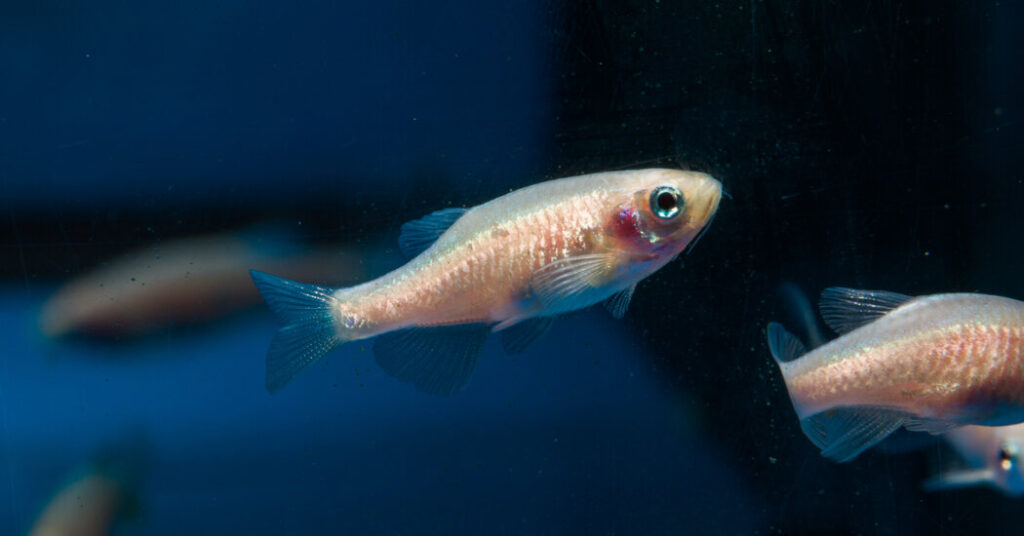
Whether tucked away in a colony of coral, hidden in the darkness of an aquatic cave or floating catatonic just above the ocean floor, fish take opportunities for rest and recovery, just as we do.
Like humans, most fish are diurnal, meaning they sleep mostly at night; while they don’t have eyelids, and therefore can’t shut out the darkness, light does disrupt their sleep. And just like us, when they snooze they’re motionless and slow to respond to environmental stimuli. If you deprive them of sleep, they will make up for the loss by sleeping longer the next night.
Now, a new study, released this month in Nature Communications, shows just how much fish sleep really does resemble our own. By tracking eye movements of zebrafish, the researchers were able to identify four different substates of sleep, akin to the “stages” of sleep that scientists have described in humans.
“There’s complexity to their sleep structure,” said Jennifer Mengbo Li, a co-author of the study and a neuroscientist at the Max Planck Institute for Biological Cybernetics in Germany.
Three of the four substates happen at night, lasting a total of 10 hours. The first — and deepest — is characterized by a stone-cold stare. As the waking hours near, a second, lighter substate sets in: The zebrafish’s eyes twitch, sideways in the same direction, before moving slowly back to center. In the third substate, entered as morning approaches, both eyes turn to the same side and stay there.
During the fourth and final substate, which takes place in brief bursts during the day, the zebrafish’s eyes move back and forth, as if sweeping the surroundings for potential risks. But the eyes can be deceiving: These five-to-10-minute naps are deep enough that much of the brain activity is suppressed, and the zebrafish are hard to wake up.
As part of the study, researchers were able to follow the fish using what’s best described as a self-driving autonomous microscope and camera system. Designed by Drew Robson, another co-author of the study and a fellow Max Planck neuroscientist, the scope and camera followed 105 fish around the tank as they swam, hunted and slept.
“This is the first time we can record the whole brain of a freely moving animal,” said the lead study author, Vikash Choudhary, a Ph.D. student at the Max Planck Institute.
Since zebrafish are transparent for their first three weeks of life, scientists can also peer directly into their brains with calcium imaging, watching which neurons fire in conjunction with various sleep stages. This allows the scientists to watch the brain in motion while simultaneously recording both whole body as well as eye movements.
“Researchers were able to show that zebrafish do have specific sleep states and that certain populations of neurons are activated and might be markers for these sleep states,” said David Prober, a biologist at the California Institute of Technology who was not involved in this study.
Dr. Prober contends that the zebrafish brain — though smaller and simpler than a human brain — can still help identify the most essential mechanisms associated with sleep. His lab has found that many of the genes, neurons and drugs that regulate sleep in humans and other mammals have similar effects in fish.
Michael Heithaus, a marine ecologist at Florida International University who was not involved in the study, said that it’s thrilling that scientists have begun teasing these different sleep states apart and trying to understand their purpose. While we know that all animals sleep for a large portion of their lives, the reasons and the mechanisms that regulate sleep are not well understood.
“It’s like a lot of things in biology: The more we look under the hood, the more complex it is,” Dr. Heithaus said.
The post Fish Sleep a Lot Like Us. (They Even Nap.) appeared first on New York Times.