NAIROBI — As a deadly outbreak of Ebola spreads through the eastern Democratic Republic of Congo, one conspiracy theory is that nonprofit workers brought the disease to get more money. Another is that the outbreak has been fabricated to frighten the population and gain access to minerals, including gold.
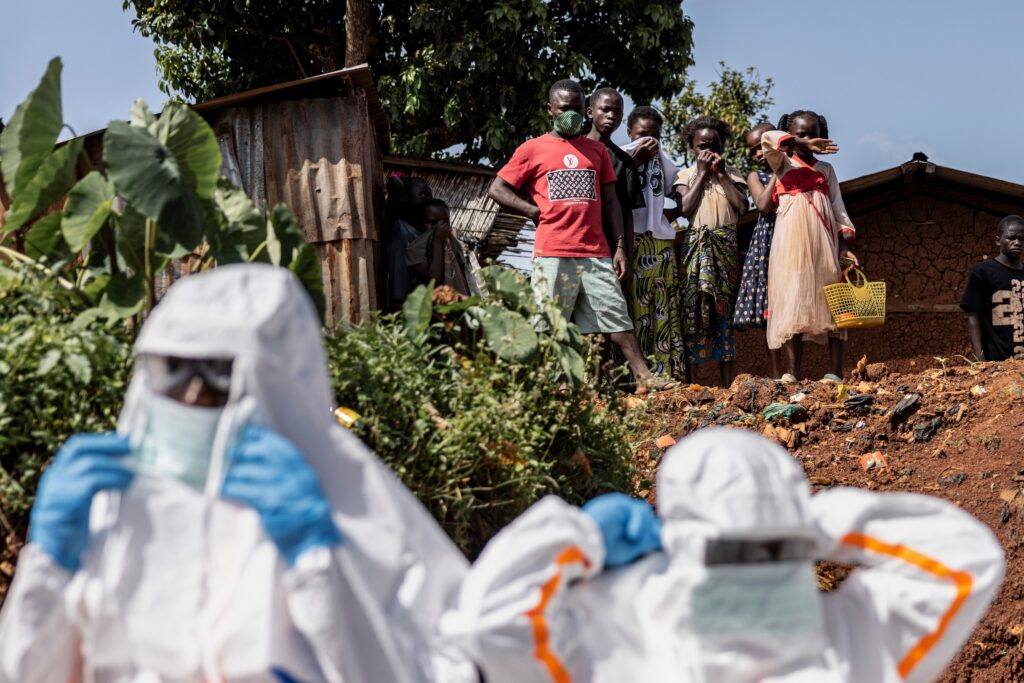
There are people who refuse to accept that preventing the spread of Ebola, which is transmitted through contact with the bodily fluids of an infected person, requires forgoing some traditional funeral rites. And there are others who do not believe Ebola exists at all — it is a fiction, they say, to steal aid money.
“There is mistrust of authorities and mistrust of humanitarian actors,” said Rose F. Tchwenko, the Congo country director for Mercy Corp, an aid organization, adding that some residents believe the disease is “fabricated.”
Last week, a group of young people unable to believe that their friend, a 30-year-old soccer player, had died of Ebola decided to take back his body by force, attacking a hospital in Rwampara and forcing health workers to flee. Amid the chaos, six patients also fled, a hospital worker told The Washington Post, speaking on the condition of anonymity because of the sensitivity of the situation.
The next day, 18 patients with suspected cases of Ebola ran away after an attack on Mongbwalu General Hospital.
The incidents, in towns at the center of the Ebola outbreak, underscored the scale of misinformation that health workers face as they confront a crisis in which the World Health Organization said there are at least 750 suspected cases and 177 deaths.
Distrust and inaccurate information about Ebola are endemic in Congo, experts say, but appear to be worse during this outbreak because funding cuts have decimated other help coming to the region and have fueled confusion about the role of the West.
“The people here don’t believe that there is Ebola,” said Luc Malembe, 40, a politician who filmed the hospital attack in Rwampara last Thursday. “That’s why they are not protecting themselves. We need a lot of sensitization here.”
A doctor at the hospital that was attacked said that residents stormed in, demanding the body of the soccer player who had died hours earlier, intending to bury him according to local custom.
The tradition is that, after someone dies, people “stay with the body for one or two days at home, they eat and feast,” the doctor told The Post, speaking on the condition of anonymity because he was not authorized to brief the press.
“He was popular, and there are people who do not imagine someone like that not being given a dignified burial,” the doctor said, adding that the young man had sung in a local church and worked in a transport business. “That is the problem, because things change when this disease strikes,” the doctor said. “Many people do not believe this disease is real, and many do not understand it.”
Ituri, the province where the majority of cases have occurred, borders South Sudan and Uganda and has a population of about 4 million. Known as a hub for gold mining, the region in recent years has been riven by insecurity, as various militia groups have clashed with one another and with the Congolese military.
Especially in more rural areas, access to electricity and running water is virtually nonexistent, said Trish Newport, the manager of Doctors Without Borders’ Ebola programs in Congo. In such impoverished areas, where there is so little medical care, residents often want doctors and nurses to focus on issues they consider more pressing than Ebola, such as malaria and measles.
Dramatic funding cutsby the United States and other nations have left less money for such programs, she said, and even more skepticism about the influx of money specifically allocated to treat Ebola.
“Now people will see that the money only comes when it is about our agenda — about not wanting Ebola to come to us,” she said, referring to the West. “There is a lot of skepticism.”
Greg Ramm, Save the Children’s country director in Congo, said his organization previously financed 96 health clinics across the provinces of Ituri, North Kivu and South Kivu, but aid cuts by the U.S. and other funders mean he can now finance just one-third of them, so people are less likely to seek or receive care.
And as health workers contract Ebola, leaving health centers unstaffed, children will die of measles, malaria, malnutrition and other preventable situations, Ramm said.
“After this is over — because this will end — the spotlight goes away, the journalists go away, and the surge of aid goes away,” he said. “And children will return to dying of malnutrition and measles and malaria because the world will have stopped caring.”
In 2018, Adam Vainqueur, a teacher from Beni, Congo, contracted Ebola.
When he recovered, he found that he had been fired from the private school where he worked and that his family had abandoned him. “When you are taken by the doctors, you are not expected to come back,” Vainqueur, now 28, said. “People knew and said the Ebola doctors were demons.”
“People fear you, your family chase you away or avoid you, at the market, people run away when they see you, or they give way when you go to fetch water,” he said. “People leave once they see you because they believe you have Ebola inside you.”
Lately, Vainqueur said, he had been receiving text messages with some telling him that their disease had returned. This time, he said, the stigma is just as bad.
Saki Roger, a Congolese neurosurgeon who contracted Ebola in November 2018 while performing an emergency Caesarean section on a pregnant woman, started a support group for survivors. Roger told The Post that victims of Ebola suffer years of lingering trauma after the disease fades away.
“We are looking at a lot of superstition and misinformation around this disease,” Roger said, adding that the two nurses he worked with also developed symptoms. One went to a treatment center, then died, he said, while the other refused to seek treatment at all, fled the city, then also died.
“The nurse who died at the Ebola treatment center was rejected by her family. Not even her husband came to see to see her while she was sick,” Roger said.
Local aid groups said one theory shared by many residents is that nonprofit workers are responsible for bringing Ebola, in order to get more money.
Grace Wairima Ndungu, the senior Africa media and communications manager for Mercy Corps, said that residents in Goma, a city of 2 million where a handful of cases have been reported, have told her colleagues: “There’s no epidemic, and it’s just NGOs trying to get money.”
If that is the attitude in the town center, she added, “you can only imagine what is happening in the rural areas.”
Tchwenko, the Congo country director for Mercy Corps, said that the attack at the hospital in Rwampara served as a flash point that tapped into a bigger sentiment. “It is the perfect storm of activities,” she said, pointing to violence by rebel groups and militias, in addition to a dramatic decline in humanitarian activities following funding cuts last year.
Part of the problem is the lag time between patients arriving at the hospital and getting their test results, said Patrick LaRochelle, an American missionary doctor who was working in Bunia, in Congo’s northeast, explaining that families often refuse to believe that their loved ones have the disease. Often, he said, patients arrive at the hospital thinking they have malaria and then get a diagnosis of Ebola.
“It’s led them to not trust the doctors; there’s rumors that doctors are giving people Ebola with injections,” he said.
Malembe, who filmed the attack in Rwampara, said that part of the problem is a gap between what people see and official narratives. Many people started dying in his community around April 14, he said, but doctors “could not tell us what was going on.”
Now, he said, the community hears the news that there has been a lot of equipment brought in to fight Ebola, but does not see that on the ground. So far, he said, there isn’t even a separate building for treating Ebola patients at the hospital.
Robert Batusa, program director for World Relief DR Congo, who is now in Goma, said his group was actively working with more than 135 local churches to stress the importance of safe burials, sanitation and reporting signs of Ebola.
It’s vital, Batusa said, to build community trust before you can enlist messengers to spread accurate information. He noted his group’s efforts to build hand-washing stations and temperature controls there and actively engage with the community.
“We mobilize churches in the community, we train them on how to improve their community, we train them on how to identify community gaps and how to develop interventions or projects to meet the needs and solve community problems,” Batusa said.
He said he fears cases could number in the thousands, pointing to the violence at the health center and the escape of a patient infected with Ebola from a hospital in Bunia.
He also warned of the secondary impact of the outbreak, as borders are shut, limiting access to food and supplies.
Distrust does not exist just in local communities but also among policymakers, said Matthew M. Kavanagh, director of the Georgetown University Center for Global Health Policy and Politics.
After the Trump administration’s decision to shutter the U.S. Agency for International Development and gut the government bodies responsible for responding to pandemics, nations that once relied on the U.S. are unsure how to proceed.
Now, he said, U.S. officials who were once key players in responding to outbreaks are sometimes not in the room at all. And even when the U.S. gets involved, he said, there is new distrust from other countries that once considered the U.S. “their favored partner.”
“There is a sense now that the U.S. is an unreliable partner,” he said.
Chason and Weber reported from Washington.
The post Contagion of conspiracy theories makes Ebola epidemic harder to contain appeared first on Washington Post.