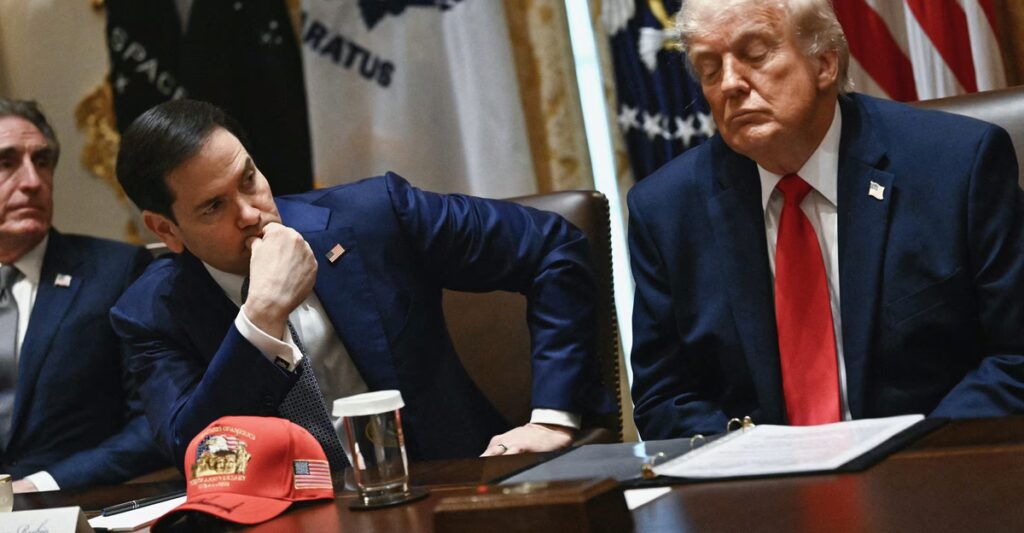
President Trump skipped his eldest son’s wedding and held staff back in Washington over the holiday weekend, expecting that a deal with Iran that he said on Saturday was “largely negotiated” would soon be ready. His secretary of state, Marco Rubio, who was on a four-day trip to India, said on Sunday that a deal could come that day. Then he said the same thing on Monday. Yesterday, Rubio suggested the deal could take a “few more days.” Then Trump scheduled a Cabinet meeting at Camp David, the site of previous landmark Middle Eastern peace accords, for today, heightening the sense of anticipation. But inclement weather forced the meeting back to the White House, and within the first 10 minutes, with the administration’s top officials and their red baseball caps arrayed around him, Trump conceded he had nothing to unveil. “They want very much to make a deal,” Trump said of the Iranians. “So far, they haven’t gotten there.”
Neither, of course, has Trump. The agreement under discussion—reportedly a one-page “memorandum of understanding”—would put negotiators on a 60-day clock to find a way to address Iran’s nuclear ambitions and its enriched uranium, or “nuclear dust,” as Trump calls it. Trump has grown deeply frustrated with his inability to get Iran to fully capitulate, aides told us, and angry at the commentators who have said the persistent stalemate has left him looking weak.
Trump’s failure to make a deal doesn’t stem from a lack of desire. He has spent weeks casting about for a way out of the conflict. He has tried to force Iran’s surrender with a series of escalating threats and deadlines. But each time, Iran has called his bluff, and Trump has found ways to extend the cease-fire, which was put in place before Vice President Vance visited Islamabad in mid-April in hopes of securing a broader deal but returned empty-handed. Despite his frequent threats, Trump is reluctant to resume hostilities; aides told us he is mindful of depleted U.S. munitions supplies and fears that Iran would retaliate against the energy infrastructure of its Gulf neighbors, worsening the world’s fuel crisis. Aides believe the U.S. blockade of the Strait of Hormuz, stopping Iranian oil exports, will eventually cause Iran to buckle. But Trump has expressed impatience with the process and has encouraged negotiators to intensify their efforts.
[Read: Trump is ‘bored’ with the war he started]
Leaders of Middle Eastern nations over the weekend urged Trump in a phone call to do what it takes to secure a deal quickly. The region has been hammered by Iranian strikes and by the crisis in the strait, a vital channel for Gulf energy exports. Iran effectively closed the strait soon after the war began, stranding hundreds of ships and prompting the United States to start its own blockade. After that call, Trump wrote on Truth Social that a deal was almost done. It was expected to include the resumption of shipping traffic through the Strait of Hormuz, an extended cease-fire in Israel’s campaign against Hezbollah in Lebanon, and potential sanctions relief for Tehran, people familiar with the discussions told us.
Trump-supporting Iran hawks, already disappointed that the regime in Tehran is still intact, feared the president was rushing into a bad deal. “This combination of Iran being perceived as having the ability to terrorize the Strait in perpetuity” and the ability to “inflict massive damage to Gulf oil infrastructure is a major shift of the balance of power in the region and over time will be a nightmare for Israel,” Senator Lindsey Graham said on X. Senate Armed Services Committee Chairman Roger Wicker posted on X that “the rumored 60-day ceasefire — with the belief that Iran will ever engage in good faith — would be a disaster.”
A Trump aide told us the president was startled and annoyed by such pushback. But the public criticism, and behind-the-scenes lobbying from Graham and others, was one reason Trump changed his tune. Rather than hyping a deal as imminent, he began to stress on social media that the agreement was not quite done, and that he’d accept only a clear win—though he didn’t specify what that would look like.
“As President Trump has said, negotiations are proceeding nicely and he has made his redlines clear,” spokesperson Olivia Wales told us in a statement. “President Trump will only make a good deal for the American people, which must ensure that Iran can never have a nuclear weapon.”
Trump’s instinct is always to go bigger, dressing up a setback with claims of larger deals on the horizon. In this case, advisers told us, he latched on to the long-shot idea to connect the Iran agreement with an expansion of the Abraham Accords—the pact that normalized relations between Israel and select Arab nations—to create the sense that he was striking a grand bargain and transforming the Middle East. But that outcome appears extremely unlikely, given widespread condemnation of Israel’s recent conduct and the damage Gulf countries have sustained from the war.
Meanwhile, the Iran talks remain stalled. And the fact that the administration is having a tough time even getting Tehran to the starting gate for negotiations on Trump’s biggest issue—stopping Iran’s nuclear development—augurs poorly for eventual success.
In 2015, then–Secretary of State John Kerry testified before a Senate committee about a new deal to restrict Iran’s nuclear development. After more than a year of talks, with Iran on one side and several nations—including the U.S., China, and Russia—on the other, an agreement was on the table, full of hyper-technical details about what Tehran could and couldn’t do for the next two-plus decades. The U.S. had plenty of other complaints about Tehran. But Kerry said the talks had centered on one thing—“the nuclear issue”—for a reason. If other issues were included, Kerry told the senators, “it would be rope-a-dope, staying there forever, negotiating one aspect or another.”
Trump in his first term ripped up that agreement and in his second term went to war with Iran to try to stop its nuclear program—but also to force regime collapse, eliminate Iran’s missile capabilities, and destroy its proxy forces across the Middle East. Now, as the president seeks an off-ramp after a massive military campaign failed to achieve any of those goals, Trump appears to be in precisely the predicament Kerry warned about: Trying to tackle too many issues at once may mean none of them get resolved.
[Read: Six days of war, 10 rationales]
Under the deal now being discussed through Qatari intermediaries, traffic through the Strait of Hormuz would ramp up, in stages, to prewar levels. But Iranian officials want the strait to remain under their oversight, possibly in partnership with Oman, even if sea traffic resumes. That may be a nonstarter for the United States, which has insisted that the strait must be a free and open waterway, as it was before the war. “The strait’s going to be open to everybody. It’s international waters,” Trump told reporters at the Cabinet meeting.
The proposed deal may also include provisions for the release of some of Iran’s assets that were frozen by international sanctions, which Iran sees as a form of war reparations, according to the people we spoke with who are familiar with the terms. But Trump appeared at the Cabinet meeting to play down that prospect: “We’re not talking about any easing of sanctions,” he said.
Whether Israel’s campaign against Hezbollah in Lebanon will be included in the extended cease-fire was unclear. Israeli Prime Minister Benjamin Netanyahu said Monday that he had ordered strikes to increase, and Israeli forces ramped up their ground campaign.
The complex web of issues is one reason that a deal to end the war has been so elusive. Another is the administration’s approach to the talks. Ultimately, Trump bears responsibility for both starting the war and ending it. Beyond that top line, though, it has been hard for the American public to tell where things stand. The only consistent source of information has been Trump’s Truth Social posts, which aren’t a model of clarity.
Since his return from Islamabad, Vance has largely focused on his anti-fraud campaign. Rubio—the first man to hold the portfolios of both secretary of state and national security adviser since Henry Kissinger—could have followed Kissinger’s model of personally overseeing the U.S. exit from war. Back in the 1970s, Kissinger, with Nixon’s blessing, bypassed the diplomatic apparatus to meet in secret with a North Vietnamese negotiator dozens of times before inking the Paris Peace Accords. But Rubio has not shown any Kissingerian inclination to get deeply and personally involved. He isn’t even the administration’s Iran point person in the way that Kerry was for the 2015 agreement during the Obama administration. Rather, Rubio has mostly kept to his lane of flexing U.S. muscle in Latin America, first with Venezuela and more recently with Cuba. After his four-day trip to India, he headed to Armenia to sign economic-cooperation deals.
The negotiations to end the Iran war have, instead, been added to the joint portfolio of Steve Witkoff, Trump’s special Middle East envoy and real-estate friend, and Jared Kushner, the president’s son-in-law, who holds no official administration role. The pair’s track record as international peacemakers is mixed. They helped secure a deal for Gaza but have failed to end the war in Ukraine. They have said little publicly about the Iran discussions; the negotiations have been all the more opaque because Witkoff and Kushner, unlike secretaries of state, don’t take any reporters on their travels and rarely hold press conferences to update the public.
Their Iranian counterparts, meanwhile, are skeptical that the envoys are genuine in their quest for peace, people familiar with the Iranians’ thinking told us. During previous rounds of negotiations, Trump has twice ordered missile launches and has repeatedly threatened more. Earlier this week, the U.S. fired missiles at targets in southern Iran, citing the need for self-defense, which Iran said showed “bad faith and unreliability.”
Trump has long been the master of asserting his own reality; he simply declares something a win, and his faithful supporters follow along. That approach is about to be tested anew. So far in this war, polls show that Americans are broadly unhappy with Trump’s decision making, which has led to economic pain at home. The price of gas has soared, with visible, meaningful reminders posted on the service-station signs that dot roads and highways across America.
If a deal comes together, Trump will likely claim victory—he already has a few times— but that would be a dubious assertion. The hard-liners in Iran have been emboldened, and, even if the Strait of Hormuz reopens, Tehran has shown it can effectively close it in the future. At a minimum, the regime has a greater understanding of the economic weapon it wields. That gives Iran leverage even as Trump claims that any nuclear deal he will strike will be tougher than the Obama administration’s 2015 agreement. “I didn’t do this to get a crummy agreement,” Trump told reporters at the Cabinet meeting.
The 2015 deal did not end the hostility between Washington and Tehran. But Obama-administration officials hoped that resolving their most consequential dispute would halt the cycle of escalation that had repeatedly brought the two countries to the brink. The deal, in some ways, was also a way to avoid a war with unpredictable geopolitical consequences. Trump didn’t act with the same caution—and may now be wishing he had.
The post A Frustrated President Can’t Get the Deal Done appeared first on The Atlantic.