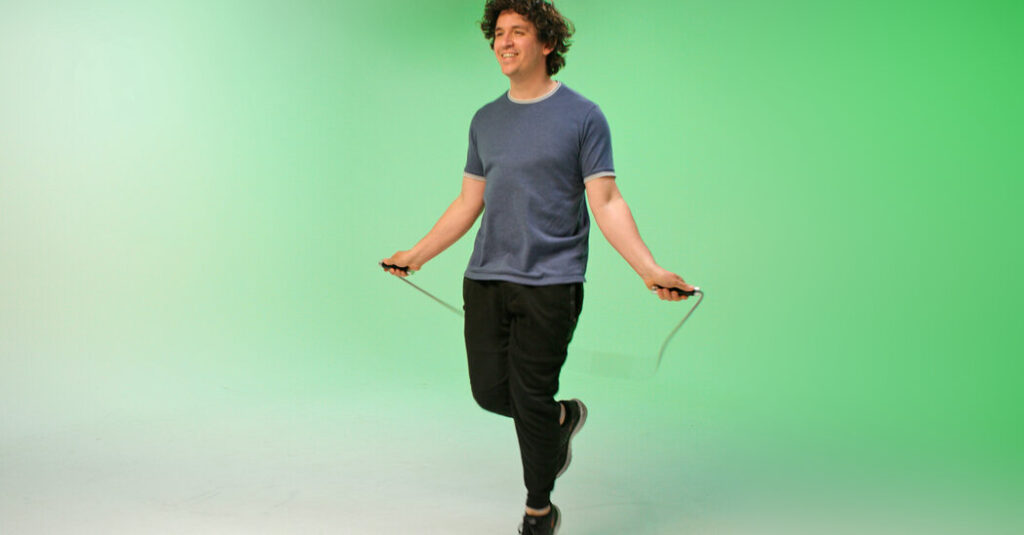
The jump rope is an excellent workout tool for longevity. It’s small and cheap, and using it offers cardiovascular benefits and a cognitive challenge.
The repeated impact of jumping exercises can also improve bone density, while the footwork and timing helps with agility and coordination. And the variety of possible steps engages the brain.
Jumping rope is also a great way to get your heart rate up, making it an ideal addition to high-intensity routines, said Tim Haft, a personal trainer in New York City.
But many exercisers are either dismissive of it or intimidated by it, Mr. Haft said.
“Most people think either little kids on the playground or Muhammad Ali,” he added.
There are plenty of ways for regular exercisers to get started with jumping rope. First, Mr. Haft suggested, just jump without the rope. You’ll still reap many of the benefits, and you can focus on your feet without worrying about tripping.
Next, try shadow jumping: Hold both handles in your dominant hand and swing the rope to the side — timing your feet to the slap of the rope without actually jumping over it. If the rope is too unwieldy — or keeps finding your face — you can fold it in half again so you’re working with a shorter rope.
Once that feels comfortable, try jumping rope the classic way. But go slowly, taking a minute of rest for every 30 seconds of jumping, said Jim Wittstrom, a physiotherapist and personal trainer in Calgary, Canada.
From there, gradually increase the amount you’re jumping. “Week one, maybe you can do three 30-second rounds. Then, week two, you might do five 30-second rounds,” Mr. Wittstrom said, noting that everyone progresses differently.
This workout, which was designed by Mr. Haft, alternates bouts of jumping rope with body-weight exercises that allow you to catch your breath while strengthening your legs and core. Each interval is based on time rather than repetitions, so go at whatever speed feels right. As your fitness improves, you can lengthen the active periods and shorten your resting time.
Overview
Time: About 15 to 25 minutes
Intensity: Moderate to hard
Rounds: Begin each session with a four-minute dynamic warm-up. If you are new to jumping rope, complete the circuit once. Work up to three total circuits as you progress.
What you’ll need
-
A 10-foot adjustable jump rope
-
A pair of supportive shoes
-
A timer
-
A mat (for some body weight exercises, not the jumping exercises)
Basic Bounce
Time: One minute (30 seconds of activity, 30 seconds of rest)
Targets: Lower legs and core
The basic bounce is the foundation for all jump rope steps. Tuck your elbows in and face forward. With your knees slightly bent and parallel, and your core engaged, jump with both feet once per turn of the rope. Try not to jump too high — ideally your feet should not clear more than one inch off the ground.
Dead Bug
Time: One minute (30 seconds of activity, 30 seconds of rest)
Targets: Abdominals, including the transverse abdominis, and lower back
Start by lying on the mat, with your arms extended straight toward the ceiling and your knees bent at 90 degrees to your thighs. Slowly lower your left arm in an arc behind you while extending your right leg until it’s parallel to the ground. Your hand and foot should hover just above the floor. Return your left arm and right leg to their starting position and repeat on the opposite side.
Stagger Jump
Time: One minute (30 seconds of activity, 30 seconds of rest)
Targets: Lower legs, thighs, hips and core
With your knees slightly bent, place your right foot forward and your left foot back, separated by about six inches. Jump with both feet, but keep them staggered. This step is slightly more difficult than the basic bounce.
Sumo Squat
Time: One minute (30 seconds of activity, 30 seconds of rest)
Targets: Abductors, quads, hamstrings and glutes
Stand with your feet slightly wider than shoulder-width apart. Angle your feet outward, about 45 degrees. Keeping your back straight, and engaging your core and glutes, lower down to a squat and rise to standing again, pushing through your heels.
Twister Jump
Time: One minute (30 seconds of activity, 30 seconds of rest)
Targets: Lower legs, hips, lower back and core
Twist your feet, knees and hips 45 degrees to the right while keeping your torso facing forward. Jump with both feet. Then twist to the left for the next jump. Continue moving from right to left and back — one bounce per position and turn of the rope.
If you’ve never done this move before, you can practice jumping three times in the same direction before switching. When changing directions, bounce once in the forward position to transition.
Reverse Lunge
Time: One minute (30 seconds of activity, 30 seconds of rest)
Targets: Quads, glutes, abductors, hamstrings and calves
Step backward with your right foot, lowering your body, while keeping your torso facing forward. Your left heel should remain planted, and your left thigh should be parallel to the ground. Your right knee should be just above the ground, with only the ball of your right foot touching the floor behind you. Return your right foot to the starting position, then repeat on the left side.
Jog Jump
Time: One minute (30 seconds of activity, 30 seconds of rest)
Targets: Lower legs, thighs and core
Hop on the right foot three times, once per turn of the rope, with your left knee lifted and bent. Repeat on your left foot. Once the movement becomes easier, try alternating feet, one hop per foot.
If this feels too hard, you can swap in one of the earlier jumps.
Gently stretch your calves after the session is over. With your left leg straight behind you and your left heel flat on the ground, step forward with your right leg. Bend your right knee to deepen the stretch in your left calf and hold for 30 seconds. Switch sides and hold for 30 seconds.
On-set trainer: Anna Maltby
The post A 15-Minute Beginner Jump Rope Workout appeared first on New York Times.