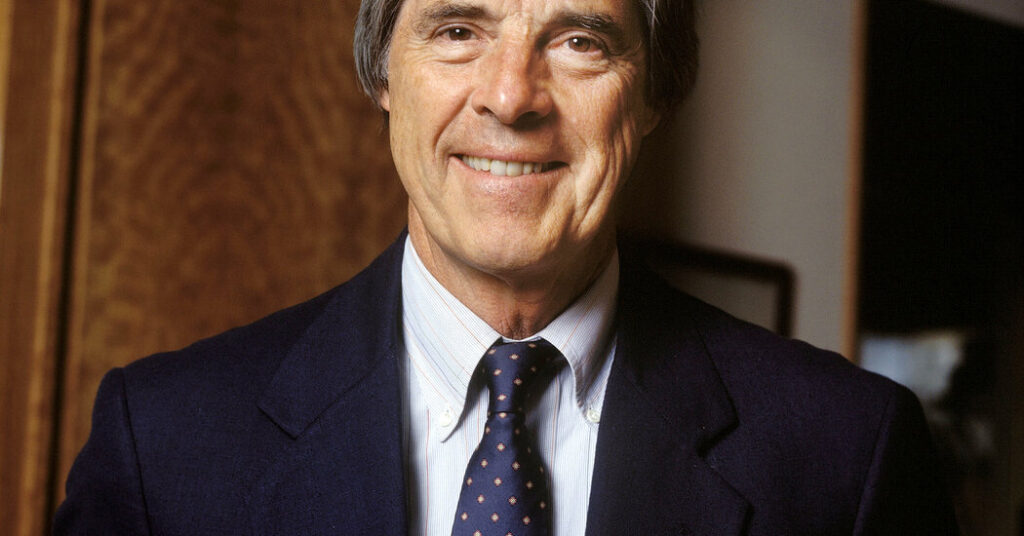
Robert Daley, a prolific author whose novels and nonfiction explored the grit and perils of police work, pro football, racecar driving and other subjects that drew on his life as a New York Giants publicist, a New York Times foreign correspondent and a gun-toting New York Police Department spokesman, died on Tuesday in the Bronx. He was 96.
His death, in a hospital, was confirmed by his daughter Suzanne Daley, an associate managing editor at The Times who oversees the international print edition. He lived in Bronxville, N.Y., in Westchester County.
Mr. Daley wrote 31 books, an adventurer’s shelf that included works on bullfighting, deep-sea treasure hunts and horse racing, with connoisseur passages on opera and wine. Many of his books were translated into other languages and were popular in Europe. His specialty as an author was New York cops: as guardians of the streets, as investigators, as assassination victims, as corrupt rogues.
His best-known work was “Prince of the City: The True Story of a Cop Who Knew Too Much” (1978). It recounted the case of Robert Leuci, a bribetaking New York police detective who, after being caught, went undercover and exposed corruption among fellow officers in an elite narcotics unit. His evidence led to 52 indictments and a skein of prison terms.
The policeman as flawed hero “has never been done better,” the journalist and author Ted Morgan wrote in a Times review, noting that Mr. Daley, through his police contacts, “coaxed his sources into providing material that is guaranteed to raise the hair on the back of the neck of every reader.”
The book was adapted into an acclaimed 1981 film of the same name directed by Sidney Lumet and starring Treat Williams. It was one of six of Mr. Daley’s books that became movies or television treatments.
In his most visible role, Mr. Daley was the Police Department’s deputy commissioner for public affairs for a year, in 1971-72. It was a tumultuous time for the police. Two Mafia dons, including Joseph Colombo Sr., were shot; four police officers were assassinated by Black nationalists; robbers staged a daring jewel heist at a luxury hotel; and a commission exposed widespread police corruption.
It was not the ideal job for Mr. Daley. He had written nine books, had been a correspondent for The Times in Europe for six years, and cut a continental figure in his military trench coat and longish hair. In a department that valued discretion, he seemed miscast. He mugged for the TV cameras and, explaining that he had received threatening letters, carried a .38 caliber revolver despite grumbles from officers and Mayor John V. Lindsay.
Mr. Daley said he took the job partly to lift the routine secrecy that he believed obscured the more admirable realities of police work. He had a staff of 35, a radio car and drivers around the clock. He was often among the first at crime scenes, ducking under yellow tapes to examine evidence like a detective. He spoke freely to reporters, often to the dismay of detectives and Commissioner Patrick V. Murphy, who had appointed him.
He described the bandits who looted the Pierre Hotel strong room for what was estimated at the time to be $1 million in gems and cash as “cool, brilliant” and “absolutely perfect.” He once brought in a busload of reporters to record the arrest of suspects in a car-theft ring. After two police officers were assassinated by the Black Liberation Army, a militant group, he gave reporters a detailed briefing, even as detectives were just beginning their investigation.
He took it upon himself to decide when the department should take suspects involved in the shooting of Mr. Colombo before a grand jury. He persuaded the chief of detectives, Albert Seedman, to announce that the solution to the case was close at hand. It was not.
Commissioner Murphy asked him to resign over “differences of opinion” on policy, and Mr. Daley walked away in May 1972 with his licensed revolver and with some documents that had crossed his desk, along with his own voluminous notes. A year later, he published “Target Blue: An Insider’s View of the N.Y.P.D.,” a memoir of his turbulent tenure.
“Daley is an incurable romantic with a warped view of his own place in history,” Mary Perot Nichols wrote in a review of the book in The Times. “He is the first public relations man in the Police Department’s history to conceive of himself as the tail that wags the dog.”
Many of Mr. Daley’s later novels were set against a New York criminal justice background, including “Year of the Dragon” (1981), about gangs in Chinatown (a 1985 film adaptation starred Mickey Rourke); “Tainted Evidence” (1993), about a prosecutor’s case against a cop-killer (Mr. Lumet’s 1996 film version was retitled “Night Falls on Manhattan”); and “Wall of Brass” (1994), about the murder of a police commissioner.
Robert Blake Daley was born in Manhattan on May 10, 1930, one of four children of Arthur and Elizabeth (Blake) Daley, who was known as Betty. His father was a Pulitzer Prize-winning sports columnist for The Times. Robert graduated from Fordham Preparatory School in 1947 and Fordham University in 1951.
After a year in the Air Force, he became the Giants’ first publicist and, for six seasons, promoted a team that included Frank Gifford, Charlie Conerly, Sam Huff and Kyle Rote, and won the National Football League Championship in 1956.
In 1954, he married Peggy Ernest, and they had three daughters: Theresa, Suzanne and Leslie. In addition to his wife and daughters, he is survived by two sisters, Patricia Trout and Katherine Fennelly; five grandchildren; and three great-grandchildren.
During the Giants’ off seasons, Mr. Daley traveled in Europe and wrote freelance sports articles for The Times. In 1956, he helped cover the Winter Olympics in Cortina d’Ampezzo, Italy, and later the Grand Prix races. His first book, “The World Beneath the City” (1959) grew out of a Times Magazine article about utility lines, water mains, subways and wriggling creatures under the streets and sidewalks of New York.
In 1959, Mr. Daley joined the Times staff, and for six years was a correspondent in Europe and North Africa, covering sports and general news in 16 countries. Based in Nice and later in Paris, he wrote about French forces fighting in Algeria and Tunisia, horse racing in Ireland, food and wine in the Soviet city of Volgograd (formerly Stalingrad) and life on the Volga, Europe’s longest river.
His last novel, “The Red Squad” (2013), explored the sinister world of the Police Department’s Bureau of Special Services and Investigations, which in the 1950s pursued suspected Communists, sometimes trampling rights and destroying careers.
“Most writers spend most of their lives locked in small rooms typing, and they don’t get paid very much,” Mr. Daley noted in an introduction to his second memoir, “Writing on the Edge: The Ups and Downs of a Freelance Career” (2014). “I refused to live like that. Throughout, I have tried to manage my career in a different way, call it my way if you like.”
Ash Wu contributed reporting.
Robert D. McFadden was a Times reporter for 63 years. In the last decade before his retirement in 2024 he wrote advance obituaries, which are prepared for notable people so they can be published quickly upon their deaths.
The post Robert Daley, Multifaceted Author of ‘Prince of the City,’ Dies at 96 appeared first on New York Times.