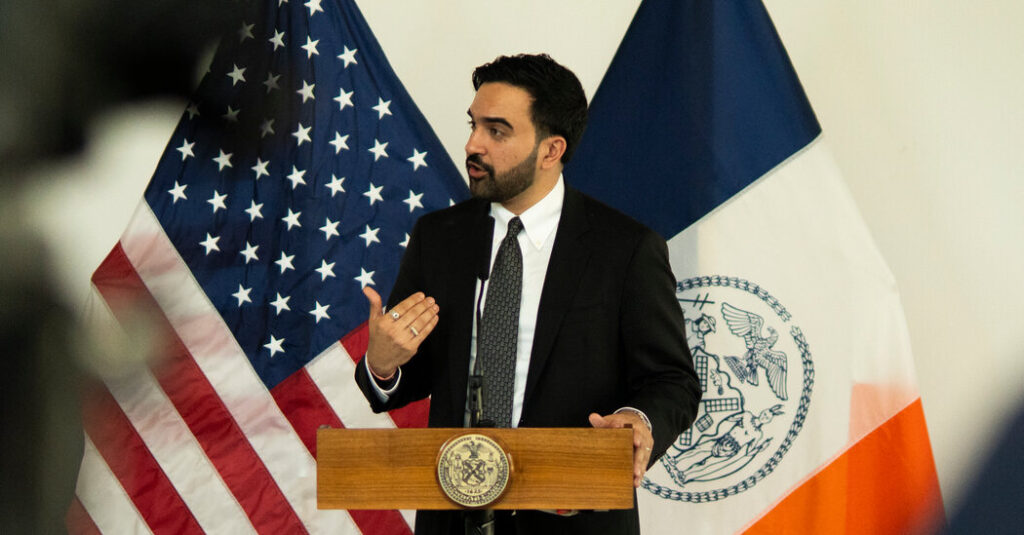
In his run-up to becoming mayor of New York City, Zohran Mamdani centered his housing strategy around freezing the rent for the city’s nearly one million rent-stabilized apartments.
But the mayor has said comparatively little about an even more vulnerable population: the 300,000 or so people who live in the city’s crumbling public housing system.
On Tuesday, Mr. Mamdani intends to release a comprehensive plan to address longstanding problems at the New York City Housing Authority.
The plan includes several measures to shore up public housing, including using two financing tools to raise money for repairs, restoring thousands of vacant apartments and building new housing on land owned by the authority.
Leila Bozorg, his deputy mayor for housing and planning, said in an interview that Mr. Mamdani had been “clear that he wants to put NYCHA residents front and center in his housing plan.”
“We think this is a holistic approach to really try to chip away at the issues facing NYCHA, including the backlog that residents deal with each day,” she said.
NYCHA residents regularly struggle with heat outages, broken elevators and mold, and the cost of backlogged repairs has soared to nearly $80 billion.
The mayor’s housing plan makes use of two relatively new programs to make upgrades. Permanent Affordability Commitment Together, or PACT, partners with private developers; another, called the Public Housing Preservation Trust, leases NYCHA buildings to a public benefit corporation.
With the preservation trust, the Mamdani administration hopes to renovate 25,000 apartments, starting with Nostrand Houses in Brooklyn and Bronx River Addition, which will receive gut renovations and upgrades to elevators and heating and cooling systems.
The plan also calls for renovating at least 4,500 vacant apartments and aims to “reboot NYCHA’s role as a public developer” to build housing on the land the authority owns. Mr. Mamdani supports a major redevelopment of a public housing complex in Chelsea in Manhattan. It also commits to soliciting more input from NYCHA residents and expanding career training for them.
Residents must vote to join the PACT and preservation trust programs, and some have been worried about losing their rights under a new structure. Mr. Mamdani’s housing plan says that “resident voices are a critical part of the process,” and his administration committed to “deeper” engagement at PACT developments after conversions.
Rachel Fee, the executive director of the New York Housing Conference, a nonprofit group that represents the affordable housing industry, said that the Mamdani administration appeared to be “on the right track by putting residents at the center of the process while expanding proven financing strategies.”
“NYCHA has been underinvested in, undervalued and too often overlooked — but there is enormous potential to improve residents’ quality of life through meaningful investment and thoughtful redevelopment of its campuses,” Ms. Fee said.
The mayor oversees NYCHA, which relies on a mix of federal, state and city funding. It has more than 170,000 apartments across 330 developments. Many were built more than a half century ago, and conditions inside them have become dire.
During the campaign, Mr. Mamdani pledged to double the city’s capital funding for NYCHA, which is about $1.2 billion annually. His executive budget proposed $5.6 billion for NYCHA in the five-year capital plan, which the mayor’s office said was the largest allowance in the city’s recent history. The funding proposal falls short of his campaign promise, though it is more than had been planned under his predecessor, Eric Adams.
Mr. Mamdani’s executive budget proposal included an additional $500 million for NYCHA renovations and $256 million in capital funding to restore vacant apartments, which often require major renovations between residents.
Ms. Bozorg said that Mr. Mamdani still aimed to double NYCHA’s capital funding “over the course of the administration” and that the housing plan offered a path “to help us get there.”
Mr. Mamdani is holding a series of “NYCHA in Your Neighborhood” events in May and June to hear from public housing residents. The mayor received some criticism because NYCHA facilities were not initially included in the city’s “rental rip-off” hearings designed to hear from renters in private buildings.
Ramona Ferreyra, founder of Save Section 9, a group dedicated to preserving traditional public housing, said that the mayor’s plan was not enough and that some ideas, such as adding an ombudsman for critical repairs, seemed like another layer of bureaucracy.
“I don’t need another hotline to call,” Ms. Ferreyra said. “I need taxpayer money to be used to invest in, rehabilitate and expand public housing.”
Daniel Barber, a lifelong resident of Jackson Houses in the Bronx and the president of the Citywide Council of Presidents, a group of NYCHA leaders, said that plans to repair elevators and heating and to get residents more involved were the bare minimum.
“This is what’s supposed to be happening,” he said.
In 2019, NYCHA was placed under the oversight of a federal monitor in an attempt to force improvements. There has been some progress, including responding to mold complaints more quickly. Mr. Mamdani’s plan calls for continuing to invest in repairs to public housing beyond PACT and the preservation trust.
In an interview last month, Mr. Mamdani said that eliminating NYCHA’s massive capital deficit “cannot be tackled without the assistance of the federal government.” He argued that Republican and Democratic administrations had not provided enough funding and had caused a “significant impact on residents’ ability to live dignified lives.”
Mr. Mamdani said that he wanted to prevent the capital deficit from growing during his tenure and that he wanted to make investments to improve people’s quality of life.
“I want to always be honest that the scale of that deficit, and the fact that the federal government’s flouting of its responsibility over many, many years, means to tackle the fullness of it will require their assistance,” the mayor said. “However, it’s not going to trap us in inaction.”
Ms. Ferreyra and Mr. Barber raised concerns over the administration’s embrace of the private sector. Instead of relying on programs like PACT and the preservation trust, they said the city should prioritize programs such as Comprehensive Modernization, an effort to more effectively use capital funds to rehabilitate public housing, and secure new revenue streams dedicated to NYCHA.
“He’s basically telling those of us that refuse to go private and are fighting privatization that we can’t have safe homes unless we welcome the private market into our developments,” Ms. Ferreyra said. “And at the same time, you’re going to then remodel the units that surround us while we live in squalor?”
Emma G. Fitzsimmons is a public policy correspondent for The Times, covering New York City.
The post Mamdani’s Public Housing Plan Partly Relies on Private Sector appeared first on New York Times.