Prosecutors portrayed the prisoners as unrepentant jihadists who bragged about their roles in the Sept. 11, 2001, attacks to federal agents during their first months in military detention at Guantánamo Bay.
Defense lawyers cast the men as so broken by violence and solitary confinement in their years in C.I.A. prisons overseas that they were groomed to involuntarily confess to U.S. agents.
Over eight days this month, the two sides offered these stark, clashing views to a military judge who is now confronted with the overarching question in the long-running capital case: Did Khalid Shaikh Mohammed, who is accused of hatching and organizing the Sept. 11 attacks, and two co-defendants voluntarily incriminate themselves to F.B.I. agents years ago, and can their statements be used against them?
The case is in its 15th year of these pretrial proceedings, and no date has been set for the trial to begin. But the judge’s decision could be a turning point almost 25 years after the attacks killed nearly 3,000 people in New York, Pennsylvania and at the Pentagon.
The judge, Lt. Col. Michael Schrama, said he would rule this summer.
Stephan Gerhardt, whose brother Ralph was killed in the attack on the World Trade Center, said the judge’s decision would provide “a major step forward as it answers probably the biggest legal question that needs resolution before a trial date being set.”
He watched some of the arguments in the court at Guantánamo this month.
The legal question before the judge is not about the crime itself, the largest terrorist attack ever in the United States. That will be left for a trial.
It is whether the prisoners were so thoroughly conditioned after more than three years of incommunicado detention, which started off with brutality and continued with years of questioning by U.S. government agents, that they involuntarily told their captors what they wanted to hear.
A crux of the question confronting the judge is the legal principle of attenuation, how to get an untainted confession after a coerced one. Prosecutors say the “clean” interrogations at Guantánamo in 2007 met the legal standard of a change in time, change in place and change in identity of questioners.
Defense lawyers say they did not.
Transfer to Guantánamo
To make his decision, the judge is reviewing years of testimony and reams of classified evidence managed by four previous judges in the case against Mr. Mohammed, Walid bin Attash and Mustafa al-Hawsawi to decide whether there was a clear moment of attenuation.
Or, as the judge called it, the pivot.
Military judges have so far thrown out the confessions of two other capital defendants, Ammar al-Baluchi and Abd al-Rahim al-Nashiri, because of what the C.I.A. did to them. Prosecutors are appealing to reinstate Mr. Baluchi’s statements.
“Mr. Khalid Shaikh Mohammed could not shut up about his role as the emir of the 9/11 attacks,” the lead prosecutor, Clayton G. Trivett Jr., said on the first day of the hearing. Mr. Trivett said Mr. Mohammed boasted about the attacks to C.I.A. interrogators after he was captured in Pakistan in March 2003 and then to F.B.I. agents at Guantánamo in January 2007.
It was in March 2003 when Mr. Mohammed was in C.I.A. custody that he was waterboarded 183 times. His lawyer, Gary D. Sowards, said that after his client was tortured, he was questioned hundreds of times, sometimes three times a day, by C.I.A. investigators.
Then at Guantánamo in 2007, the agents who questioned the defendants did not give them an explicit Miranda warning of their right to remain silent, the agents later testified. The prisoners were also not given a “cleansing statement” informing them that their previous statements could not be used against them.
The men were in their fourth year in U.S. custody and they had not been allowed to consult a lawyer, though Mr. Mohammed had asked for one. That would come more than a year later, after they had confessed and were charged.
Mr. Trivett, the prosecutor, told the judge that the pivot point took place when the prisoners “walked off” a C-17 cargo plane at Guantánamo Bay in September 2006 and were told they were in the custody of the Defense Department. It was Labor Day weekend, and President Bush announced days later that they had been transferred to Guantánamo for criminal prosecution.
In court, defense lawyers showed the judge classified photos of the men on the airstrip in shackles and blindfolds, like the chains and hoods the C.I.A. had used to move them around the world between secret prisons. To the prisoners, their lawyers said, it was another stop on their odyssey through the black sites that began with their capture and torture in 2003.
The two weeks of arguments toggled between these narratives.
Secret Recordings
Defense lawyers described the early years of C.I.A. custody when the defendants were beaten and shackled upright and nude in agonizing ways to deprive them of sleep. Their heads were repeatedly slammed into a wall, and agency records showed they were subjected to humiliating rectal abuse.
After the men were broken, they continued to cooperate under a threat of returning them to “the hard times,” a term used by agency psychologists who had violently interrogated them, their lawyers said.
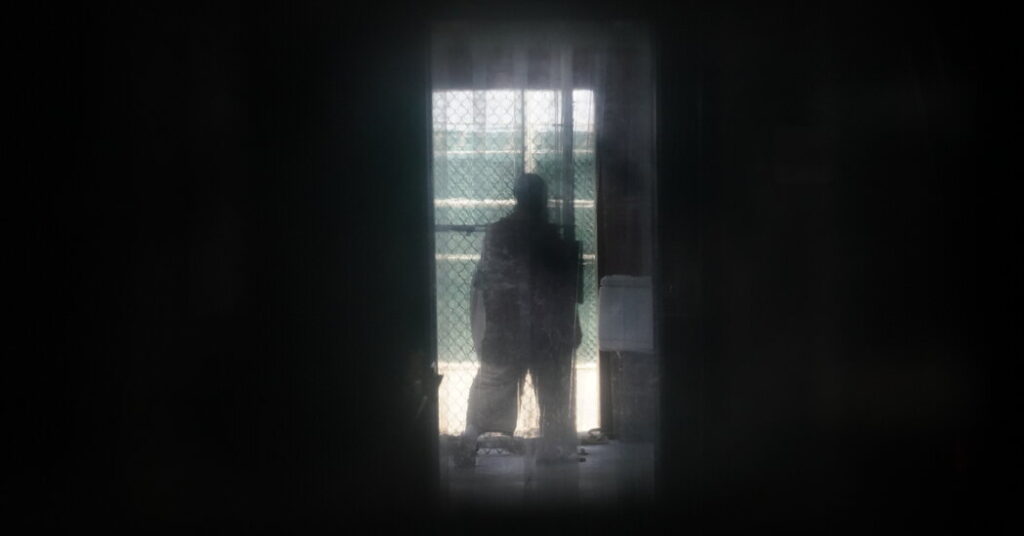
Conditions at Guantánamo were somewhat different, the lawyers said, but not different enough in the minds of men who had been conditioned to cooperate in years of isolation. Before his F.B.I. interrogations at Guantánamo, each man was held alone in his cell 23 hours a day, then let out into an open-air portion for conversation with another prisoner two cells away, the testimony showed.
The prisoners saw representatives of the International Red Cross for the first time after more than a thousand days of detention, and could write home that they were alive. But the prison copied those messages and, over the objections of the Red Cross, gave them to prosecutors to use against the prisoners.
Two agents testified that, on his first day of interrogation in 2007, Mr. Bin Attash blurted out a request to “tell the judge” that he was proud of his contributions to the Sept. 11 attacks.
Defense lawyers described once-classified episodes of abuse in court to persuade the judge that the men were still in the thrall of C.I.A. conditioning when they were questioned in 2007 at Guantánamo.
Matthew Engle, who is representing Mr. Bin Attash, said C.I.A. records show that his client was at first chained and left wearing only a diaper, and then, in his second year of agency custody, starved into submission. Mr. Bin Attash “came to adopt a persona he had never had before,” the person who defiantly told F.B.I. agents to send a message to an imaginary judge, as no case had yet been charged.
Walter Ruiz, the lawyer for Mr. Hawsawi, said the C.I.A. had secretly held him at Guantánamo for a few months starting in late 2003, and brought him there with a torn, hemorrhaging rectum from a brutal cavity search at the last black site. He was still bleeding when he was brought back to the base in late 2006 and told he was in military custody.
Prosecutors played covert prison recordings of the defendants discussing their 2007 interrogations to show that their confessions were voluntary.
“The C.I.A. time is over,” Mr. Mohammed is heard saying on a tape, quoting his questioners. “Now the choice is in your hands.”
Defense lawyers said the recordings were cynically chosen selections of prisoners describing what they had been told in their interrogations, not necessarily their acceptance of the claim. Mr. Engle asked the judge to listen to other recordings.
Carol Rosenberg reports on the wartime prison and court at Guantánamo Bay. She has been covering the topic since the first detainees were brought to the U.S. base in 2002.
The post Judge to Decide How Long Torture’s Taint Infected the Sept. 11 Case appeared first on New York Times.