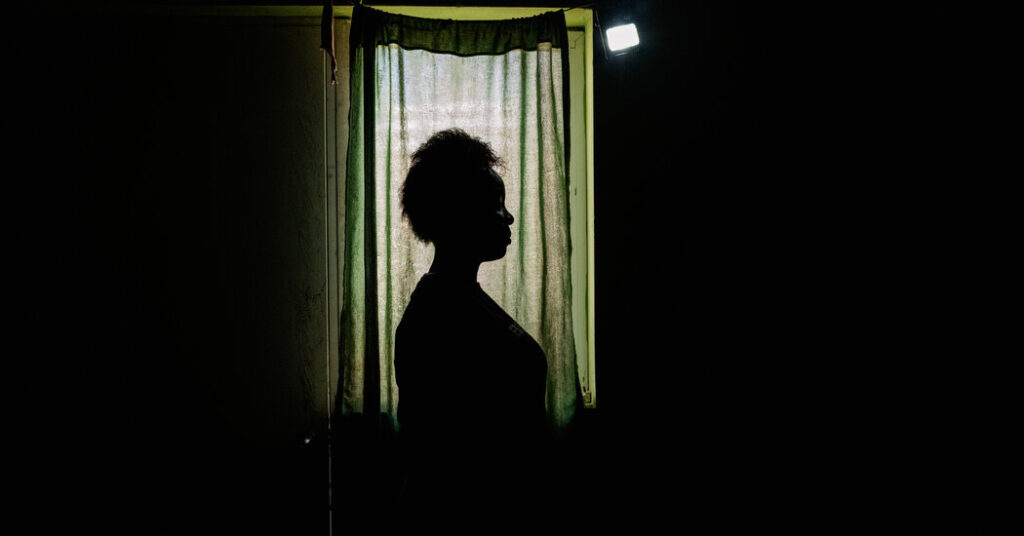
Katty Joseph, a Haitian woman living in the Dominican Republic, was afraid to go to a hospital to have her baby.
She did not want to get deported.
Dominican immigration officials stationed at public hospitals were detaining undocumented migrants who were then deported, including mothers and their newborns. The dragnet, underway for over a year, has overwhelmingly ensnared Haitians fleeing a catastrophic humanitarian crisis in neighboring Haiti.
Ms. Joseph, 20, arrived in the Dominican Republic a year ago and was living in the backroom of a car repair shop after the owner took her in. That is where, in late October, she said she gave birth.
Propped on a blanket on the grease-stained floor, she said she pushed through the stifling Caribbean heat with the help of a friend. Ms. Joseph cut the umbilical cord herself with a razor, she said, but the baby didn’t cry.
Less than 24 hours later, he was dead, she said.
“It was a very difficult moment,” Ms. Joseph said in Creole, searching for words to describe her loss.
The Dominican Republic is carrying out one of the most extensive mass deportation campaigns in the Western Hemisphere, expelling thousands of Haitians back to a country in shambles.
The effort has extended to hospitals, a contentious move critics have denounced as inhumane and reflecting deep anti-Haitian sentiments on the island nation.
Dominican officials describe the hospital crackdown, which began in April 2025, as a crucial step to remove Haitians they say are draining public resources. By the government’s metrics, the policy has worked: Deportations are up, and the number of Haitians seeking hospital care is down.
But over the past year, it has led a growing number of Haitian women to give birth at home or in other unsupervised and often squalid settings, according to medical professionals and local advocacy groups.
They warn that mothers and infants face life-threatening risks — including infections and hemorrhages — without medical intervention.
The fallout is clear: Hospital births among Haitian women dropped by nearly 60 percent in the 12 months since agents were deployed — to 13,856 from 32,967 in 2024, according to Dominican health statistics.
“It’s been catastrophic,” said William Charpentier, the president of the National Board for Migration and Refugees, a Dominican advocacy group assisting Haitian mothers.
Over several months, The New York Times interviewed nearly a dozen Haitian mothers, as well as doctors and informal midwives helping Haitian women give birth in the shadows. The Times documented the deaths of one newborn from medical complications and one mother who died of septic shock two weeks after delivering twin boys at home.
Giving Birth in the Shadows
Ms. Joseph said the owner of the car repair shop took her baby to a pediatrician four hours after the boy was born in Puerto Plata, on the northern Dominican coast. The pediatrician, Dr. Juan Payero, said the baby’s vital signs were stable, but he was concerned that the infant was hungry and had not yet cried.
Dr. Payero said he urged Ms. Joseph to go to a hospital, but the baby died a few hours later. Ms. Joseph said she dug a hole and buried the baby’s body herself on a hill near the town where she lived. An autopsy was never performed to determine the cause of death, she said.
The baby, Dr. Payero suggested, could have died from malnourishment, lack of oxygen, an infection caused by the unhygienic conditions in which he was delivered, or tetanus from the razor used to cut the umbilical cord.
The crisis is the latest flashpoint in decades of tension on Hispaniola, the Caribbean island shared by Haiti and the Dominican Republic. The Dominican economy has long relied on Haitian migration to power its agriculture, construction and tourism industries, but the recent surge triggered a backlash.
Tens of thousands of Haitians have crossed the 240-mile land border in recent years, escaping relentless bloodshed and deprivation in one of the most unstable countries in the Americas.
The Dominican government responded with a far-reaching deportation campaign supported by many Dominicans worried that Haiti’s gang violence would spill over the border and that the exodus was burdening taxpayers.
President Luis Abinader, tapping into a wave of nationalism that fueled his re-election in 2024, imposed weekly deportation quotas that have led to the expulsion of more than 478,000 Haitians since January 2025, including border crossers deported multiple times, according to Dominican officials.
The last government survey, from 2017, estimated that nearly 500,000 Haitians lived in the Dominican Republic, with an additional 252,000 born in the Dominican Republic to Haitian parents.
Mr. Abinader oversaw the construction of a 100-mile border fence surveilled by soldiers and sensors, but his most divisive move took aim at places traditionally considered sanctuaries: hospitals.
In April 2025, the government began requiring the island’s public hospitals to report patients without proper documentation to immigration authorities so that they could be detained and deported after receiving care. Not even the Trump administration has enacted similar measures at U.S. hospitals as part of its deportation campaign.
Dominican officials said the move was necessary to prevent overcrowding in hospitals they described as inundated by Haitian migrants.
Vice Adm. Luis Rafael Lee Ballester, the general director of migration, said he was unaware of any spike in at-home births among Haitian women.
He stressed that undocumented Haitians face deportation only after receiving and paying for medical care in hospitals. Under current protocols, mothers are detained 72 hours after giving a natural birth, while those who undergo C-sections are detained after seven days.
“We’ve seen ourselves obligated to take a series of measures for national security and to guarantee the safety of our citizens,” Admiral Lee Ballester said in an interview, adding that officials were acting with “a high degree of professionalism and respect for human dignity.”
The policy, which has resulted in the deportation of breastfeeding mothers and their infants, has been denounced by human rights organizations and the United Nations, with a top U.N. official in Haiti saying it raised “serious humanitarian and human rights concerns.”
Cristiana Luis, the president of the Movement of Dominican-Haitian Women, an advocacy group, said, “It’s an affront to the human dignity of women. And their girls and boys.”
Twins, Orphaned at Birth
Over the past year, fear of deportation to their crisis-ridden homeland has kept many Haitians from seeking medical care.
Last November, Linline Poleis, 28, gave birth to twins, Duleyson and Dudleyca, in a house under construction where she was living without permission, according to her family. She refused to go to a hospital for fear of being deported and was alone during the delivery, until a midwife arrived later to help cut the umbilical cords, her family said.
She quickly became ill and began to bleed profusely from her pelvis, according to family members and neighbors interviewed by The Times. Neighbors said they pooled 4,500 pesos, or $75, to send her to a private health clinic, where she was treated for high blood pressure.
The next day, Ms. Poleis collapsed and died on a sidewalk in Santo Domingo, the country’s capital, her family said. Her autopsy report, conducted by Dominican officials and reviewed by The Times, found she died from septic shock, septicemia and endometritis — a uterine infection that is a leading cause of postpartum death.
The orphaned twins are now in the care of their father’s family.
A New Crop of Midwives
The spike in at-home births has revived a cottage industry of parteras or midwives, who were common decades ago but had largely disappeared as the Dominican Republic moved toward a hospital-based maternity system.
Kenya Degraff, a 28-year-old community activist, said that since becoming a midwife last year, she has crisscrossed the island helping more than two dozen Haitian women give birth — never charging them a fee.
“Right now, many Haitians here don’t have money,” Ms. Degraff said, referring to the high costs to give birth at private hospitals to avoid immigration officials. “Are you going to let someone die because of money?”
The Times late last year visited the house of another midwife in northern Dominican Republic crowded with six Haitian women. The midwife said she charged $100 to $250 for her services, from simply cutting the umbilical cord to providing traditional steam baths, which can help soothe new mothers.
“Dominicans don’t know I do this at home,” said the midwife, who requested anonymity out of fear for that Dominican officials could deport the women she helps.
Islan Luis, 21, was visiting the midwife’s house after giving birth two days earlier because she did not have the $2,000 she said it cost to give birth at a private hospital.
Ms. Luis said she had gone to shower in her home and felt a pain in her hip when she suddenly went into labor in the bathroom.
“The baby was born immediately after I felt the pain,” said Ms. Luis, who was still suffering from abdominal pain but had not yet seen a doctor.
After 17 hours of labor at the midwife’s house, another Haitian woman, who requested anonymity out of concern that she could be identified and deported, rushed to a public hospital to give birth.
The Times accompanied the woman and her husband to the hospital, where they said they paid a $250 bribe to avoid being reported to immigration authorities, on top of the roughly $85 for the hospital care.
Shortly after giving birth, she said, she had to share a bed with another Haitian mother and both of their babies.
Nearby, she added, Dominican mothers cuddled their babies in their own individual beds.
This report was produced with the support of the International Women’s Media Foundation (IWMF) as part of its Reproductive Health, Rights, and Justice in the Americas Initiative. The Times retained full editorial control over the article, and funders do not review stories before publication.
Frances Robles contributed reporting.
Luis Ferré-Sadurní is a reporter for The Times based in Bogotá, Colombia
The post Hospital Deportations Push These Mothers Into Risky Home Births appeared first on New York Times.