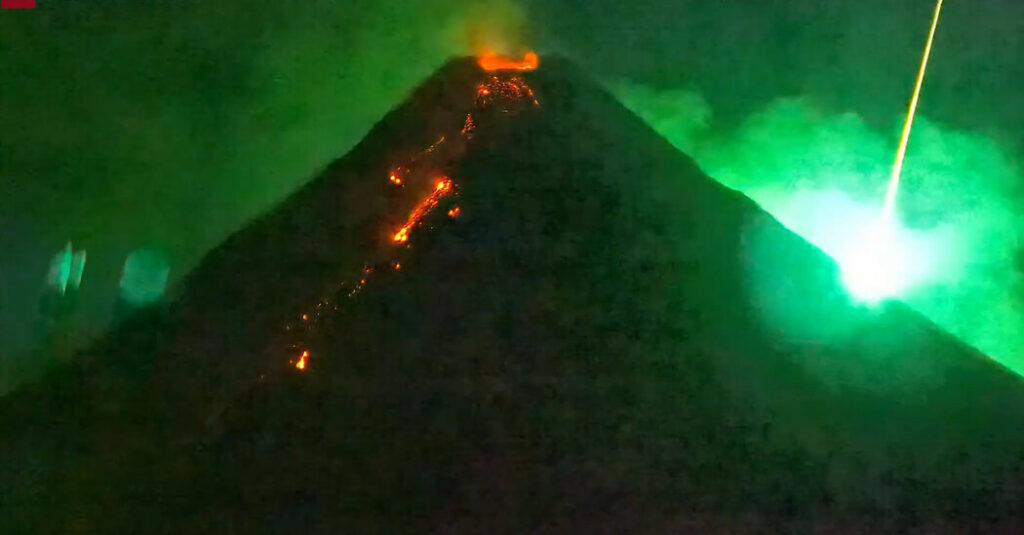
As night fell over the island of Luzon in the Philippines on Monday, Mayon, the country’s most active volcano, was putting on a show, its slopes painted with glowing streams of lava.
Suddenly, at 10:33 p.m. local time, a light shot down from the ink-black sky, first as a ball, and then as an incandescent streak. For a second, it outshone Mayon’s fiery rivers of molten rock. Then, as quickly as it had appeared, it vanished — a momentary, exhilarating event caught by at least two webcams.
Fireballs — burning fragments of either a rocky asteroid or an icy comet — are not especially uncommon. But it’s rare to see a fireball photo-bombing a volcano as it erupts.
“It is a gorgeous video of an unusual coincidence,” said Bill Cooke, who leads the Meteoroid Environments Office at NASA’s Marshall Space Flight Center in Huntsville, Ala. “One might even use the word wonderful.”
Rebecca Williams, a volcanologist at the University of Hull in England, noted that, “There’s nothing more spectacular to me than a volcanic eruption.” But, she added, “what a juxtaposition of two of the most powerful forces in the natural world.”
Some scientists think the flaming meteor was punching well above its weight. “That massive volcano was briefly upstaged by the impact of something the size of a coffee cup,” said Andy Rivkin, a planetary scientist and asteroid expert at the Johns Hopkins Applied Physics Laboratory in Maryland.
Impressive as it is, the webcam footage is somewhat illusory: Despite the way it appears, the meteor did not crash into the massive volcano. Instead, it self-destructed high in Earth’s atmosphere and most, if not all, of it was vaporized.
“It is possible, but not likely, this produced a meteorite,” said Peter Brown, a meteor physicist at Western University in Ontario, Canada. “My bet, particularly given the prominent trail, would be nothing survived.”
Mayon — an exceptionally lofty and symmetrical mountain — is capable of both beautiful and terrifying eruptions. The lava-licked landscape is sometimes scoured by thundering avalanches of molten rock and noxious gases. A series of explosive, ashy outbursts in early May sent thousands of people fleeing to nearby emergency shelters.
Mayon’s fury can safely be viewed via several webcams, including one operated by afarTV and another owned by the Philippine Institute of Volcanology and Seismology. The volcanology institute recorded the fireball in stark monochrome, while afarTV captured it as an eerie green paroxysm. One local witness reportedly mistook it for a missile.
That the fireball temporarily outshone the lava isn’t surprising. Mayon’s lava is probably cooking at about 1,800 degrees Fahrenheit (1,000 degrees Celsius). But the compressed air in front of the space rock is typically thousands of degrees hotter.
Experts say much about the extraterrestrial visitor remains unclear. “The deep green color is likely an artifact of the camera itself,” Dr. Brown said of the fireball, meaning that the footage does not offer clues about its chemical composition.
The behavior of the meteor’s atmospheric entry can offer a hint if it comes from an asteroid or a comet; cometary shards plunge to Earth at considerably greater speeds than their rockier cousins. But additional footage from a variety of angles would be needed before anyone could make an accurate speed and trajectory determination.
More than anything, the eruption-fireball mash-up, Dr. Rivkin said, was “aesthetically striking.”
It was also a reminder that, despite eruptions and asteroids both having reputations as tremendously dangerous, we owe our existence to them: “We have asteroids and volcanoes to thank for our atmosphere and oceans,” Dr. Williams said. Asteroids brought plenty of water, while volcanoes propelled the water skyward. Much of the rocky land on which humans walk was also forged by ancient eruptions.
“In some ways, this is what I imagine our early Earth to have looked like,” she said.
The post A Fiery Visitor From Space Photo-Bombs an Erupting Volcano appeared first on New York Times.