TRUDEAU & DOONESBURY: The Cartoonist Who Turned the News Into Art, by Joshua Kendall
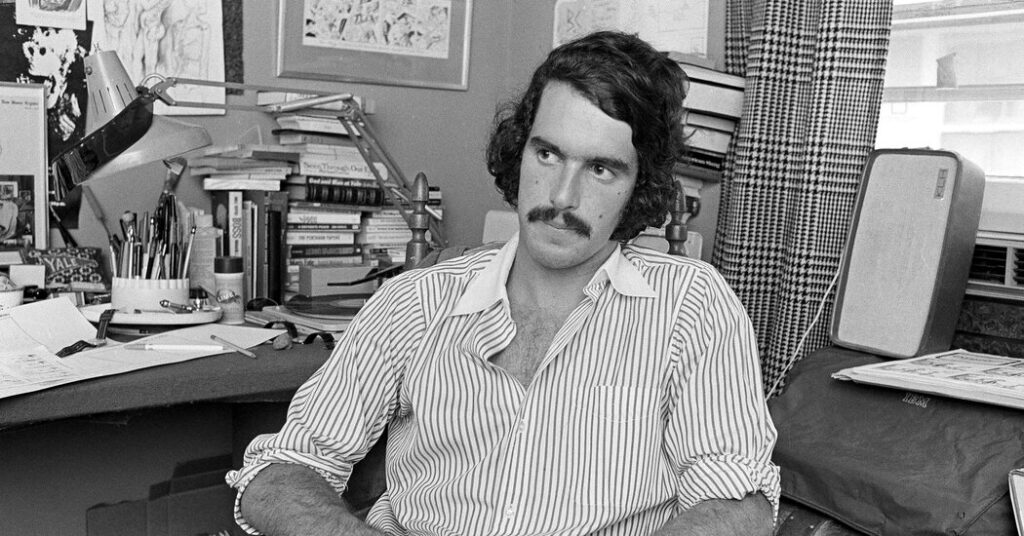
Garry Trudeau is a short guy who grew into a tall guy but never forgot what being a short guy was like. He was raised in the Adirondack Mountains, not so far from the Canadian border. The men in his family were genteel and lettered country doctors. Trudeau’s grandfather established America’s first tuberculosis sanitarium in Saranac Lake, N.Y., in 1884. Robert Louis Stevenson was an early patient.
The cartoonist had an unfettered childhood, largely spent outdoors. The idyll ended when his parents separated when he was in sixth grade. He was shipped downstate to one boarding school and, later, packed off against his will to St. Paul’s, the prep school in Concord, N.H.
He loathed both places. Unathletic and a “shrimp” (his term), he was bullied at St. Paul’s. He describes the intimidation as “Lord of the Flies” stuff. He grew to despise preppies, epitomized by the swaggering Ur-preppy George W. Bush,whom he would meet at Yale and later repeatedly zing in “Doonesbury,” his era-defining comic strip. The only good thing that happened at St. Paul’s was that, during his senior year, he unexpectedly grew six inches.
Born in 1948, Trudeau was a child of privilege. He summered in East Hampton, N.Y., where his family owned a house designed by McKim, Mead & White, the Gilded Age architectural firm. Trudeau’s mother, after the divorce, lived in an apartment on Manhattan’s Park Avenue. If you are lucky enough to have been given an advantage in life, Trudeau would tell his daughter, when she feared she was routinely given nepo-baby treatment, what matters is what you do with that advantage.
Trudeau’s life is on display in a new biography, Joshua Kendall’s “Trudeau & Doonesbury: The Cartoonist Who Turned the News Into Art.” It’s the first major biography of this reclusive satirist. It was written with Trudeau’s cooperation — he agreed to be interviewed, and he granted Kendall access to his archives — but it doesn’t dig too deep. It verges on hagiography.
It’s possible Trudeau doesn’t have any skeletons, even plastic ones, in his cupboard. As the Newsweek editor Dominique Browning complained to Jonathan Alter in 1990, after Alter had turned in the first draft of a profile of Trudeau, “Nobody leads this kind of golden life.”
Kendall’s book works anyway; it has a good story to tell. I devoured it in two or three sittings, as if it were an ideal bag of popcorn. This book will be a many-sided nostalgia trip for anyone who’s read “Doonesbury” in something like real time, and a mind-popping introduction to Trudeau’s oeuvre for tykes who did not.
I got to “Doonesbury” late. I’m 16 years younger than Trudeau. But I caught up with the best-selling anthologies and broke their spines with repeated handling. They were my “Peanuts.” Like more than a few people I know, I sometimes suspect “Doonesbury” is responsible for at least 15 percent of my personality and worldview.
Kendall’s biography hits cruising speed when Trudeau arrives at Yale. It was 1966 and the counterculture was peeking over the horizon. Trudeau planned to become an artist or a designer, but the cartoons he drew for The Yale Daily News (his first was an illustrated letter to the editor) were immediately prized for their detached wit and their casual, slouchy, anti-comics-page style.
His strip was called Bull Tales, and often it gently satirized a character named B.D., after the studly Yale quarterback Brian Dowling. Among the other original characters were Mike Doonesbury, a socially maladroit Everyman, Zonker Harris, a pot-smoking slacker, and Megaphone Mark, a campus radical. All had Trudeau’s skeptical and world-weary trademark eyes. They were vaudeville, of a clever sort.
The strip went national while Trudeau was still a student. His syndicator thought he needed a better name than “Bull Tales.” “Doonesbury” was derived from the nickname of one of Trudeau’s friends, Charles Pillsbury, a scion of the baking products family.
It’s hard to overstate the impact “Doonesbury” had in the 1970s. Trudeau dragged a knowing hippie sensibility, and the tone of a wised-up opinion section, onto the playground of the comics pages, right alongside “Beetle Bailey” and “The Family Circus.” There was nothing else like it. By the middle of the decade, the strip was running in some 450 newspapers, with a total of 60 million readers. His first “Doonesbury” anthology sold 600,000 copies.
At 26, Trudeau became the first comic strip artist to win a Pulitzer Prize for editorial cartooning. The next year he became the youngest person to receive an honorary degree from Yale. He was a handsome, eligible bachelor who married Jane Pauley, a co-host of the “Today” show, in the summer of 1980. Such was their combined fame that helicopters buzzed over the island wedding.
Trudeau made his bones — the journalist Nicholas von Hoffman referred to him as “an investigative cartoonist” — with a controversial (and very funny) series of comic strips that gave voice to what people were already thinking in the early days of Watergate. In one, John Mitchell, the attorney general under President Richard Nixon, was, in Megaphone Mark’s words, “Guilty! Guilty, Guilty, Guilty!” Another strip noted that “instigation” wasn’t the right word to describe Nixon’s role in the scheme; “complicity” was better.
The Washington Post and The Boston Globe refused to run these strips. Other newspapers began to move “Doonesbury” to the opinion pages. So winsome were most of the strips that the people attacked in them tended to be flattered rather than outraged, and asked Trudeau for the original drawings.
“Doonesbury” consistently stirred the pot. Some papers pulled the strip when Trudeau used the word “horniness”; others did so when he showed an unmarried couple in bed. Still others balked when he took readers on a tour of Ronald Reagan’s brain. He printed a photograph of Frank Sinatra with reputed mobsters, and depicted Bill Clinton as a waffle and Bush as an asterisk (because of the close 2000 election). He had George H.W. Bush put his manhood in a blind trust.
Gov. Arnold Schwarzenegger of California was portrayed as a big and beefy hand, because of sexual harassment claims against him: Trudeau gave him the moniker “Herr Gröpenfuhrer.” A series of strips that parodied the 1984 anti-abortion documentary “The Silent Scream” — in Trudeau’s version, an unmarried woman undergoes an abortion 12 minutes after conception — was turned down by Trudeau’s syndicator. The strips ran in The New Republic.
“Doonesbury” didn’t always sail under a pirate flag. The strip owes its lasting appeal to the fact that it is character driven. To his original four he added many others, including Joanie Caucus, who catches a ride with Mike and Mark on a cross-country motorcycle trip (Mike rides in a sidecar) after leaving her misogynistic husband. She ends up going to law school and marrying Rick Redfern, a Washington Post journalist.
Uncle Duke, an amoral gonzo journalist, was modeled after Hunter S. Thompson. Thompson despised the portrayal and sent Trudeau a wad of used toilet paper in the mail. There was Phred, a well-meaning Vietcong “terrorist,” and Honey Huan, Uncle Duke’s sidekick. Roland Hedley, a self-absorbed television journalist, was an inspired knockoff of Sam Donaldson of ABC News.
There was also Andy Lippincott, the first openly gay character to appear on the comics pages. Some papers didn’t run the Lippincott strips, or the ones in which he learned he had contracted H.I.V. Trudeau handled that subject so carefully, and it meant so much to many people, that Andy became the only fictional character to be represented on the AIDS Quilt.
Trudeau has insisted that he can’t write a joke to save his life. His aim has been to deliver “a four-panel smile” that peaks in the third panel, rather than a final-panel laugh. His best strips still feel like little conspiracies between himself and the reader. They were, and are, a daily confirmation of one’s sanity.
He’s allowed his characters to grow up, even if he didn’t give them pot bellies or let them lose their hair. (He wanted them to remain recognizable.) B.D., for example, lost a leg in the Iraq War. Hedley later worked for Fox News and began to tweet. Zonker enrolled in the bogus Trump University because he dug its motto, “Greed est bonum.”
Donald Trump has been lampooned in “Doonesbury” since 1987. It’s long been obvious that Trump and the presidency were two circles that, on a Venn diagram, Trudeau hoped would never overlap. In more recent times, Uncle Duke and Honey have worked on Trump’s superyacht. They incompetently run it into a reef.
“Doonesbury” ceased being a daily comic, and began appearing only on Sundays, in 2014. The strip continues to choogle along, chronicling the effects of Trump’s policies on Trudeau’s characters. He makes their dilemmas universal. In them you feel in touch with the whole broad anatomy of American life.
Kendall’s book is not as sophisticated, in tone and content, as Trudeau’s strips are. Its revelations are on the level of details like Trudeau’s fondness for jogging and squash, his famous Halloween parties (he once came dressed as Steve Weed, Patty Hearst’s boyfriend at the time she was kidnapped by the Symbionese Liberation Army), and the facts that he dated Candice Bergen, passed a kidney stone and is a doting father.
It’s a meat-and-potatoes biography. Sometimes that’s the best kind: Get out of the way and let the story tell itself. I occasionally longed for a more authoritative voice.
Trudeau has led a hermitlike existence; he’s fought to not become a national treasure. Yet he’s arguably the coolest baby boomer standing, in part because he’s still on the side of the world’s dark horses, bottom dogs and little guys.
TRUDEAU & DOONESBURY: The Cartoonist Who Turned the News Into Art | By Joshua Kendall | Abrams | 339 pp. | $35
Dwight Garner has been a book critic for The Times since 2008, and before that was an editor at the Book Review for a decade.
The post The Story of ‘Doonesbury’ and a Half-Century of American Absurdity appeared first on New York Times.