On a recent night, Yusimi Castellano crouched over her squat iron stove, arranging charcoal and gently placing the Styrofoam and the plastic she used as kindling over it. She used a cigarette lighter to start a small fire.
Noxious smoke billowed through her 18th floor apartment, eventually sweeping out toward the former military barracks where the Cuban Revolution is said to have begun and the verdant mountains that wrap around Santiago de Cuba, the country’s second-largest city.
Slowly, the charcoal began to glow. She put a grill made of old coat hangers on top and boiled some spaghetti for her family’s dinner.
“I shouldn’t be cooking with charcoal,” said Ms. Castellano, 58, who has asthma and lately has been short of breath and coughing constantly. “But if I don’t cook, I die.”
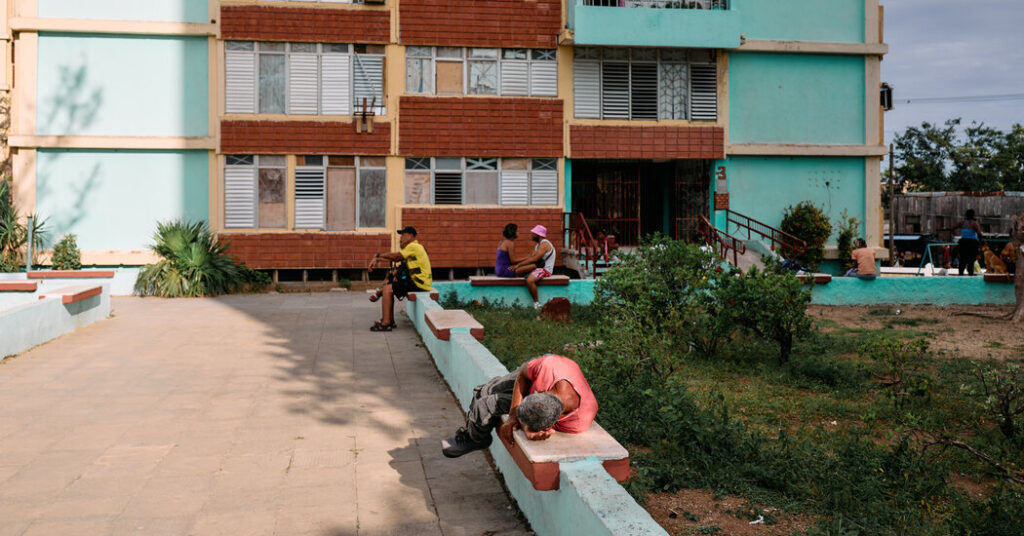
Ms. Castellano’s crude cooking methods have become the norm across the complex of five 18-story buildings, each with 120 apartments, where she lives and that were once meant to showcase the revolution’s promise when they opened four decades ago.
Today, some people can’t even afford charcoal, and resort to chopping firewood to cook in their homes.
Life here and across much of Cuba, already difficult because of an economy that has been in shambles for years, has become even worse since the Trump administration mounted its escalating pressure campaign against the country’s communist government.
First, the Trump administration stopped oil deliveries from Venezuela, Cuba’s main benefactor, after U.S. forces in January captured Venezuela’s president.
Then President Trump used the threat of tariffs to cut off foreign fuel shipments almost entirely, including from Mexico, Cuba’s other crucial supplier.
The Cuban government says its oil reserves have run out and that its aging electric grid is becoming increasingly unreliable. The country produces some oil but far from enough to meet its needs.
Outside Havana, the capital, power outages now last 20 hours a day. The lack of energy has set off an enormous humanitarian crisis that has become deadly.
The main refinery in Santiago has stopped producing liquefied petroleum gas, cooking gas mostly made from Venezuelan and Mexican oil.
Last December, Ms. Castellano picked up a small canister filled with cooking gas from a state store at the bottom of her building. The canisters were supposed to be refilled every month, but by then they were being refilled roughly every other month. Since January, however, no gas has been given out.
Breakfast in Ms. Castellano’s home has become a rarity. With the elevator no longer functioning most of the time, the delivery boy who used to bring bread is unwilling to slog up 18 floors.
But the family has no choice. Five mornings a week, Ms. Castellano’s niece walks Ms. Castellano’s 87-year-old mother, Giorgina, who has dementia, downstairs and to a state-run day program for older people a few blocks away. In the afternoon, the two must trudge back upstairs.
“The country is being strangled,” said the niece, Yailen Menéndez, 38.
Residents are sleep-deprived. Because nobody knows when the power will come on, people leave lights and fans on. If the electricity kicks on, the sudden glare or cool breeze will wake them so they can do their chores before another outage.
“Night has become day,” said one neighbor of Ms. Castellano’s, who stopped by quickly to drop off a sprig of oregano. “Everybody wakes up when the lights come on to wash, cook — to do everything.”
While many households in Havana still have gas piped into their kitchens, Santiago, like the rest of the country, doesn’t have that type of infrastructure. (Santiago’s population, according to the last census in 2012, was about 431,000, but that was before an enormous wave of migration from Cuba. Many apartments in Ms. Castellano’s complex are empty.)
The city, where a majority of the population is Afro-Cuban, has traditionally been a bedrock of government support, but it’s poorer than Havana, has a less developed private sector and receives fewer remittances from abroad. With less to cushion the crisis, Santiago has been particularly hard hit by the economic collapse.
Haydee Gómez Suárez, 63, who lives in a different tower from Ms. Castellano’s, sells thin plastic bags for bread for the equivalent of 2 cents each outside privately owned bakeries. But the bakeries’ ovens are electric.
“If there’s no power, there’s no bread,” she said. “And if there’s no bread, I can’t sell a single bag.”
She has lost more than 20 pounds in recent years, she said, and eats just one meal a day.
Water leaks through her damp, dingy apartment. She cooks with cardboard and scraps of wood she finds in mounting piles of trash.
She sluices buckets of water over her kitchen walls, but the smell from her cooking fires clings to her furniture, and soot has darkened her walls.
It’s a far cry from when the towers opened in 1983. One Cuban magazine described the complex, built with earthquake-resistant technology, as “the future face of the city.”
The buildings were inaugurated on the 30th anniversary of the failed rebel assault on the Moncada military barracks, which the buildings overlook. The attack, staged by Fidel Castro and his small band of rebels on July 26, 1953, was later mythologized as the start of the revolution that toppled a U.S.-aligned dictator.
(Fidel’s brother, Raúl Castro, who also fought in the nearby Sierra Maestra mountains, was indicted last week on murder charges for the downing of two civilian planes 30 years ago that killed four men, including three Americans.)
The apartments in the complex were given to families of the rebel guerrillas and to workers at a new textile plant billed by the government as one of the largest in Latin America. Each building’s name is linked to the rebel campaign.
“It was a projection of a future — a country bounding forward toward development and emancipation,” said Aida Morales, a researcher in the historian’s office in Santiago.
Asked what the projection is now, she laughed. “We’re an island; you can’t go anywhere but the sea,” Ms. Morales said. “And there’s no one to help us.”
As night fell, Anyerman Quiñones Goicoechea, 40, who lives in the complex and is a building painter for a state-owned company, sat brooding in the dark in a rocking chair. After working for the state for more than 20 years, he feels he has nothing to show for it.
“The system has to fall,” he said. “They have to go. Or change the way they think.”
He blames the blackouts mostly on the regime. “This country prioritized building hotels, not power plants.”
Four floors above him, a couple had a different viewpoint. Antonio Nieto Paneque, 83, and his wife, who did not want to share her full name, ate cold rice and beans she had prepared at 11 p.m. the night before when the power returned.
Mr. Nieto Paneque said he joined an urban guerrilla group in Santiago as a teenager in 1957, smuggling pistols throughout the city.
“The revolution brought electricity to the countryside,” he said. “We believed peasants had the same right as people in the city.”
His wife pointed to their rice cooker, hot plate, refrigerator and a “very good” pressure cooker, all distributed two decades ago when the government, flush with cheap Venezuelan oil, sought to move Cuban kitchens on to the electric grid.
“We lived normally before Trump took power,” Mr. Nieto Paneque said, an LED headlamp strapped around his forehead. “Our lives were stable.”
In 2019, the first Trump administration began imposing sanctions on companies shipping Venezuelan oil to Cuba, and in response the Cuban government introduced what it said were temporary energy-saving measures. They turned out to be permanent.
Even before the more recent round of actions by the Trump administration, sanctions had left the Cuban government without enough money to buy the fuel the country needed, some economists say. Trump administration officials have blamed Cuba’s woes on what they call the government’s corruption and incompetence, not the U.S. oil blockade.
Still, while most Cubans now go without cooking gas, electricity and public transportation, the Cuban police and armed forces continue receiving fuel for their vehicles.
Cuba’s Soviet-era electric grid is obsolete, weakened by decades of underinvestment and a lack of maintenance — a result of the island’s failed economic model and sanctions on parts needed to maintain the system.
Halfway up the blacked-out tower where the Castellanos live, the orange glow of a wood fire illuminated the balcony of one of the apartments. Silhouetted figures bent over flames.
In the park below, life went on. A street vendor rapped the metal box keeping warm his roasted peanuts sheathed in paper flutes. Nearby, other vendors sold candies, condoms and candles.
Yoandris García, 33, another resident of the complex, sat near them, preferring the cooler air to another sleepless night sweating in bed.
He said he lost his job last month when the minibus company he worked for ran out of fuel. The next day, he said matter-of-factly, he planned to walk four miles to cut wood with a machete and haul it home on his shoulder.
Across the avenue, the single streetlight went off. Mr. Garcia said he hoped that meant the electricity might be directed elsewhere, as is sometimes the case.
“Now they’ll put it on over here,” he said, nodding toward the apartment towers. Nothing happened.
For many here, the question of why there is so little electricity is irrelevant. Disillusioned, disempowered and exhausted, many say they no longer care. They are too busy surviving.
“Those in power know the truth,” said Felo González, 50, a furniture repairer. “Our job is to hustle.”
Adrian Rey Duharte Garcés contributed reporting.
The post Out of Gas, Cubans Cook With Charcoal and Wood to Survive appeared first on New York Times.