Oil prices fell sharply and stocks rose on Monday after American officials said that the United States and Iran had agreed in principle to a peace deal that would reopen the Strait of Hormuz. But final approval of a deal could take days.
The deal would reopen the waterway between Iran and Oman, a vital trading route for oil and natural gas that normally carries up to one-fifth of the world’s oil supply. In addition, Iran would commit to disposing of its highly enriched uranium, said a U.S. official.
Iran’s leaders and official state media have not publicly commented on what a potential agreement would say or what is being discussed.
Oil prices dip.
-
The price of Brent crude, the global benchmark for oil, was about $95 a barrel, down about 5 percent.
-
West Texas Intermediate crude, the U.S. benchmark, was around $91 a barrel, down more than 5 percent.
-
The losses during Asia’s trading day came on the heels of modest declines in the United States on Sunday.
Stocks up slightly.
-
Futures on the S&P 500 pointed to a 0.9 percent increase when stocks resume trading in the United States on Tuesday.
-
Stocks in Asia, where countries import vast quantities of oil and gas, were trading higher in most markets, with the biggest gains coming in Japan and Taiwan, where shares were up about 3 percent. Stock markets in South Korea and Hong Kong were closed for a holiday.
Gasoline prices drop a bit.
-
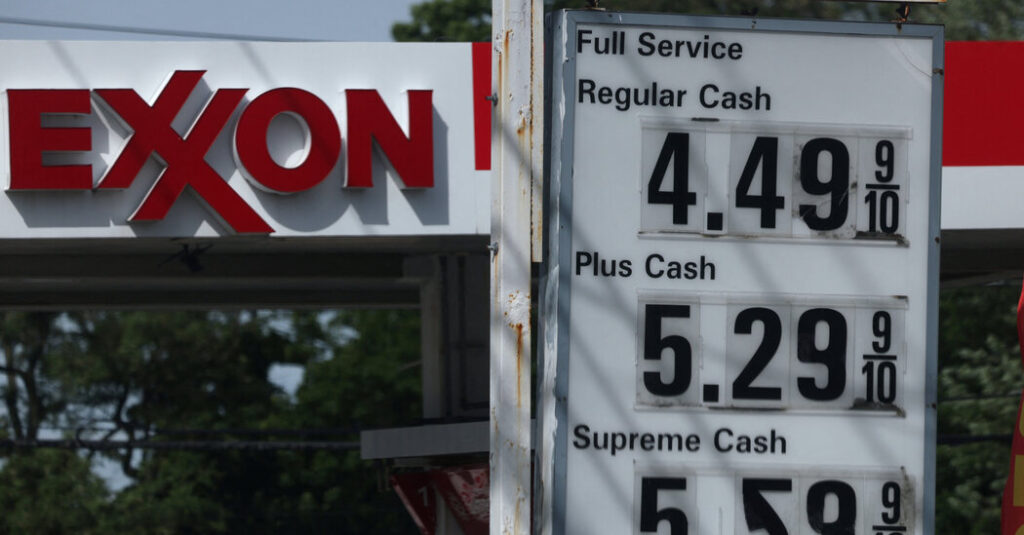
Gas prices fell slightly on Sunday, to a national average of roughly $4.51 a gallon, according to the AAA motor club. The increase has raised the cost for drivers by 51 percent since the war began.
-
Gas prices don’t move in lock step with crude, usually trailing increases or drops by a few days.
-
The average price of diesel also dropped slightly, to $5.62 on Sunday, up about 49 percent since the start of the war.
Jack Ewing covers the auto industry for The Times, with an emphasis on electric vehicles.
The post Oil Prices Fall Sharply on News of Possible Iran Deal appeared first on New York Times.