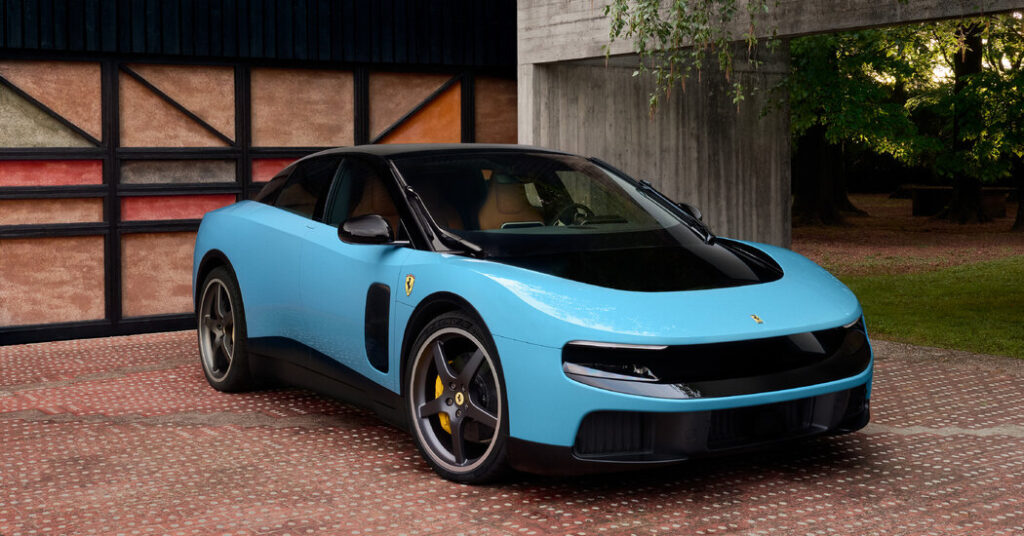
Ferrari just pulled the cover off Luce, its first fully electric car. The five-seater is one of the biggest gambles in the Italian company’s history, arriving amid a string of missed targets and expensive promises by luxury carmakers to go electric.
In Luce, Ferrari engineers believe that they have developed a sports car capable of taking turns at high speeds despite being weighed down by more than half a ton of battery cells and electrical circuitry bolted to the floor pan.
But will the ultrawealthy spend more than half a million dollars on an all-electric Ferrari that doesn’t quite have the classic look or distinctive engine roar of a Ferrari?
“This has been a major investment from Ferrari’s point of view in a product that, at the moment, there’s no real certainty as to what the market is for it,” Angus MacKenzie, international bureau chief for MotorTrend. “They’re nervous, would be fair to say.”
The story of Luce (pronounced loo-CHAY, or “light” in Italian) is uncommon in the roughly 80-year history of Ferrari’s road-car business. The company teamed up with LoveFrom — the agency founded in 2019 by Jony Ive, Apple’s former design chief, and the industrial designer Marc Newson — to develop Luce’s glass-and-polished-aluminum frame, which is capable of hitting close to 200 miles per hour.
John Elkann, Ferrari’s chairman and a scion of the Agnelli family automobile dynasty, contacted Mr. Ive and LoveFrom shortly after the design firm opened shop in the hope of collaborating on a project. Their efforts began five years ago, around the time that Mr. Elkann’s handpicked new chief executive, Benedetto Vigna, started at Ferrari.
A physicist who spent decades at the chip maker STMicroelectronics, Mr. Vigna has become linked to Luce’s fortunes, and Ferrari’s wider push into electrification, some analysts say. In an interview on Monday, he pushed back on that idea. But he acknowledged that Luce’s arrival heralded a new era for Ferrari.
“There are some leapfrog moments, and I am fortunate to be living one at this time,” Mr. Vigna said before an unveiling ceremony on the outskirts of Rome with some of the company’s V.I.P. customers.
He was feeling confident that the night would go well. Throughout the day, his phone was blowing up. “More than 20 messages from clients,” Mr. Vigna said, shaking his head with a grin while peering down at his smartphone.
“Look, this is another one,” he said, pulling up a picture someone had sent him. It was an image of a cherry red sports car with the Ferrari prancing horse logo on the hood. It was not the Luce, though.
The level of buzz, he thought, was a good sign. But the real test comes when Ferrari officially starts taking orders this week for a car that will cost 550,000 euros in Italy. The U.S. pricing has not been determined yet, he added.
High stakes
The waiting list for the most-sought-after Ferraris can last years. Analysts are keen to see if the Luce has a similar appeal. Some would-be customers will probably be attracted by the car’s zero-emission bona fides.
But for the die-hard Ferraristi, it will be all about performance. How will Luce’s unique engineering — row upon row of battery cells lined up between the front tires and the back ones, and four electric motors, one per tire — perform at top speed?
There are design features that may raise eyebrows: The four-wheel-drive Luce has four doors and ample trunk space, giving it a look of a weekend car for the billionaire set. The car has a range of roughly 530 kilometers (329 miles) on a full charge — in the rear of the pack of more economical E.V.s.
Ferrari watchers have long wondered how the company’s engineers would be able to replicate the signature growl of a revving Ferrari engine in an electric model. The automaker’s solution was to install an accelerometer, at the center of the axles; the device captures and amplifies the natural sound and whir of the car’s moving parts as it accelerates. Whether the purists appreciate the effect is another question.
There’s a lot riding on Luce. In October, the company disappointed investors with a lackluster growth forecast. It also downshifted on its electrification ambitions, 16 months after it had opened a €200 million “e-building” to much fanfare.
Ferrari now sees 20 percent of its 2030 model lineup being all-electric, compared with the 40 percent E.V. target it struck in 2022. (It left unchanged its plan for hybrids to make up 40 percent of new cars built.)
The market for high-end E.V.s has largely stalled, however. Other luxury carmakers — including Mercedes-Benz, Porsche and Lamborghini — have postponed, scaled back or abandoned their electrification plans. Caught between President Trump’s tariffs and a cooling market, global automakers have taken roughly $70 billion in write-downs as they have rolled back their E.V. production targets.
Many investors wondered if Ferrari, whose profits had largely defied the woes of the automotive sector and Mr. Trump’s trade war, had also misjudged the market for E.V.s. Shares in Ferrari suffered their worst one-day fall on record when the company released its gloomy growth projection in October. They are down roughly 28 percent since, wiping roughly $28 billion off the company’s market valuation.
Mr. Vigna said on Monday that both he and Ferrari were still bullish on the E.V. market. “Some people are telling me, ‘I will become a client of Ferrari if, and only if, you deliver to me an electric Ferrari,’” he added.
Bernhard Warner is a senior editor for DealBook, a newsletter from The Times, covering business trends, the economy and the markets.
The post Ferrari Is Finally Going Electric. Will the Purists Buy It? appeared first on New York Times.