One of the boldest questions Barbara Walters ever asked was less a question than an insult. The year was 2011, and Walters was interviewing three members of the Kardashian family—the sisters Kim, Khloé, and Kourtney—and their mother, Kris Jenner. The conversation was, in theory, a compliment to her guests; Walters had included the Kardashians in the most recent edition of her annual “10 Most Fascinating People” list. But now, sitting with the four women, she observed: “You don’t really act; you don’t sing; you don’t dance. You don’t have any—forgive me—any talent.”
Had Walters been hoping to manufacture some drama with the remark—one of her own talents was her ability to make famous people cry on national television—she had underestimated the celebrities before her. “But we’re still entertaining people,” Khloé replied, meeting Walters’s barb with practiced placidity. Kim, taking her sister’s cue, noted the challenge of making people “fall in love with you for being you.”
Their serenity should not have come as a surprise. The Kardashians were professionally versed in treating the real as not quite real. And they had heard versions of Walters’s critique before. From nearly the moment that their first show, Keeping Up With the Kardashians, premiered, in 2007, its success had been met with suspicion. In its affect, the series was notably listless: Everyone involved (even the strivers it depicted) seemed a bit bored. It followed people who were wealthy and pretty, and their efforts to get wealthier and prettier. That it entertained viewers seemed, to its detractors, an indictment—not just of the family but also of the people who kept watching it. KUWTK was a canary in the content mine: evidence of all that can go wrong when “reality” is remade for ratings.
The anxiety the show provoked only added to its allure. KUWTK endured for an improbable 20 seasons, fueled by fans and hate-watchers and the fact that, commercially, the two amount to the same thing. By the time its finale aired on E!, in 2021, the show’s run read like a vindication of the Kardashians and their critics. The family was famous for being famous, the naysayers said. The Kardashians agreed—and then rode the fame, along with their Lamborghinis, all the way to the bank.
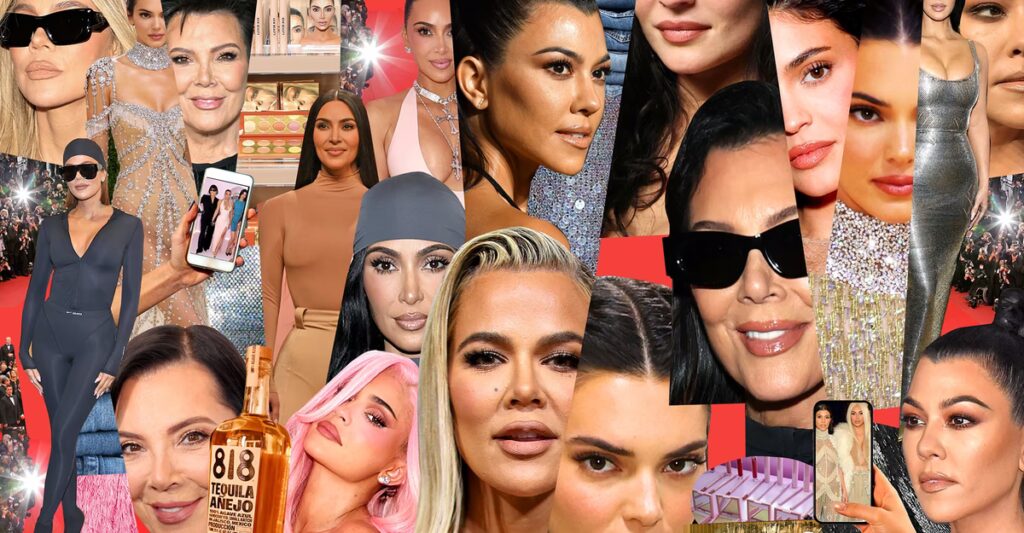
Today, the Kardashians are, collectively, more than just billionaires. They are a conglomerate with a brand identity, a Fortune 500–size operating budget, and an openness to being publicly traded. Repackaged as Instagram posts, TikTok reels, and meme-friendly screenshots, they are also their own corporate assets, their own sponsored content. The Kardashians are endlessly selling things (diet aids, makeup, apparel). Mostly, though, they are selling themselves.
[Read: The pandemic clarified who the Kardashians really are]
This is what Walters was hinting at when she asked the Kardashian women—informed them, really—about their lack of talent. Fame, being a currency, is typically earned. Talent has traditionally been one route to fame’s wealth. It has also, however, been associated with a kind of godliness: a gift that is possessed and that might be given to the world at large. Walters, in questioning the Kardashians’ talent, was doing more than merely insulting her guests. She was also (forgive her) implicating them. Their fame, she suggested, was ill-gotten—lucre not quite stolen but gained as passive income.
The claim was not new. What was remarkable was that it failed to recognize the more salient feature of the family’s ascendance: The Kardashians did not amass their power despite their lack of talent; they rose because they understand, with the canny foresight of the early adopter, how talent is being redefined.
Even the physical goods the Kardashians have brought to market—Skims, Kim’s shapewear brand, was recently valued at $5 billion, and Kylie sold more than half of her eponymous cosmetics company, in 2019, for $600 million—have been extensions of their telegenic brand. They are things that defer to images: products that exist primarily because, in the attention economy, eyeballs are meant to be monetized. And the Kardashians keep making us look.
You may not be able to name all of the people in the family (whose most prominent members also include Kendall and Kylie Jenner; the five sisters’ brother, Rob; and Kris’s former spouse Caitlyn Jenner). But you are subject to them all the same—and to the images, carefully posed and flawlessly filtered, that Kardashian Inc. and its subsidiaries churn out with factory efficiency. The Kardashians reside in Hidden Hills (and in Calabasas, and Malibu, and the Coachella Valley); as pieces of content, though, they live everywhere. Awareness of them is no longer an opt-in proposition.
Their power, because of that, is hegemonic—and historic. When, in 2015, Cosmopolitan dubbed the Kardashians “America’s First Family,” the magazine was making its own bid for eyeballs; it was also making a point. Democracies have their dynasties, and the Kardashians are among Americans’ unelected leaders, shaping our language and tastes and beauty standards, one piece of sponcon at a time. The title of their reality show acknowledged that ethereal form of influence. We keep up with the Kardashians in the same way that we keep up with the Joneses: involuntarily and inevitably. Like the Medicis, had that family patronized only themselves—like the Carnegies, had they manufactured not steel but empty air—the Kardashians have ascended, in their case by proving that nothingness, in a culture that defers to images, can be the stuff of empires.
They are also, as the psychotherapist and author MJ Corey argues in her exhaustive new analysis Dekonstructing the Kardashians, perfect metonyms for American culture—humans who have, as media figures, adopted the epic and somewhat pitiable proportions of Las Vegas, Disneyland, or the WWE. The Kardashians are hyperreal and fantastical, aspirational and kitsch. In her preface, Corey offers a note of apology for the topic at hand, quoting the author David Sinclair—who, in writing about the Spice Girls, observed that his subject would require him to defend the group’s honor and his own.
The rest of Corey’s book, however, is unapologetic, and rightfully so: The Kardashians matter, Corey suggests, because of who they are, but also because of who we are. They are fun-house mirrors, their cosmetically enhanced curves reflecting us back to ourselves both as we exist and as we might hope to be.
[Read: The sadness of the Kardashians]
Corey’s book—spun out from Kardashian Kolloquium, the name of various social-media accounts that she has maintained over the years to track the doings of America’s shadow First Family—reads less as a biography of one clan than as a study of the culture that elevated it. This makes Dekonstructing the Kardashians particularly compelling: To deconstruct the family, to treat them as a text to be read, as canon to be accepted, is to understand the media moment. The book’s subtitle is, aptly, A New Media Manifesto. The Kardashians, Corey writes, are “a composite of historical touchpoints, media tropes, and shifting identities.” They are reliably overexposed and underappreciated. Offering themselves up as images to be analyzed—“even if I’m objectifying myself, I feel good about it,” Kim once said, like a Pandora unleashing a flurry of think pieces—they function, effectively, as myths.
This is their talent, their gift. Societies need shared stories, shared icons, shared lore. The Kardashians provide them. The family, Corey argues, embodies the postmodern theorist Roland Barthes’ notion that images are collectively authored: objects that find their meaning in the way that viewers interpret them.
Dekonstructing the Kardashians can be dizzying in its scope. Corey, at different points, compares Kim to Marilyn Monroe, a Coke bottle, a Disney princess, and Mickey Mouse. Theorizing about the family, she invokes Benjamin and Baudrillard and Hegel and so many other thinkers that the book can read as a brief history of modern, and postmodern, thought. Remarkably, though, the book’s argument justifies its breadth. Dekonstructing the Kardashians, somewhat like Naomi Klein’s 2023 masterpiece, Doppelganger, is both about its nominal subject (Klein’s being, most directly, the writer Naomi Wolf) and not really about it at all. Klein treats Wolf—with whom she is often confused—as a metaphor for the divisions (of information, of political conviction, of reality) that are unsteadying American culture. Doppelgängers, the “twin strangers” of German folklore, are omens. Klein’s own double, having recently turned to the “mirror world” of conspiracism and paranoia, is a person whose path hints at trouble ahead.
To some viewers, the Kardashians may seem like trouble. For Corey, they are most interesting when met on their own terms. Who are they, as people? Their audiences will likely never know. Nor should we much care. The operative question is what they are, and why—and how they keep people watching.
This is perhaps why the Kardashians have retained their capacity to infuriate. Their success calls viewers’ bluff. Their status punctures one of Americans’ most fragile pieces of lore: the idea that the country, through its economy, is also a meritocracy. In that myth, markets are agents of morality. Through the market’s transactions, the idea goes, talent is rewarded; hard work gets its due.
The Kardashians, captains of industry in a post-industrial age, defy the old myths. Kim and her siblings were born into an age of excess, when “greed was good,” aspiration was limitless, and admiration for “lifestyles of the rich and famous”—something converted from a sociological category to a piece of entertainment—was losing its association with shame. Today, they are their own economic engines. The family employs not only the traditional Hollywood retinues (agents, assistants, stylists, housekeepers) but also people who act as their personal marketing departments, legal teams, and brand consultants.
The apex predators of our ever-more-stratified media environment have found their place at the top less by preying on others than by proving their willingness to be consumed: their bodies, ourselves. The Kardashians expose everything—the precise make of her breast implants (Kylie), the diet she used to drop a reported 16 pounds in three weeks (Kim), the plastic surgeon who performed her recent facelift (Kris)—while revealing, in practical terms, very little.
Their ability to shape-shift, literally and otherwise, is crucial to their appeal. They are living memes, infinitely adaptable and communally shared. They say almost nothing and, in that, they could mean almost anything—which makes them sphinxlike too. The Kardashians deliver their riddles in the internet’s global vernaculars: images, hashtags, assorted outrages. Gazing down, graceful and inscrutable, they befuddle all who behold them partly because they mean to and are good at it, and partly because befuddlement tends to double as engagement on Instagram.
Perhaps the family’s biggest riddle is what exactly it is giving back along the way. The Kardashians have been rewarded handsomely for their entrepreneurial solipsism. This is why they have the gross domestic product of a small country. But it is also why their power can seem so gross. The Kardashians may not be the icons we want, but they are the ones the system has elevated. As long as we keep looking, they will be the ones that we deserve.
*Illustration sources: Andreas Rentz / Getty; Angela Weiss / AFP / Getty; Araya Doheny / Getty; Arturo Holmes / Getty; Axelle / Bauer-Griffin / FilmMagic; Bing Guan / Bloomberg; Dave Hogan / Getty; Dimitrios Kambouris / Getty; Getty; Jaime Nogales / Medios y Media / Getty; Jamie McCarthy / Getty; Jamie McCarthy / WireImage; Jared Siskin / amfAR / Getty; Jeff Spicer / Getty; John Shearer / WireImage; Kevin Mazur / Getty; MEGA / GC Images; Michael Loccisano / Getty; Phillip Faraone / Getty; Rachpoot The Hollywood Curtain / Bauer-Griffin / GC Images; Robin L Marshall / Getty; Rosalind O’Connor / NBC / Getty; Stefanie Keenan / Getty; Steve Granitz / FilmMagic; Taylor Hill / FilmMagic
When you buy a book using a link on this page, we receive a commission. Thank you for supporting The Atlantic.
The post The Kardashian-Industrial Complex appeared first on The Atlantic.