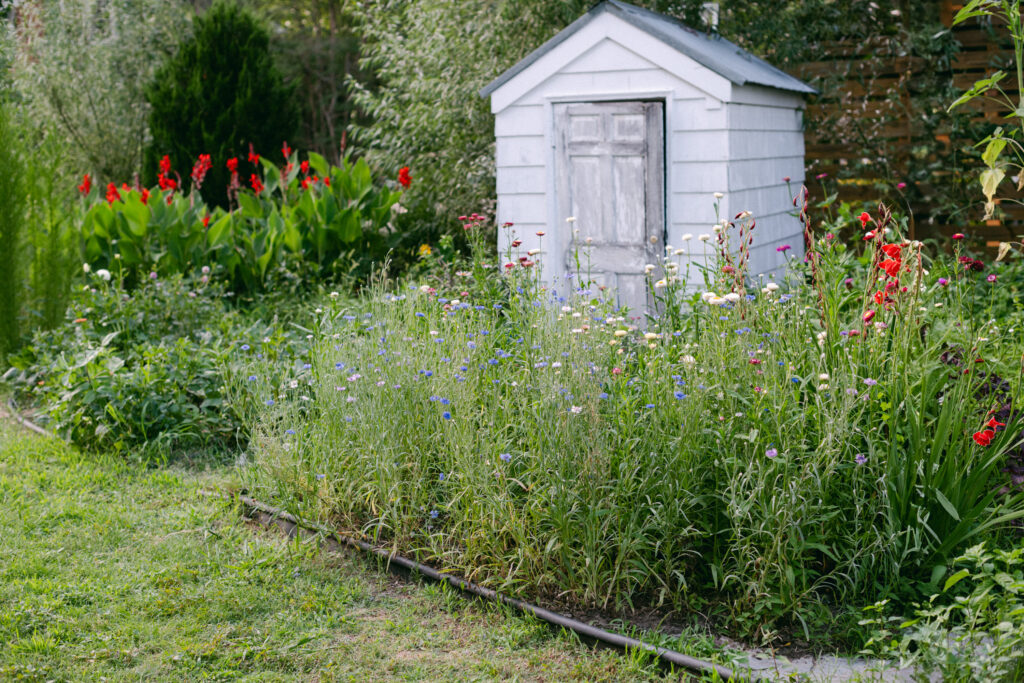
Marisa Mender-Franklin had always considered herself a gardener, but when the 37-year-old elementary school teacher grew the flowers for her 2020 wedding, she discovered a new love: farming. Unfortunately, her yard, like many in the Midtown neighborhood of downtown Memphis, was small and mostly shaded, not exactly ideal for the flower farm she now dreamed of.
Then, Mender-Franklin says, she began noticing many unused spaces — vacant lots, the lawn of the elementary school where she taught and many of the yards in her working-class neighborhood, which, together, added up to a lot of land. She had an idea.
“Flowers in need of a garden,” Mender-Franklin posted on her local buy-nothing Facebook group in early 2021. In exchange for space to grow, she promised to provide lawn care and, of course, a steady supply of fresh-cut flowers.
Within a day, she had 40 offers. One was from a neighbor sick of mowing her double lot, another from a couple of ardent gardeners whose failing health kept them inside. “It just made so much sense for all of us,” Mender-Franklin says.
Now, five years later, Mender-Franklin is a full-time flower farmer, and her business, Midtown Bramble and Bloom, grows all the flowers it sells in bridal bouquets, prom corsages and get-well-soon deliveries across 10 borrowed lots and lawns. Mender-Franklin has seven employees and operates out of a neighborhood storefront where she also teaches workshops on pollinator gardens and flower arrangements.
Mender-Franklin is part of a cadre of farmers across the United States who practice urban micro flower farming, providing “payment” in the form of lawn care, seed mix and, of course, fresh-cut flowers in exchange for space to grow. The model poses a few logistical challenges for the farmer (if you think keeping up with weeds in one yard is tough, try 10), but it does more than cultivate a small business: It also helps to sustain native wildlife and boost neighborhood pride, one yard at a time.
Businesses in bloom
For most of her adult life, Rachel Nafis was an ER nurse with farming aspirations. Living in San Diego, she and her husband raised chickens and kept bees. In 2012, they tried their hand at growing vegetables and livestock on a 45-acre ranch outside the city. Wildfire and rodents quickly chased them back downtown, she says, but she “just couldn’t shake that strong calling and desire to farm.”
In 2018, Nafis added a row of dahlias to the vegetable garden in her backyard and was soon scheming a way to create a cut-flower farm without leaving the city. The 37-year-old summoned her courage to ask an elderly neighbor if she could use his lawn to grow flowers.
“He was in his 80s and not able to take care of it anymore,” she says. “The weeds were chest-high.”
A quick yes gave Nafis the confidence to ask other neighbors, who readily volunteered their yards.
Over the past eight years, she has planted hollyhock, delphinium and echinacea across City Heights, a densely populated and diverse neighborhood that has long lacked green space. And in September 2021, Nafis quit her job and devoted herself full-time to growing flowers.
“Nursing was meaningful work,” she says, “but I didn’t love it the way I love farming.”
Today Psalter Farm Flowers supplies three local flower shops and provides a 69-member community-supported agriculture program (CSA) with flowers grown in nine urban gardens totaling a quarter-acre.
In Norfolk, flower farmer Dee Hall, a former condo manager, has accumulated about half an acre of lots within 10 minutes of her home in the city’s Colonial Place neighborhood to grow blooms for Mermaid City Flowers, which she opened in 2020.
“I think people are happy to not have to maintain their own yards,” she says. The weekly bouquets of fresh-cut flowers are an added bonus.
For Hall, who grew up in St. Lucia gazing at the night-blooming cactus in her grandmother’s garden, growing a flower business close to home is about more than convenience.
“Land access has historically been a barrier for people of color in the United States,” she says. “I could have tried to move out to the country, but I wanted to be in a place that I felt comfortable.”
Cultivating community
When Clarke Forrest and Marnie Baird moved into their San Diego home, they quickly got to work planting trees and a garden in the spacious backyard. The front of their single-story bungalow, though, remained a barren conundrum.
“Front yards have always been this puzzle to me,” says Baird. “No one ever uses their front yard.”
When they heard about Nafis’s business model, they eagerly offered her access to their land. And now, after two growing seasons, Forrest and Baird love coming home to a lawn full of kaleidoscopic blooms and chatting with Nafis about what she’s growing outside their front window. But Nafis isn’t the only frequent visitor in their front yard.
“We’re seeing a lot more birds and bugs and little animals,” says Forrest. “We’ve created this little nature space in the middle of the city. It’s just an absolute delight.”
Before she turned her front yard into a cut-flower farm, Hall noticed the absence of wildlife in her urban neighborhood.
“I knew there were native birds I should be seeing here and I wasn’t,” she says.
Now that her space is full of coneflowers, cosmos and yarrow, the avian life has rebounded. It’s a development she points out when she talks to her neighbors about regenerative agriculture and the many virtues of native plants, subjects she’s passionate about. “The flowers are a conversation starter,” she says.
Nafis has also noticed the way her flower beds have encouraged kinship in a neighborhood without a lot of community space. One of the yards she cultivates belongs to a lonely older man. Having people around and beautiful flowers to look at “mean a lot to him,” she says. “There’s a lot of mutual giving and receiving.”
Growing pains
Micro flower farming in the city is not without its difficulties.
“Having your farm split into 10 different places is such a logistic challenge,” says Mender-Franklin, who recalls pulling a wagon full of compost through downtown Memphis from one garden to another during her first growing season. “People were looking at me like I was insane.”
Duplicating each irrigation and timer system is also costly. “Then of course they all break at different times,” she says. And although farmers reimburse landowners for the water they use, they don’t get a say about who has access to the gardens and when.
“There are definitely challenges to being in someone else’s space,” says Mender-Franklin, who has had dogs tear up her beds and roofers drop materials on them. Passersby have ripped up whole plants for their own yards.
But the benefits far outweigh the risks, says Mender-Franklin, who moved to Midtown in 2020, just months before the pandemic shutdowns.
“I really didn’t feel connected to our neighborhood before [starting the business],” she says. “Now, I know so many people and I feel really proud to be from Midtown. We’re not fancy, but we look out for each other, we care for our neighbors, and we do cool things.”
The post Forget a cup of sugar. These neighbors asked to borrow the backyard. appeared first on Washington Post.