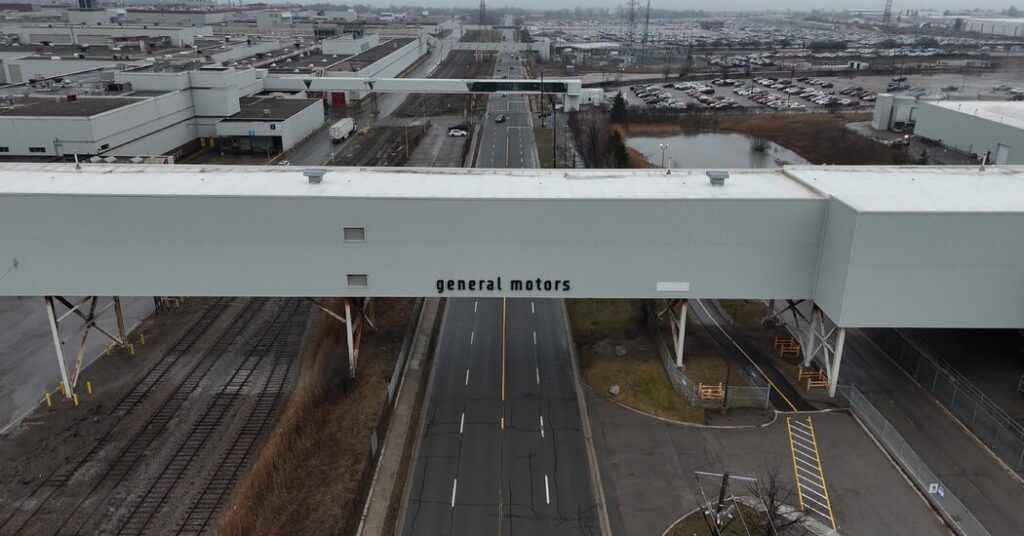
When General Motors of Canada underwent a model changeover in 1999 at its sprawling factory complex in Oshawa, Ontario, the last Chevrolet Lumina to come off the line went on a monthlong farewell tour. It was wheeled around the factory, and employees signed their names in permanent marker on its white paint.
No one at the Canadian Automotive Museum in Oshawa, where the Lumina is now displayed, has counted the signatures. But in 1999, roughly 22,000 unionized G.M. employees could have taken a pen to the car.
G.M.’s dominance of Oshawa, east of Toronto, for nearly a century was part of the giant footprint U.S. automakers long enjoyed in Canada — a presence that has gone into a steep, accelerating retreat as President Trump wages economic war against Canada.
Across the river from Detroit, Chrysler, now part of Stellantis, once economically ruled the city of Windsor, Ontario, from its assembly plant. And Oakville, Ontario, part of the Toronto metro area, was practically a Ford company town, with two giant plants and corporate offices.
At the industry’s peak around the turn of the last century, cars and trucks, most made by U.S. manufacturers, accounted for nearly 40 percent of all exports from Ontario, Canada’s industrial center and most populous province.
The massive factories and the hundreds of thousands of workers they employed underscored the tight bonds between the United States and Canada.
For over 60 years, Canada’s auto industry had thrived from free trade agreements that sent much of its production to the United States. By ending tariffs, those agreements also made cars built in American factories affordable for Canadians, a boon to U.S. industry.
But Mr. Trump’s tariff campaign is shattering that dynamic, hollowing out the once-mighty Detroit-based carmakers in Canada. The future of a free-trade agreement that has knit together Canada, the United States and Mexico is also up in the air.
‘Writing is on the wall’
G.M.’s plant in Oshawa has shrunk to 2,100 union employees, about 10 percent the size of the work force nearly three decades ago.
The Detroit Three, once the only carmakers in Canada, last year produced just 23 percent of the 1.2 million cars and trucks that came out of Canadian factories, largely supplanted by Asian automakers.
A decade ago, American companies accounted for 60 percent of auto assembly jobs in Canada, but by 2024 that figure had fallen to 38 percent, according to a study by the Trillium Network, a manufacturing analysis group at Western University in London, Ontario. That percentage is likely to fall further after a recent series of plant closings and layoffs.
The fundamental question is now: Do U.S. auto companies have any future in Canada?
“We know that the writing is on the wall in terms of the decline,” said Dimitry Anastakis, an economic historian at the University of Toronto. “Whether that means complete demise is a different kettle of fish.’’
Mr. Trump’s blow to automakers in Canada is not just from tariffs. His turn from electric vehicles has also unraveled incentive deals, worth billions of dollars, that Canada gave carmakers to shift away from internal combustion engines.
Since Mr. Trump took office last year, Stellantis abandoned plans to make a gas and electric Jeep in Brampton, Ontario, moving production to Illinois, and sold its interest in an electric vehicle battery factory in Windsor.
G.M. stopped building electric vans, emptying a factory in Ingersoll, Ontario, and also cut jobs and production at a plant in Oshawa.
Ford abandoned plans to make electric vehicles in Oakville and is refitting that factory to make large pickups.
The survival of what remains of the Detroit-based industry, according to people in the industry, politicians and economists, rests largely on the fate of the U.S.-Canada-Mexico trade pact now under review.
Making investment decisions is challenging “because there is no certainty around the rules of the game,” said Brian Kingston, president of the Canadian Vehicle Manufacturers’ Association, the Detroit-based companies’ trade group.
A return to a tariff-free system should be an essential goal in negotiating any new agreement, he added.
But Mr. Trump has shown no inclination to reduce or eliminate a 25 percent tariff he imposed last year on Canada’s auto industry, and has said he wants manufacturing returned to the United States. “We don’t need their Cars,” he wrote on social media last year.
Prime Minister Mark Carney’s government, which did not respond to requests for comment, has been angered by some U.S. automakers’ moves away from Canada. The government is demanding that Stellantis abide by commitments it made to retool its Brampton plant in exchange for receiving government money.
But Mr. Carney, as part of his quest to minimize Canada’s economic reliance on the United States, is also looking elsewhere for help.
He has cracked opened the door of the Canadian market to Chinese electric carmakers, which have been effectively shut out of Canada and the United States by 100 percent levies, allowing a small number of cars into Canada at a relatively low tariff rate.
Mr. Carney also made an agreement with South Korea to explore bringing that country’s industry to Canada.
U.S. automakers in Canada had been hurting well before Mr. Trump’s tariff volley. Japanese cars eclipsed American-made cars in popularity as Honda and Toyota rose to prominence in the 1980s.
And NAFTA, the North American free-trade agreement that preceded the current pact, made it harder for Canada to compete because labor costs were significantly lower in Mexico.
Cross-border carmakers
While existing U.S. tariffs threaten the viability of Detroit-based carmakers in Canada, more than 120 years ago levies, along with geography, gave birth to the Canadian car industry.
At the start of the 20th century, Gordon McGregor was running a failing horse-drawn wagon works in what is now Windsor. His plan was to move into Canada’s nascent auto industry.
At the time, Canada imposed high tariffs on U.S. goods, seeking to prevent its industries from being overwhelmed. McGregor, as a former duty collector, knew levies on auto parts were significantly lower than for finished vehicles.
He saw an opportunity.
McGregor crossed the river to Detroit and cut a deal with Henry Ford.
In 1904, just a year after Ford had opened his company in Detroit, Ford parts were being turned into Model C cars at the new Ford Motor Company of Canada.
McGregor was in the car business. And Ford had not just found a way into Canada, but could also use the Canadian plant to export cars to all of Britain’s former and current colonies at low tariff rates.
Another Canadian family with a carriage works in Oshawa made a similar arrangement in 1907, with the Detroit-based Buick, to import American-made parts and produce vehicles in Canada.
While Canadian carmakers, unable to compete with Ford’s Model T, came and went, American companies flourished. By the 1920s they dominated Canada’s auto industry.
But it was not ideal.
The Canadian market was relatively small and meant factories operated at inefficient production levels.
Limited technology forced plants to effectively build a single model, which transformed into several ostensibly different models with minor cosmetic changes. Canadian shoppers ended up with fewer choices and higher prices than U.S. buyers.
By the late 1950s, the low tariffs with Britain had also become a problem as it began exporting many cars to Canada to build up its vehicle industry after World War II and pay off war debts to Canada.
In response, Canada placed new tariffs on British cars. Then it took a much more consequential step. In 1965 it entered a landmark trade agreement with the United States known as the Auto Pact.
It was not pure free trade. Instead, American-owned manufacturers were basically allowed to import one vehicle duty free from the United States for every vehicle they made in Canada.
But the result was explosive. Focusing on producing models for both Canada and the vast United States market, G.M. was soon building 500,000 cars a years in Oshawa, about 110,000 more vehicles than all carmakers in Canada combined had churned out in 1960. Canadian production peaked at 3.1 million vehicles in 1999.
Those glory days are over.
Last year, 1.2 million vehicles came out of Canadian plants, about three-quarters from Toyota and Honda.
The collapse of U.S. automakers in Canada has cost thousands of jobs in recent years. “We’ve lost more jobs in Canada in the auto sector over many decades than the U.S. has lost in on a proportional basis,” said Lana Payne, the president of Unifor, the union that represents workers at the Detroit automaker factories in Canada.
“Canada is a very small player in a very big game,’’ Professor Anastakis, the economic historian, said, “so you could say it’s amazing we’ve maintained as much as we’ve had for all these years.”
“But if you can’t make money,” he added, “it doesn’t matter. These are not charitable operations.”
Ian Austen reports on Canada for The Times. A Windsor, Ontario, native now based in Ottawa, he has reported on the country for two decades. He can be reached at [email protected].
The post Detroit Once Ruled Canada’s Car Industry. Trump’s Tariffs May End That. appeared first on New York Times.