LUANDA, Angola — Christianity is flourishing in Africa. But what shape it will take for most believers is an open question.
In the moments leading up to Pope Leo XIV’s arrival in the capital of Angola last month, the streets were buzzing with excitement as men and women sporting T-shirts emblazoned with his face prepared to welcome the man that Catholics regard as the Vicar of Christ, or the representative of Jesus on Earth.
Rosario Avelino Salvador, a former Catholic, was unimpressed.
As he drove through Luanda’s downtown, he explained his journey from loyal Catholic to devout evangelical — the same journey that myriad Angolans have made in recent decades and a window into one of the biggest threats to Catholicism today, even on the continent where the religion is growing most quickly.
“Before, I wasn’t connected to the religion,” said Salvador, a father of four who joined the Church of the Kingdom of God in Angola, an offshoot of a rapidly growing church headquartered in Brazil — where it is part of a new wave of evangelical, Pentecostal churches that are booming in the world’s most Catholic country by population as it undergoes a religious demographic transformation of its own. “Now, I know the truth that can liberate me.”
One of those truths, he said, pointing a finger for emphasis as he repeated an age-old critique of Catholicism, was that only God should be worshiped.
“The pope,” he added to make sure his point was clear, “is a human.”
(Catholics also contend that God alone should be worshiped, while saints are due veneration and the pope obedience and respect.)
Leo’s tour of Africa, which ended last month, put on display the centrality of the continent to the Catholic Church — and the challenges it faces as Africa emerges as the leading battleground for competition between organized faiths. Christianity has surged in Africa over the past 50 years, increasing from 39 percent of the population in 1975 to nearly half last year, with the number of Catholics increasing from 54 million to 271 million, according to the World Christian Database, which publishes detailed estimates of religious affiliation based on census data, surveys and other sources.
But Pentecostal/charismatic faiths, a category that includes some charismatic Catholics but in large part Protestant evangelicals, grew even faster, going from 23 million worshipers in 1975 to 252.3 million last year — the largest gains in absolute terms of any Christian denomination.
Pentecostal churches often emphasize enthusiastic worship, personal conversion experiences sometimes described as being “born again” and practices known as spiritual gifts of the Holy Spirit, such as healing or speaking in tongues. Charismatic Christians worship in that style in non-Pentecostal denominations.
Scholars of religion say decentralized Pentecostal churches can expand more rapidly than Catholic parishes, which require priests to go through years of seminary study, as well as authorization of local bishops who report to Rome. Other differences come from the pulpit, with Pentecostal churches often known for livelier services and for embracing the “prosperity gospel,” or the promise of earthly riches through faith.
In Angola, a southern African nation of 40 million that is home to one of the oldest Catholic churches on the continent, Catholic leaders said they are concerned about the shift — and were hopeful that Leo’s visit might bring some people back into the fold.
Some Catholic prelates in the country have harsh words for their Pentecostal counterparts. “Today, a lot of humans are thirsting for God, but that thirsting is not always fulfilled in the best way,” Bishop Maurício Camuto said when asked about those who leave the Catholic faith to join Pentecostal churches, adding that some pastors present themselves as “the one who can solve all the problems.”
Alberto Segunda, who was born Catholic and now leads the Church of the Kingdom of God in Angola, said that he found “prosperity in every sense” after deciding to be born again in the evangelical church. But he said that sometimes the value of monetary prosperity is overemphasized or misunderstood.
“The most important thing is not prosperity itself,” he said, “but the soul’s salvation.”
Inside Salvador’s church on a recent Sunday morning, in a neighborhood on the outskirts of Luanda, the pastor’s voiced boomed from the altar.
“The Lord can connect you to your prosperity,” said Pastor Edipiel Santiago, who was speaking in Portuguese, which is the lingua franca in Angola, a former Portuguese colony. “All doors will open.”
Angola, which was a Portuguese colony until 1975, has immense oil wealth but also deeply entrenched poverty, making it one of Africa’s most unequal societies. The neighborhood where Salvador attended church, on the outskirts of Luanda, was one in which many residents were struggling, the pastor said from the altar, and growing frustrated with their continued struggles.
“You are inside a church, and you are asking, ‘Why don’t I see the results in my life?,’” Santiago said, adding that the solution was clear:
“Open your hearts and your spirits,” he said, “completely.”
While most Catholics eschew the notion of financial rewards as gifts from God, scholars of Christianity say that promises of material wealth are more common in Pentecostal churches.
With promises of prosperity, in some parts of the movement, have come accusations of fraud. Across the continent in recent years, including in South Africa, Cameroon and Rwanda, Pentecostal religions have been rocked by allegations of scam preachers. In Angola, the government closed Universal Church of the Kingdom of God churches in 2020 after a group of Angolan pastors accused leadership in Brazil of corruption.
The Catholic Church, meanwhile, has struggled with its own share of scandals, including its response to instances of clergy sexual abuse and accusations of financial opacity.
Under Segunda, the Angolan churches reopened, with their slightly changed name and more autonomy, but he said they are still spiritually connected with the main church in Brazil, which counts at least 8 million followers. Segunda estimated that in Angola, the number of church members has gone from about 3,000 when he joined the church 30 years ago to more than 500,000 today.
Pastor Bartolomeu Adelino Bango, who has been part of the universal church in Angola for 32 years, said that church leaders have tried to focus “more on the spiritual side” in recent years and less on “materials.” He said that sometimes there is too much emphasis placed on the prosperity gospel by those who do not understand the religion.
“There are so many people that will go so many years with nothing,” he said, so concentrating too much on the prosperity gospel can ultimately “lead to spiritual blindness.”
Salvador’s mother, who was also raised Catholic before joining the Pentecostal church, said that she still feels “half Catholic” and would have gone to see Pope Leo’s Mass if her car had not broken down — a common sentiment in countries undergoing Catholic-to-Protestant religious demographic change, in which cultural and religious elements of Catholicism often live on alongside Protestant practices. But she said she followed her son and his wife to the universal church, because they all felt more connected there to the religion.
“When the Catholic priests talked to people, they would just read and not tell us where to look in the Bible,” said Rita Salvador, his wife. “And they don’t explain it well.”
José Luís Barata, another former Catholic who was in the congregation that Sunday, said that he hadn’t been drawn to the church because of promises of prosperity, but because it gave him hope at a moment of crisis when he most needed it.
“They believe Jesus is our savior, and that with him, nothing is impossible,” he said.
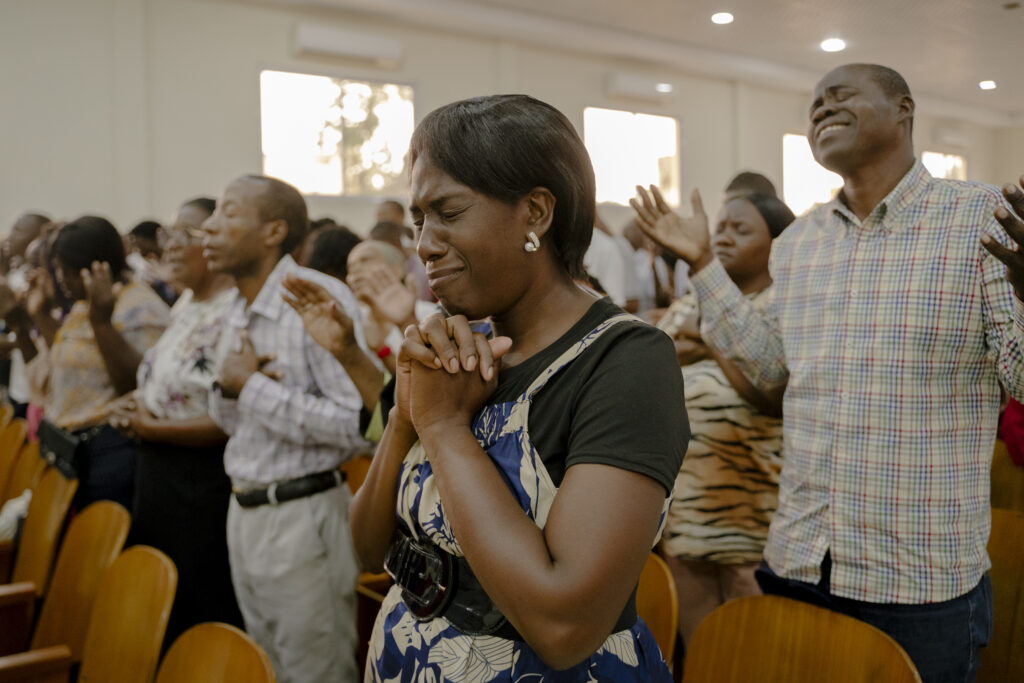
In Bango’s church on a recent Sunday, “Hosanna” was blasting, pew after pew of worshipers raised their hands and closed their eyes, swaying back and forth in prayer. When livelier hymns came on, they busted into full dance, an usher shimmying through the marble aisles, twirling a few women as he went.
In between bursts of song, calls for donations to the church went out. A few dozen men and women reached for their purses and wallets, filing into the aisle to drop notes and coins into the bag and receive their blessing.
Diógenes Godinho, 50, said he joined the church at the request of his sister, hoping to feel more connected with religion. In Catholicism, he said, it felt like the priests were dictating everything, like he was never asked to touch the Bible himself.
“Religion is like school,” he said, “and I wanted to study it.”
But as a member of the Universal Church of the Kingdom of God for eight years, he said he was astounded by what he saw: people giving away money, cars and even houses to the church, believing that after such gestures, “they would then profit. It was about making sacrifices with what you have, then getting blessed with more.”
About six years ago, he said, after giving about 10 percent of his own salary to the church and watching others lose much more, he decided enough was enough. But asked whether he considered rejoining the Catholic Church, Godinho gave a shake of his head.
“No,” he said, “not at all.”
Instead, he joined another Pentecostal church. But this time, he added, he’s more cautious.
Herculano Coroado contributed to this report.
The post Africa is Catholicism’s future, but Pentecostal churches are growing faster appeared first on Washington Post.