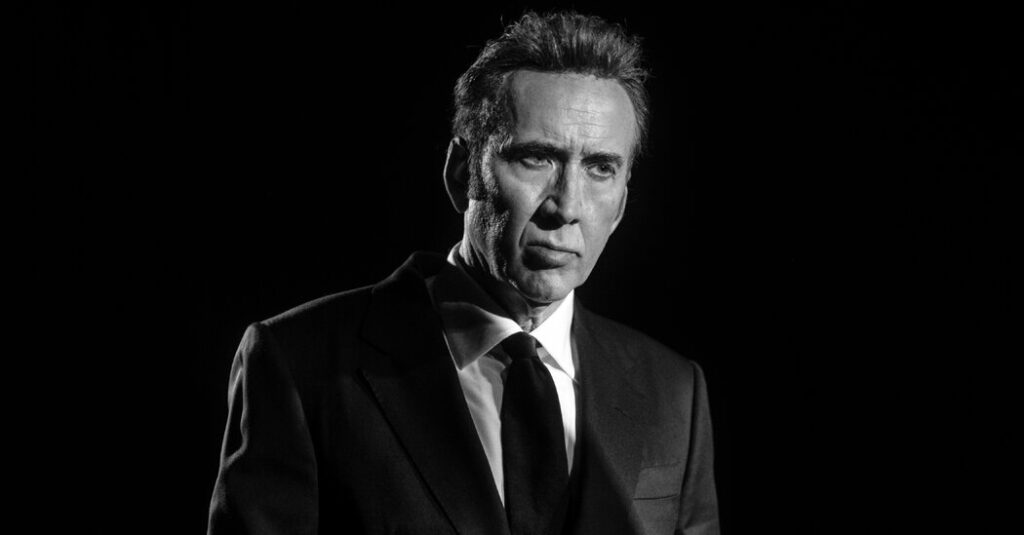
I’m just going to lay my cards out on the table: I believe Nicolas Cage is a truly special artist and the most original actor since Marlon Brando. It’s not only that he’s capable of delivering beautifully naturalistic performances, like in “Leaving Las Vegas” (1995), for which he won an Oscar for best actor, or that he has credibly jumped between romantic comedies like “Moonstruck” (1987), action movies like “The Rock” (1996) and unclassifiable films like “Adaptation” (2002). It’s that he brings a distinctly postmodern, wildly imaginative and thrillingly risky approach to all of it. (This fall he’ll be playing the title role in David O. Russell’s “Madden,” about the iconic N.F.L. coach John Madden.) Cage’s outsize style — which has led to his work being frequently memed — also pulls in references from other films, painting and music, both highbrow and lowbrow, and has taken acting far beyond limited notions of verisimilitude or even, frankly, traditional judgments of good or bad.
The same devotion to originality shows up in his life offscreen, too. Cage, who is 62 and whom I previously interviewed in 2019, is, to be fair, a bona fide eccentric. His idiosyncratic interests, lavish spending habits and free-spirited nature are, in their own way, as legendary as his highly distinctive performances and at times have threatened to overshadow his groundbreaking artistic legacy. (I’m far more interested in the latter, but the former is still pretty intriguing!)
What else can I say other than there’s no one like him. The latest evidence is the new series “Spider-Noir,” based on a Marvel comic and available to watch in either color or sumptuous black and white. The show, premiering in the United States on MGM+ on May 25 and globally on Prime Video on May 27, is Cage’s first big foray into TV, and in it he plays Ben Reilly, a hard-boiled private investigator in 1930s New York who also happens to be a web-slinging superhero. The resulting mash-up, like so much of this interview, is gloriously weird, and perfectly Cage.
Subscribe: Apple Podcasts | Spotify | YouTube | Amazon | iHeart
I just watched the speech you gave to graduates at Cal State Fullerton 25 years ago. In that speech, you said, “Artists have the license to go straight up the devil’s ass, smile at him and survive.” When have you done that? I did it on “Bad Lieutenant” [2009] with Werner Herzog. Werner was an influence on that particular speech because he said: “If you don’t have the money to make the movie, you have to steal the camera and steal the film and make the movie. Do it any way you can.” I think it was saying something about passion, about facing the odds to get to the truth of what you hope to express as an artist. Sometimes you have to be willing to allow your psyche, your imagination, to go to very dark corners of your thoughts in order to convey a truth so that it doesn’t feel phony. I think that’s partially what I was talking about in that speech about going up the devil’s ass. It’s not always a fun process to go to that dark corner of your mind, or even look around you at current events in a newspaper to get to that place where you feel the emotion.
Have you ever looked at current events to motivate a performance? Certainly. I remember specifically on a little movie I made called “Joe” [2013] I was having trouble getting to that feeling of intense anger. And I recalled a newspaper article I read about a little boy who was at the zoo. He fell into a cage or an environment of African painted dogs and they ate the child alive. I remember getting very upset. How could something like that happen? And in a scene in “Joe,” I was upset that this child that I was mentoring was the victim of abuse. So I went and looked at that current event. It got me there.
Something else in that Cal State speech that really stuck with me is how you talked about a willingness to invite negative reaction to the work, a willingness to be despised. You said that when somebody has a negative reaction, it’s genuine, and a genuine reaction is something you’re striving for. I think about that a lot. If you’re only doing something that people like, it’s possible you’re not taking them on an exciting enough ride. But it takes courage to be willing to be despised or laughed at or misunderstood. When did you realize you were willing to elicit that kind of reaction, or maybe even drawn to it? I think it was on “Peggy Sue Got Married” [1986], which everyone knows was a movie that I did not want to partake in. I found a way — and the powers that be said OK — to play the part in a way that I thought would be interesting to me, which was to use this voice that was not considered very attractive and to change my appearance where it almost became like a cartoon. I knew that was not going to go over very well. At the same time, it’s what kept me interested. I knew that I was taking an enormous risk, but it was so exciting every day I went to work. Everyone around me was like, “Stop, stop, stop,” and I just kept going. I’m very happy with that performance, but in the process, I knew I was going to invite a lot of negative commentary.
After “Peggy Sue Got Married,” you did other performances where you were taking things to places that were probably going to be misunderstood. Was that because you liked what you’d done? It was a personal choice. Francis Bacon famously said that it’s impossible to record anything as a fact without causing some injury to the image. So I was actively looking for the grotesque, like a Bacon painting. “Vampire’s Kiss” [1989], even “Raising Arizona” [1987], I was challenging Joel and Ethan [Coen] because I was sticking to my plan that my character, H.I. McDunnough, was going to have this Woody Woodpecker, Looney Tunes style, which they originally liked, but there were days when they were frustrated and were like, “I could’ve cast this person, I could’ve cast that person.” I finally just said, “Why’d you hire me?” That stopped that conversation. The results are terrific. Joel, Ethan, myself and Holly [Hunter] got somewhere together that was remarkably funny. But at the time, it was right on the edge. Then “Vampire’s Kiss,” I had a very specific vision. I wanted to bring a Max Schreck-like style to the ’80s yuppie attitude. This is before “American Psycho.” This literary agent is going to the best restaurants and he’s going on dates and then slowly devolving into a vampire. I wanted to bring out the Schreck-like behavior, and I did the horrible thing that I don’t need to go back to with the ingestion of that thing.
A cockroach. Right. That was me trying to make a big noise and say, We’re going to do something different.
One of the innovative things that you brought to acting was a postmodern, almost metatextual element. You take elements from genres outside of film and performance and import them into what you’re doing. For example, in “Face/Off” [1997], there’s a moment where your character gives a Francis Bacon-style look to the camera. Or in “Mandy” [2018], there’s a scene where you look quickly at the camera and the camera zooms into a close-up, like in a Bruce Lee movie. Are there similar examples of you doing that kind of technique that people have not noticed? I felt that the “Wild at Heart” [1990] performance was Warholian. Warhol would take these icons and do these marvelous collages with them. I thought, Why not do that with film performance? Which brings me to “Spider-Noir.” [Laughs] I can get there now or I can circle back.
Go for it. So, Duchamp’s shovel [the artwork is titled “In Advance of the Broken Arm”] started this idea in pop art of taking a utilitarian tool, isolating it, and we could regard it as fine art. Then you had Warhol doing that with the soup cans. I looked at all that, and then I looked at Lichtenstein. Lichtenstein embraced a mass utility in the comic strip and broke it all the way down to the little printing press dots, and threw it into a still life that became a kind of Seurat pointillism. But Lichtenstein was taking a comic graphic and making it fine art and almost being irreverent about fine art while doing it. So what I’m doing with “Spider-Noir” is taking the reverence I have for the actors that I cherish, like Bogart or Cagney, and trying to make a collision in such a way that I’m taking television, which is a mass tool that many people ingest, and I’m saying, Look at this! The hope is that a young person would go: “Oh, wow, what is that? That’s black-and-white. I’m not too familiar with black-and-white. I can watch it in color, but I can also watch it in black-and. … What is black-and-white? Oh, my gosh, there’s this immense volume of beautiful art that all these early actors were in. Let me check that out.” And oh, and by the way, he’s Spider-Man. So it’s like, Boom, this crazy Lichtenstein collision.
I have more questions about acting, but first, there’s something I was curious about related to spiders. I know you’ve had a lot of exotic pets. Have you had a spider? Oh, sure. I’ve had spiders, tarantulas. There is a spider that I found fascinating, which is listed as one of the more intelligent animals. It’s called the Portia spider. This spider literally knows what bugs like which tune on his web. So he knows what to play to get the fly and he knows what to play to get the grasshopper. That’s really something that exists!
This is slightly related: I read a Reddit “Ask Me Anything” you did a couple years back, and the subject of praying mantises came up, and you said, “Don’t get me started on the praying mantis.” Why not? Those aliens in the horror movie “Quatermass and the Pit” looked like praying mantises and it flipped me out. I was very impressionable as a child, which brings me to another reason I’m glad that I managed to finally do a season of television: Even before I discovered James Dean and Brando, I was all about the Zenith television in my living room. I wanted to get inside that TV, because those little people in that TV were far more interesting than the people in my living room. At the earliest age, the TV was the savior of my childhood.
Why “savior?” I don’t want to go into too much detail, but it was not the calmest domestic environment. I could escape by watching shows, or I could go in the backyard. Amazing how much time I spent in the backyard without anybody checking on me. I started digging a hole. I thought I was going to dig my way to China, and I kept digging and digging and digging, and nobody found the hole, and I had a shovel and I kept digging, and I saw roots and weird bugs, and I kept digging and digging. I would cover the hole with a plank of plywood, and then someone uncovered it and said: “Do you see what Nicky’s doing? Oh, my god, look at the size of this hole!”
Did you get in trouble? Yes, I did get in trouble for the hole. I got in trouble for the hole, and I got into trouble for jumping off ramps on my Huffy bike, going higher and higher. Evel Knievel was big back then. I remember at one point I was going to put on a show for the neighborhood and I would jump over beer kegs. I don’t know how I had beer kegs. I’d go over one, two, three, four on my ramp. Then I decided I was going to build a hoop of fire. I was going to build this round thing out of cardboard and douse it with kerosene and light it on fire. That was when they took the bike away.
Was that hoop-of-fire thing real? These are all true stories.
Let me return to acting. In an interview you did a couple of years ago the subject of retirement came up, and you said that you felt like you had pushed screen performance as far as it could go. What were the boundaries? I don’t think it was so much that I pushed it to the limit. I think I couldn’t come up with any more ideas as to what to do with it. I felt like I had realized what I had wanted to achieve with film performance with things like “Vampire’s Kiss” and “Raising Arizona” and “Adaptation.” I kept pushing the envelope, and I felt that I had said what I wanted to say with cinema, landing on “Dream Scenario” [2023], which I’m very proud of, and thinking: “How am I going to stay interested? What’s going to challenge me?” So I thought, Let’s do something interesting on television. David Lynch had done “Twin Peaks.” He took the mass tool of television and introduced surrealism to millions of people, which is immense. Halston did it. He was a genius designer and decided he wanted to take the mass tool of J.C. Penney, but the snobs in New York pooped on his head and it didn’t pick up. I thought, Well, what can I do? With “Spider-Noir,” I’m hoping that I will have instilled an interest in younger generations to enjoy the black-and-white style.
There’s a movie you did that came out in 2025 called “Gunslingers.” It’s a western, and your character does a voice that I would describe as “modern blues man.” [Laughs]
What was that voice? So what happened with that was, we had a back-to-back strike in Hollywood, and suddenly I got a phone call: “You need to do this movie right now or you’re going belly up.” I’m like, What am I going to do? I want to do this other movie, but they pushed. How am I going to be able to afford to do the other movie, which is called “Madden”? So the double strike hit, and I got the phone call and I thought, Oh, god, please, I don’t want to do another commercial. I had done commercials in Japan a million years ago and I got burned there because I thought it was for a toy, this little pachinko machine. I asked, “Is there anything wrong with this product in Japan I should know about?” “No, it’s a toy.” I said OK. I did the commercial, which was fun and goofy and slapstick, and I got to embrace my inner Jerry Lewis. But it was basically Japanese gambling. So I thought, I don’t trust commercials as a thing I should be doing. Plus, at the time I was going through this thing, like, What would Jim Morrison do?
What would Jim Morrison do? That’s terrible advice! Well, he would not do a commercial, but he didn’t live that long. So who knows what would have happened. I’m older than Beethoven was when he died, and Humphrey Bogart and James Dean and John Lennon and all of these heroes of mine. I’m still here and I didn’t know how I was going to be able to buy the time to get to “Madden,” and along comes “Gunslingers.” And I thought: OK, I’m a cameo in this movie. Let’s have some fun with it. I remembered going on “Dick Cavett” a million years ago with Miles Davis. Miles was like: [Miles Davis impression] “Nick! Where’s your leather jacket? Did you learn nothing from Dennis Hopper, man? What are you wearing that suit for?” I had this trumpet with me, and I wanted Miles to teach me how to play the trumpet. And then the trumpet fell down behind me. “Be careful with that instrument!” I got the trumpet but I couldn’t get a sound out of it. There have been three times in my life when I really felt that humiliating, embarrassed feeling. One was when I couldn’t get a sound out of a trumpet with the maestro. One was when I had to sing “Love Me Tender” to the president’s wife on a table at the Cannes Film Festival because David Lynch demanded it. And one was when I couldn’t get the tune right on a harmonica in a high school play. All three were disasters. But to answer your question, I was channeling what I remembered that I loved about Miles’s voice. Plus I wanted to wear a green bowler hat. I thought: If I can do a Miles Davis sound and a green bowler hat, I’m happy. So let’s make the movie.
I’m still trying to get over the fact you were ever asking yourself, What would Jim Morrison do? Did that ever go wrong? Probably. “Should I really have another whiskey? What would Jim Morrison do?” [Laughs] I’m a big fan of his poetry and his stage presence, his voice. His voice is so iconic it doesn’t sound real. [Sings the Doors’ “Touch Me”] “Come on, come on, come on now touch me, babe / Can’t you see that I am not afraid?” It’s so full, you know? My aunt knew him at U.C.L.A.
Talia Shire? Yeah, they would go for car rides and talk philosophy. He was a smart man.
And thus concludes the Jim Morrison portion of this interview. That’s probably best.
What can you tell me about playing John Madden? I don’t think you’ve played an iconic real-life character before. I really didn’t know who he was. I don’t have, in my view anyway, much in common with him. David O. Russell offered me a movie a million years ago. It was a good movie, and he offered it and I said no, and he’s the only director that I ever said no to who actually came back and offered me another movie. Most of them, they get their feelings hurt and don’t call you back. It’s happened a million times to me. It’s happened with Christopher Nolan, it’s happened with Woody Allen, it’s happened with Paul Thomas Anderson. They don’t call me back.
What movies did Christopher Nolan and Paul Thomas Anderson offer you? “Insomnia.” The Paul Thomas Anderson movie was a very early movie. He’d shown me a short film with Philip Baker Hall ——
Who was in “Hard Eight.” And we were going to do something and it didn’t work out. Anyway, David did call me, and it showed a lot of class that he would call me back and invite me again, and I didn’t want to say no to him again because I have great respect for his talent. And it was a beautiful experience. I enjoyed working with David. I enjoyed working with Christian [Bale], John Mulaney. But it was a big challenge. I don’t think of myself when I think of John Madden. So I was like, OK, how can I get way out of my comfort zone? Which is what David Bowie said to me. I asked him, “How did you keep reinventing yourself?” He said, “I just never got comfortable with anything I was doing.” That’s stayed with me.
In a movie called “Deadfall” [1993], your character, Eddie, looks to me like you’re doing a riff on Andy Kaufman’s alter ego, Tony Clifton. No, and I’ve heard that before. That’s not true. I wasn’t riffing Tony at all. I was doing my own thing, which is interesting because I saw a screening of that movie with Spike Jonze, who had directed me in “Adaptation,” and he loved that performance. Then I saw his Beastie Boys video for “Sabotage.” They’re all in these bad wigs and terrible sunglasses and they all look like Eddie from “Deadfall,” and I was like, I think I know where that came from!
Earlier, you pointed to “Dream Scenario” as being a culmination of what you were doing. In that movie you play a college professor who starts showing up in people’s dreams. Can you explain what was going on in that performance that makes you point to it as a kind of culmination? Because I was contending with this sort of memeification — I coined the word “memeification”; I don’t think it was ever used before — that I had lived through and needed to find a place to put it. And that was the perfect vessel because the memes were not unlike the dreams. And so the dreamification of my character in “Dream Scenario” was similar to the memeification of Nicolas Cage.
It’s interesting that you bring up “Dream Scenario,” because I was wondering if addressing the memeification was part of your motivation for doing the film. That movie came out not too long after you did “The Unbearable Weight of Massive Talent” [2022], in which you played a version of yourself; the character of “Nicolas Cage” was also contending with a public perception that he was uncomfortable with. In taking on films that directly addressed the memeification, were you trying to puncture it? Because I think the fever with that has broken since then. Not consciously. But that’s an interesting observation. Has it? I didn’t know that. What is a meme, really? I mean, what is that? Is it a snapshot of something that happened culturally? It’s interesting to look at that communication as a result of some of my performances, that it would land in cyberspace in such a way that my face in “Vampire’s Kiss” became the “You don’t say?” meme. I think I’m flattered by it — that it communicated and was remembered that potently that it got into a whole new technology that I wasn’t even aware of when I made “Vampire’s Kiss.” That’s how I’m choosing to look at it. It kept me in the conversation.
I have a slightly different theory for why some of your stuff got memed. Memes are the encapsulation of a particular feeling or sentiment. Similarly, the “Vampire’s Kiss”/ “You don’t say?” meme captures an emotion that people have in the purest possible form. That’s why it gets passed around: People use it as a shorthand for a feeling. Seen in that light, getting memed is a signal that you were doing your job correctly. I think that there is a need for a vessel for folks who are good citizens, who are doing their best to be upstanding members of the community, to live vicariously through and get their ya-yas out. I don’t know how conscious I was of it, but that has communicated through some of the meltdown performances in my work, where people can tap into it and live through it without having to go and do it. Whether it’s “Matchstick Men” [2003] in the pharmacy — “Would you like me to take you out on the street and piss blood?!” — or flipping out in “Vampire’s Kiss” or whatever it is. Perhaps that more than anything else is what has enabled me to endure. James Dean, when he did “Rebel Without a Cause,” he was speaking to me. I was 15 when I discovered that. I knew what that felt like. So as a person that enjoys being an audience member, I find actors have helped me find my own identity or understand what I was going through in my own life. It happened with Bruce Lee. It happened with John Travolta and “Saturday Night Fever.” It gave me a feeling of, Oh, I can do this.
Did you ever tell that to your “Face/Off” co-star John Travolta? Sure. What’s funny is, I was going to Horace Mann Elementary School [in Beverly Hills], and I used to go to the tropical aquarium store. Even then I was interested in fish. I had these two buckets of tropical fish in my hands and I had on the T-shirt with no sleeves, walking with the buckets. And I thought I was Tony Manero from “Saturday Night Fever” walking down the street, and lo and behold, I’m at the stoplight waiting to cross near the school and up glides John Travolta in a blue Adidas track suit and a gold 250 SL Mercedes. And he’s looking at me and I’m looking at him like, Oh, my god, I am you right now with my buckets of not paint but fish. That happened.
Can I do a rapid fire “Nicolas Cage lore” series of questions? Let’s have it.
In “Vampire’s Kiss,” you asked to have hot yogurt poured on your toes during the sex scene? There was some yogurt. There wasn’t hot yogurt, and I think I was administering the yogurt to myself.
But why? I don’t really remember.
It’s better that you don’t. Probably.
OK, next. There was an old Playboy interview from the ’80s, and in it there’s an offhand reference to you stealing an aquarium from the Museum of Modern Art. Did that happen? Well, it wasn’t an aquarium. It was in California, and it was in the trash. It was a Lucite box that covers artifacts. I just took it — and used it as an enclosure for a king snake.
So not stealing, technically? No, not really. Trash picking.
Last one: Apparently at Graceland, there’s a private family-only area. I read that you were granted access to the private area and tried on some of the King’s clothes and sat in the bathroom in the same position that Elvis was in when he was found dead. Is that true? No, that’s not true at all. What is true is that my ex-wife Lisa Marie Presley and I, there were a couple of nights at Graceland where she wanted to go upstairs, and so I did. I remember lying in Elvis’s bed, and he had one of those little fiber optics things that spin and change colors. I remember staring at that and being very relaxed by it and calmed by it, and I enjoyed thinking of him looking at that and how it must have relaxed him. It was a beautiful, poignant little moment in my life.
OK, so acting is all about choices, and you’re known for making unconventional ones. I assume that in art, you’re able to be very intentional and decisive about the choices you make. Are you able to access that kind of control in life? That’s a pretty astute question. It’s no secret that over the years, particularly early on, I had a lack of impulse control. Probably shouldn’t have bought that car or shouldn’t have bought that property. In art, the comedian in me is looking for the surprise. In my personal life — for example, when you met me seven years ago — I was more interested in other habits than I am now. I am extraordinarily boring now. I live a very monastic life. I am not taking any risks whatsoever. If I can avoid it, I am really going to go the other way. I am all about raising my toddler to have a happy and healthy life. I do have vices. I drink entirely too much caffeine. I’m drinking 200-milligram strawberry energy drinks six times a day. I’m not good with my phone, and the doom-scrolling’s gotta stop. But I’m not enjoying a martini, and I am not doing other things. So, to answer your question, I am not doing any unexpected things in life at the moment.
Early in your career you were interested in the idea of developing a mythology around yourself, of becoming larger than life. You achieved that. What was good about achieving that and what was challenging? Because you might be larger than life to other people, but it’s your life. Yes, when I began I wanted to cultivate this mythology around myself. That was before we had the internet. I didn’t have the means to imagine that one day it would become this thing we call memes or would go into different cultures around the world or whatever it is that the internet deploys. So it went beyond what I initially was trying to cultivate — a mystique, an aura, all that beautiful stuff that the black-and-white golden age, the Bogarts and Cagneys and Bette Davis had. The goal was to create that mystery. So can I say what’s the good thing? The good thing is it kept me in the zeitgeist. But is it perfect for me? No, because that’s not what the movie’s necessarily about — that little two-second moment. I don’t know if that’s what I had in mind. What I had in mind was movies like “Midnight Cowboy” and “Rebel Without a Cause” and “Last Tango in Paris.” I had in mind movies that you would go, and sit down, and watch.
This interview has been edited and condensed. Listen to and follow “The Interview” on Apple Podcasts, Spotify, YouTube, iHeartRadio or Amazon Music. Follow us on Instagram and TikTok.
Director of photography (video): Timur Civan
David Marchese is a writer and co-host of The Interview, a regular series featuring influential people across culture, politics, business, sports and beyond.
The post Nicolas Cage Made Himself a Legend. Then He Had to Live With It. appeared first on New York Times.