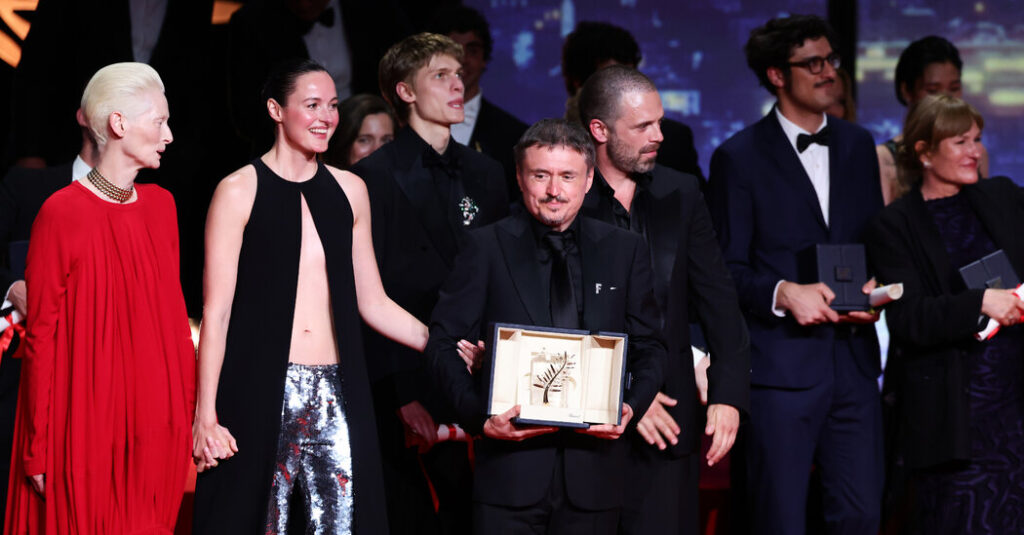
The 79th Cannes Film Festival came to a close on Saturday when the Palme d’Or was awarded to “Fjord,” the Romanian filmmaker Cristian Mungiu’s multilingual drama starring Sebastian Stan and Renate Reinsve as a devout Christian couple who are accused of physically abusing their children.
Speaking from the stage, and fluidly switching from English to French, Mungiu said he believed it was important for cinema to address “relevant” things, noting that today’s society “is split, it’s divided, it’s radicalized.” In “Fjord,” once child protection services opens an inquiry, an ostensible family matter becomes headline news and, in turn, a proxy war between religious conservatism and social liberalism.
The award is Mungui’s second Palme. He also won it in 2007 for “4 Months, 3 Weeks and 2 Days.”
This year’s festival was comparatively muted, particularly in light of last year’s strong lineup. The absence of the major American studios was a contributing factor, as was the lack of globally recognizable stars on the red carpet.
The absence of a critical favorite, especially in the high-profile main competition where films vie for the Palme, also added to the doldrums. As is always the case at Cannes, there was plenty to like and admire, but the word love was not heard all that often.
Three of the top prizes — those for best director, actress and actor — had two winners. Before he announced the Palme winner, the head of the jury, the filmmaker Park Chan-wook, referred to the diversity of the panel, which included the actress Demi Moore and the director Chloé Zhao, among others.
The Polish director Paweł Pawlikowski won best director for “Fatherland,” a prize that he shared with the Spanish filmmakers Javier Calvo and Javier Ambrossi, who made the time-skipping “La Bola Negra.” Set in different historical periods, the movie weaves together the stories of men whose lives are at times entangled. At the heart of the tale is an unfinished play from the writer Federico García Lorca, who was murdered by fascists at the start of the Spanish Civil War.
The more restrained “Fatherland” is a beautifully turned fictionalized drama about a real trip that the author Thomas Mann made to Germany in 1949. For a few awkward minutes, the multiple winners for best director seemed to throw off the event’s organizers, and Pawlikowski stood sidelined on the stage without an award.
“That was a piece of disastrous mise-en-scène,” Pawlikowski joked when he was finally able to address the audience.
Wars both past and present, and from across the globe, filled this year’s festival. The Grand Prize, effectively for second place, went to “Minotaur,” a ferocious exploration of personal and state power. Directed by Andrey Zvyagintsev, the movie transposes a French film — Claude Chabrol’s “The Unfaithful Wife” — to Russia in 2022 at the start of its full-scale invasion of Ukraine. As bombs fall, a wealthy Russian businessman back at home faces a series of marital and professional crises that he navigates with appallingly brutal self-interest.
“My message is clear,” Zvyagintsev — who lives in exile in France — told Le Monde before the festival. “This is a pacifist film that opposes the war waged on Ukraine by Vladimir Putin’s regime.”
The best actress award went to the stars of “All of a Sudden,” from the Japanese director Ryusuke Hamaguchi (“Drive My Car”). A deeply poignant drama, the film centers on the director of a care center for older adults, played by Virginie Efira, who strikes up an intense friendship with a Japanese playwright, portrayed by Tao Okamoto. The teary actresses held hands as they took the stage.
The best actor prize was given to Valentin Campagne and Emmanuel Macchia, who play young soldiers in the World War I drama “Coward,” from the Belgian filmmaker Lukas Dhont.
“The Dreamed Adventure,” a leisurely passed, engrossing drama written and directed by Valeska Grisebach, won the Jury Prize. Set in contemporary Bulgaria, it pivots on an archaeologist who, as she sifts through the dirt, excavates the past, revealing that there is more to her than her Mona Lisa smile.
Emmanuel Marre won the screenwriting award for his powerful French World War II drama “A Man of His Time,” about a bureaucrat in Vichy who, with deference and chilling amorality, eagerly helps keep the Nazi war machine running.
Manohla Dargis is the chief film critic for The Times.
The post Multilingual Drama ‘Fjord’ Wins Palme d’Or at Cannes Film Festival appeared first on New York Times.