THE DANGER TO BE SANE: Creativity and the Eccentric Mind, by Rosa Montero
There’s a reason that the adjective “tortured” so often accompanies the word “writer.”
In the spring of 1871, the 17-year-old Arthur Rimbaud penned a letter to a fellow French poet in which he described the creative act as something roused by a detached, observing self. “I is someone else,” he writes. “If brass wakes up a trumpet, it is not its fault. This is obvious to me.”The man who wants to be a poet, “looks for his soul, inspects it, tests it, learns it. As soon as he knows it, he must cultivate it!”
And the poet’s spelunking of the soul, as Rimbaud notes, can occur only through “a long, gigantic and rational derangement of all the senses. All forms of love, suffering and madness.” (Aspiring M.F.A. candidates: You might want to consider a career in dentistry.)
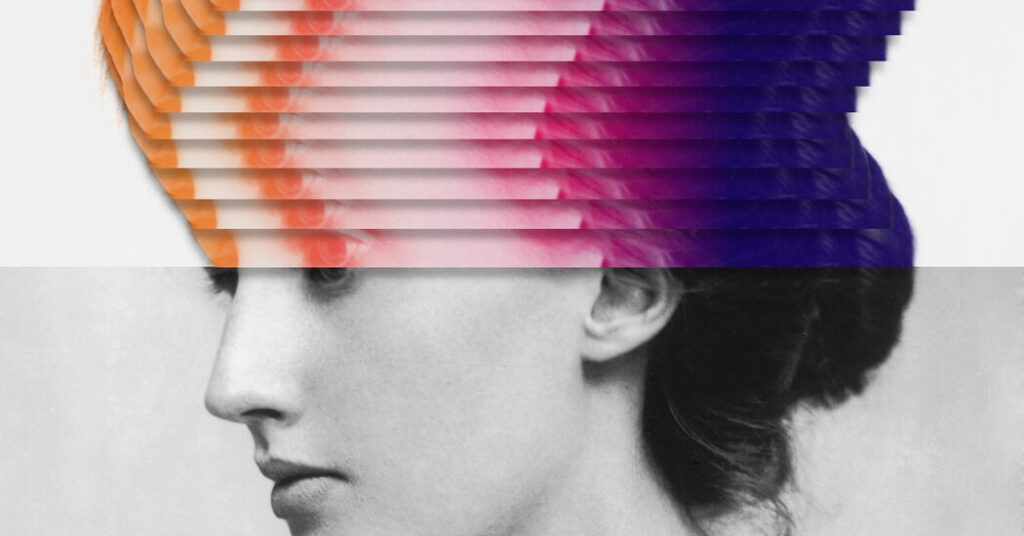
In her brilliant new book, “The Danger to Be Sane,” the Spanish journalist and author Rosa Montero delves into the connections between psychic turbulence and creativity in the lives of writers and poets throughout history, including Emily Dickinson, Marcel Proust, Virginia Woolf, F. Scott Fitzgerald, Janet Frame and Sylvia Plath.
Montero’s interest in glitchy neurological wiring is personal: “I’ve always known something inside my head didn’t work right.”
As she examines the minds of famous writers, alongside her own mental health struggles, unpacking why and how writing is borne of suffering, she blends cultural history, literary biography, memoir, philosophical musings, neuroscience research and grim stats: Writers, she says, are 50 percent more likely to die by suicide than the general population. This is probably not an ideal beach read.
Yet Montero is such an eccentric and delightful tour guide that her take on how the creative sausage gets made is utterly original and, ultimately, consoling. She avoids easy labels or post-mortem diagnoses, and is compassionate throughout. Acknowledging a tendency toward obsessiveness among novelists, she explains that it’s understandable, “because how else are you going to persevere for years, with stalactite patience, in the slow rumination of an imaginary story?”
She doesn’t romanticize suffering in the name of art. Nor does she land on a fixed explanation for why, exactly, writers write — but she does have her theories: Notably, the majority had early experiences of trauma, abandonment and catastrophic loss. (Sylvia Plath, who died by suicide at 30, once wrote: “Perhaps some day I’ll crawl back home, beaten, defeated. But not as long as I can make stories out of my heartbreak, beauty out of sorrow.”)
Whether “the attempt to transform horror into something valuable,” as Montero puts it, is “a death-rope or a lifeline,” as the poet Robert Lowell once described it, is endlessly complicated and elusive.
“The work is always on the prowl,” Montero writes, “just as madness is always on the prowl. It’s a question of who ends up winning.” Another factor too prevalent to ignore among writers is the plague of alcohol addiction, or what the author calls “a malicious, treacherous muse — an assassin who, before killing you, brutalizes you, humiliates you and robs you of your words.”
Although Montero concedes that her experience with mental illness are infinitely less severe than the “harrowing land of psychosis” inhabited by Virginia Woolf, the author knows what it means to endure “the sudden incursion of blackness” and the terror that comes with it. She compares her history of panic attacks to a slip and fall in the bathroom that breaks your back: “One second before, your life was normal and vertical,” and one second later, “you find yourself horizontal and broken, stunned, helpless, wounded by unspeakable pain.”
Woolf, however, continuously grappled with unspeakable pain, writing in her diary on March 8, 1941, “Oh dear yes, I shall conquer this mood,” 20 days before she ended her life.
That creative people, particularly writers, have weird brains is not news, but Montero’s approach proves fascinating and even suspenseful. She’s steadfast in her empathy even when exploring the most extreme emotions, impulses, and psychological quirks — including her own. Nothing shameful to see here. “Submit to being called a neurotic,” she writes. “You belong to that splendid and pitiable family which is the salt of the earth.”
In a 2025 NPR interview, the novelist Zadie Smith observed of the writing life that “you find out the things that are actually peculiar to you. That’s always the question … like, is this normal? Do you feel this? And sometimes the answer is yes, and sometimes the answer is no.”
Whether or not you’re a writer (but especially if you are), reading “The Danger to Be Sane” evokes something like joy and relief.
THE DANGER TO BE SANE: Creativity and the Eccentric Mind | By Rosa Montero | Europa | 256 pp. | $28
The post How Do Great Authors Transform Suffering Into Art? appeared first on New York Times.