People in Cuba are enduring food shortages, near-constant blackouts and suffocating heat.
For many, the only relief comes in packages from relatives hundreds of miles away in Miami.
As the island nation faces economic collapse under the U.S. oil blockade, South Floridians are rushing to ship boxes stuffed with canned meats, bags of rice and beans and other staples to hungry relatives. They are also sending mosquito nets, flashlights, fans and loosefitting nightgowns for coping with insufferable nights. Some pay off-the-books couriers known as “mulas,” or mules, who fly to Cuba to deliver goods or envelopes of American cash.
Jorge Smith, 64, who left Cuba for Miami four years ago, has been shopping for a stronger solar-powered generator for his daughter and her 5-year-old son in Havana. With electricity ever more fleeting, the 60-watt machine he bought and shipped them months ago no longer suffices.
“They only have two hours grid power a day,” said Mr. Smith, an Uber driver who, like many Cuban Americans, struggles to pay his own bills in an increasingly unaffordable Miami.
While he is deeply opposed to the Cuban government, Mr. Smith doesn’t agree with the blockade. “By cutting off the oil, they cut off the life of the people,” he said. “It’s the people who suffer.”
Cubans have long relied on relatives in the United States, who today can turn to informal couriers, multiple shipping companies in Miami and Amazon-style shopping sites that arrange deliveries to the island.
But demand has intensified as Cuba’s Communist government struggles to contain a catastrophic energy crisis. The island has all but run out of fuel for local transport, and its aging power stations are unable to keep its electrical grid running.
Oil shipments from Venezuela, Cuba’s longtime benefactor, were already dwindling before the Trump administration captured the Venezuelan leader, Nicolás Maduro, in January and asserted control over the nation’s oil industry. To pressure the Cuban government into collapse, the Trump administration then imposed a de facto blockade barring all foreign oil from reaching the island.
Cuban officials announced last week that its fuel oil supplies had been completely depleted. As part of its pressure campaign, the Trump administration on Wednesday announced it had secured an indictment against Raúl Castro, the nation’s former leader, for his suspected role in the fatal downing of two planes piloted by Cuban exiles.
Food for sale in both state- and private-owned Cuban stores has long been exorbitantly priced, said Michael J. Bustamante, a University of Miami historian who specializes in Cuban affairs.
“If you’re in a position to have family members on the outside that can try to get you stuff, you already have a leg up on a big chunk of the Cuban population,” said Dr. Bustamante, whose family recently helped arrange delivery of a wheelchair to an older relative with dementia.
Yet Cuban Americans find themselves in a delicate position. Many support President Trump’s pressure campaign, even as their families turn to wood charcoal to cook now that blackouts are far more frequent.
“I don’t want my son to suffer, but if that’s the only way to be free, well, I have to put up with it so that Cuba can be free,” said Tania Lompard, 66, who came to Miami from Cuba nearly two decades ago.
She and her husband recently sent 105 pounds of beans, canned ground beef and powdered milk to her adult son. The goods were shipped through Cubamax, a Florida chain that also serves as an online supermarket, travel agency and remittance company.
Such businesses are contentious in Miami.
They have described themselves as vital to delivering the type of humanitarian aid permitted under the decades-old U.S. embargo, which prohibits most exports to Cuba. The new oil blockade briefly disrupted the companies’ deliveries on the island this winter, but they resumed after the Trump administration began allowing private businesses to procure their own fuel.
Some Cuban Americans, including a number of elected officials, have criticized the companies, arguing that their business helps prop up the island’s Communist regime, and that the goods they ship include luxury items prohibited by law.
“Using those services means supporting the regime,” said Lázaro Campos, 42, who instead buys plane tickets for friends to visit Cuba with goods packed in long black duffel bags known as “gusanos,” or worms.
Cubamax executives did not respond to several requests for comment.
In South Florida, Mr. Campos scrapes by on whatever jobs he can muster: handyman, construction worker, delivery driver.
He supports three children in Cuba, one a 17-year-old who said that his school had stopped providing food, and that classrooms had become unbearable without fans. Mr. Campos also sends medicines for his elderly mother, who relies mostly on rainwater to drink and bathe after her town’s water pump broke. She lives on Isla de la Juventud, an island province where ferries delivering supplies have been cut back because of the lack of fuel oil.
Mr. Campos’s living conditions aren’t easy, either — he can’t afford rent, so he sleeps in his white Mitsubishi S.U.V. or crashes with friends.
For Ivis Cladera, the soaring price of gas has crimped her ability to send cash every week to her parents in the Matanzas province. She drives about 20 miles each way between her apartment in Hialeah, outside Miami, and her job at a casino in Hallandale. She earns less than $11 an hour, or minimum wage for servers in Florida.
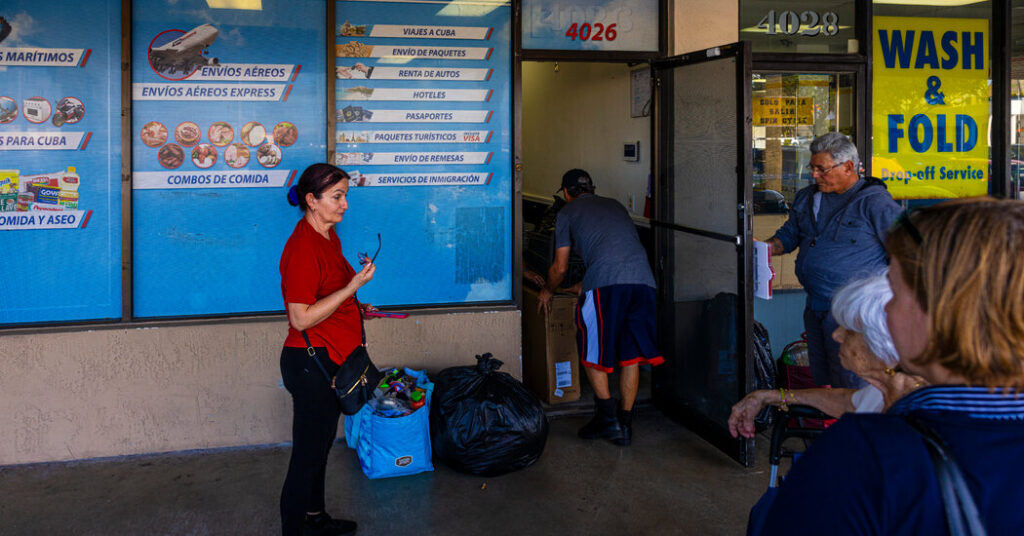
On a recent afternoon outside a Cubamax in Hialeah, Ms. Cladera was sending sterile syringes to Havana so her mother can inject her blood circulation medication. In Havana, her parents have virtually no electricity — but she doesn’t want to invest in solar panels to send them, as other Cuban Americans have done.
“It’s too expensive,” she said. “Besides, I’m hoping Communism will fall soon.”
The post Food, Flashlights and Fans: Floridians Step Up Aid to Cuban Relatives appeared first on New York Times.