ROANOKE, Va. — At the end of a long, narrow road nestled in the Blue Ridge Mountains sit two properties whose owners are both in the bird business.
One saves them if they’re hurt; the other sells them fried with your choice of sides.
The two longtime neighbors are locked in a bitter and costly legal dispute.
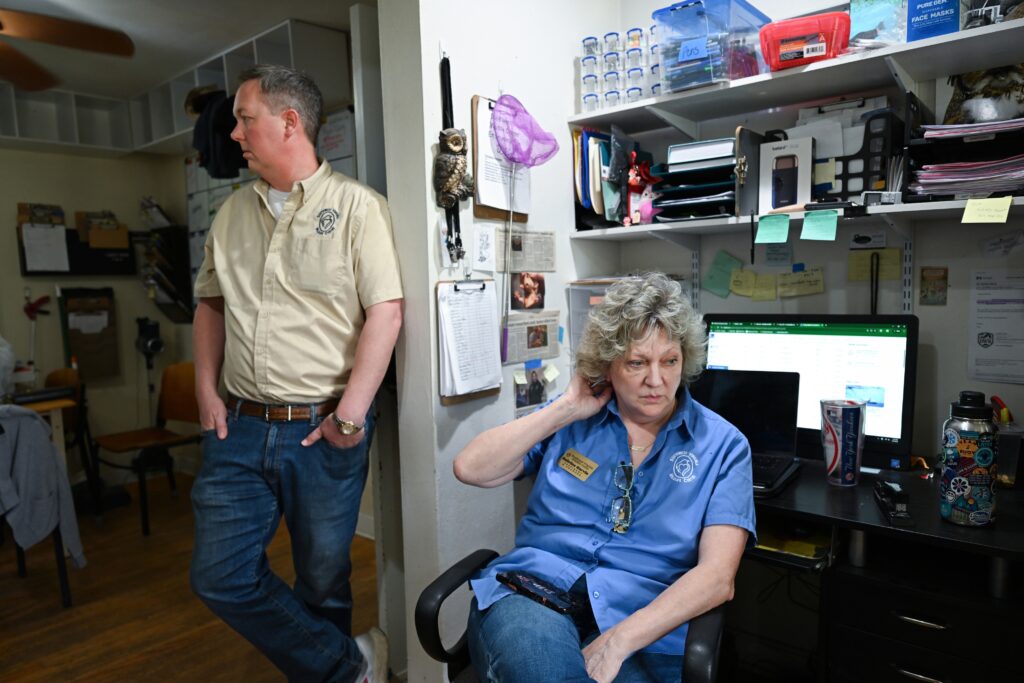
Chester Leonard rehabilitates wounded bald eagles and other large raptors at the Southwest Virginia Wildlife Center of Roanoke. Stan Seymour has found success through his 14 Bojangles fried-chicken restaurants. Locals refer to him by his nickname “Stan the Chicken Man.”
Their once-friendly coexistence on land accessible via the small road began unraveling eight years ago, when Leonard’s wildlife center set out to build an aviary for large birds of prey on its property so the raptors have enough space to stretch their wings and practice flying before they’re released back into the wild.
Since then, there have been claims of gunfire and a drone used to disrupt the center’s operations, vulgar name-calling online targeting Seymour and his wife, and the occasional middle finger raised in passing by other neighbors who have also become involved. Allegations of conspiracy, defamation and trespassing have swirled. And there are hundreds of pages in court filings debating noise, traffic, local zoning regulations and the legitimacy of a land easement from the 1930s that governs the use of their shared driveway.
Combined, the two sides have spent about $700,000 in legal fees in a battle now focused on whether one of Virginia’s few wildlife refuges should be allowed to expand.
“It’s strange,” Leonard said of Seymour in an interview. “He’s in the animal business. But I can’t get my head around why he’s so against us. We’re not doing anything dangerous or anything to harm the environment. … We’re literally just trying to save animals.”
Seymour has a different bird’s-eye view.
He said an aviary on the property would bring added traffic and noise to the area where he and his wife, Jane Seymour, have lived for 22 years. Roanoke County shouldn’t have allowed the center to operate there in the first place, he said, especially because to access the landlocked parcel, staff and visitors have to drive over a portion of Coleman Road that he and another neighbor own.
“Their cause is a good cause,” Seymour said about the center that rehabilitates 2,800 animals per year. “But the county shouldn’t have them there to begin with.”
The neighbors used to be neighborly — in part because they had to be.
Coleman Road sits on a slight hillside, surrounded by woods. It was once part of a single 40-acre property that was gradually sold and subdivided into individual lots during the 1940s.
The Seymours bought a parcel with a 1917 farmhouse on it in 2004. In 2006, they bought another nearby lot with a pond and built a custom four-bedroom home where they now live. One of their three sons lives on the farmhouse lot, Seymour said.
The ownership of the road, however, has always been complicated.
The first part of the road, which is paved, is maintained by the state; the rest is gravel and stretches across Seymour’s property and those of other neighbors. Under a 1930s-era private road easement, certain individuals are allowed to use the road to get to their properties, according to court filings.
In 2013, Leonard’s mom, Sabrina Garvin, and his stepdad, Lucky Garvin, bought the roughly three acres at the end of Coleman Road. After years of working long hours as a real estate agent and loan officer, she had gotten the necessary permits to become an animal rehabilitator and started taking in injured animals, setting up in their sunroom. But the operation quickly outgrew that spot. The couple converted the small ranch-style home on the property and opened the vet hospital and wildlife center.
At first, it wasn’t a big deal to share the road and pass by Seymour’s house — less than a quarter-mile away — to get to their wildlife center, Leonard said. They waved at their neighbors. When some local Eagle Scouts volunteered at the center and built structures to house animals, Seymour brought over a bucket of fried chicken and some sweet tea, Leonard said.
But the relations soured.
In 2017, after Jane Seymour, who was a personal trainer and CrossFit coach, hurt her back and started staying home more, she noticed how much traffic was coming up the road, according to her husband.
“That’s when she said: ”‘What the hell is going on up there? Why the hell are all these cars going up there and on the easement we own?’” he said.
That same year, Seymour said, he bought a second lot on Coleman Road that abuts the wildlife center’s property line. A year later, the Roanoke County Board of Supervisors granted a special use permit to the wildlife center that allowed it to build the aviary for large raptors.
“We thought he was going to be neutral, but when the aviary came into the picture, it all changed,” Leonard said.
Leonard said there’s a need for the large aviary because there’s an uptick in raptors brought in that are suffering from lead poisoning or other injuries, such as being struck by a car, and the property doesn’t have a large enough enclosure to help them all.
Eagles have a much larger wingspan than most raptors — averaging 6 to 8 feet — so they need a bigger indoor arena to practice flying and rebuild strength. Currently, the birds must be driven to other facilities that are at least two hours away, then brought back to Roanoke before being released to the wild. The back-and-forth, Leonard said, puts added stress on them.
“Having a center here where we can care for eagles will help us,” he said, “and help them.” Besides, he said, “People love eagles. They’re America’s national bird.”
Seymour isn’t swayed.
In the last eight years, he’s filed a series of lawsuits to try to stop the construction and essentially force the center to move. One case, regarding the board of supervisors’ issuing a special use permit for the aviary, went to the Virginia Supreme Court and was returned to a circuit court judge, who has not yet issued a decision. Another case dealing with access to the road to get to the center is likewise pending.
There is also a personal motivation.
Seymour said he ratcheted up his fight after seeing insults hurled against his wife of nearly 40 years on social media and hearing some at local baseball games or the grocery store. Supporters of the wildlife center, he said, have also picketed one of his Bojangles restaurants — which Leonard and his mother say they know nothing about.
One legal filing claims that Jane Seymour posted on Facebook that supporters of the wildlife center were “loonatics,” a comment some viewed as “threatening and intimidating.” Her husband said it was simply meant to be a bird pun.
“They started talking bad about my wife and my business,” said Seymour, who has twice run unsuccessfully for a seat on the board of county supervisors and employs 450 people at his restaurants. “That hardened it. They should not have said those things about my wife.”
“I’m not going to give up,” he said. “I’ll fight this to my dying breath.”
Seymour and another neighbor filed a defamation suit against the wildlife center. The center countersued, accusing Seymour and two neighbors of trying to drive it out of business by flying a drone too close to the animal cages. Another time, they allege, Seymour and neighbors participated in several hours of “repeated and exceedingly loud discharge of firearms.”
The group engaged in the “shooting episode” with “full knowledge and awareness” that the wildlife center was hosting a lecture by a regional bat expert for their staff and volunteers, according to the filing.
At times, the wildlife center said, neighbors who oppose them have blocked Coleman Road with logs, stones, gravel berms, and heavy ropes and chains. They’ve accused the Seymours of “immature and petty conduct designed to harass and intimidate” and “frustrate, vex and interfere” with their operations.
Seymour denied the claims in an interview. He said the shooting incident didn’t involve him. One of his sons had a friend on a skeet shooting team who had asked if he could come over to his property and target practice, he said.
“I’ve got 20 acres, so we’re legally allowed to shoot here,” he said. He added that he doesn’t own a drone.
The two sides have spent thousands in legal fees — about $450,000 for Seymour and $230,000 for the wildlife center. Roanoke County has also been pulled into the fight over the special-use permit that was granted. A county spokeswoman said the county had no comment on the pending litigation with Seymour.
Leonard said that dealing with Seymour and other neighbors who are opposed to the wildlife center’s expansion has felt like a “death by a thousand cuts.”
“He’s trying to bleed us dry with money,” Leonard said.
Recently, Sabrina Garvin said, she waved at some of her neighbors, just like in the days before the fight. The response was a raised middle finger, she said.
“It’s very aggravating because of the time we’ve spent and the money,” Garvin said, as she helped feed several rows of loudly chirping birds. “There are more important things in life.”
Razzan Nakhlawi contributed to this report.
The post Chicken joint owner and wildlife center, once friendly neighbors, locked in feud appeared first on Washington Post.