President Trump has fumed repeatedly about Britain’s failing to help the U.S. wage war on Iran. The United Kingdom responded by allowing U.S. bombers to strike Iran from southern England, while Britain’s fighter jets have flown thousands of defensive missions across the region.
Now the British military is embarking on yet another phase: to secure the Strait of Hormuz if the war comes to an end, dispatching an advanced destroyer to the region and another ship armed with autonomous mine-hunting equipment. The move to remove mines from the waterway could also serve to deflect further criticism from Mr. Trump.
The war with Iran was not Britain’s making, but the country cannot escape the conflict’s far-reaching effects. Halted traffic in the strait has crippled international shipping and driven up energy prices in the United States and around the world.
The British military took a handful of reporters on Friday to Gibraltar, a small patch of British territory at the tip of Spain. The trip seemed like an effort to highlight its military capabilities and resolve, and to show the Trump administration that a close ally was doing its part.
The special relationship the two countries enjoy has frayed on the surface since Mr. Trump entered the White House.
At Gibraltar, Al Carns, Britain’s armed forces minister and ex-Royal Marine officer with extensive combat experience, brushed off U.S. criticisms. He said that the U.K. had had “more jets in the Middle East than we’ve had for 15 years” and that “we’ve shot down over a hundred drones.”
He said Britain was leading the way in trying to resolve the acrimonious stalemate in the strait.
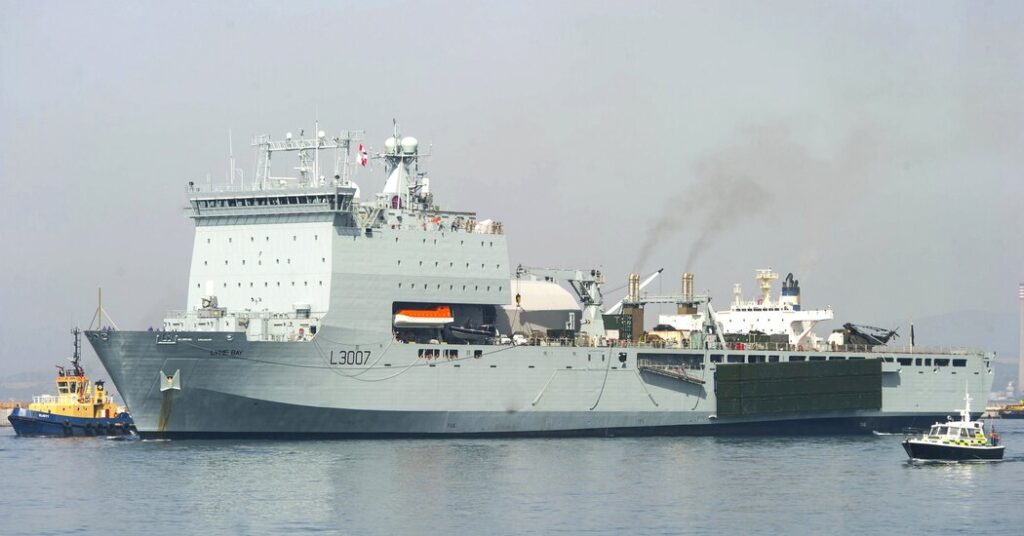
“Which other country can pull together 40 nations to come up with a solution to deal with a complex problem that we couldn’t predict because we weren’t involved in?” he said on the deck of the R.F.A. Lyme Bay, an amphibious landing vessel, as pallets of ammunition were loaded into its cavernous hull.
Around 850 large vessels, with around 20,000 seafarers, remain stranded in the region, waiting until it is safe to pass through the Strait of Hormuz, which carried roughly a fifth of the world’s daily oil supply before the war.
The R.F.A. Lyme Bay is at the center of British efforts to open the waterway if an agreement can be reached. The British military has been scrambling to outfit the ship with autonomous maritime systems — unmanned weapons for use on the sea — for the last several weeks. It will serve as the “mother ship” for the autonomous systems, the military said.
Britain has already deployed the H.M.S. Dragon, one of six destroyers, to the region. Once cleared to depart, the Lyme Bay will make its way there, too. Other countries are to send forces as part of what has been named a multinational military mission.
The French and British are leading the effort. This month France deployed its carrier strike group as part of the possible mission to open the Strait of Hormuz, while the Germans are sending a minesweeper in anticipation of an operation.
On deck of the R.F.A. Lyme Bay, two squads of British Navy mine-clearing specialists displayed their battery-powered autonomous sea drones for reporters. A smaller version of the drones can be deployed by two people in the back of a boat.
Another larger version of the submersible drones uses high-fidelity sonar systems to scan the seabed and can dive 300 meters, about 980 feet. The drones can drastically reduce the time it would normally take a traditional mine-clearing ship to do the job. An unmanned surface vehicle is used to deploy the drones.
Iran has a variety of mines, British military officials said, including ones that sit on the seabed and send gas bubbles to the surface, causing serious damage to a ship’s hull. The mines use magnetic, acoustic and light sensors to find their targets. A mine can include hundreds of kilos of explosives.
Naval Cmdr. Gemma Britton, who is in charge of the mine-clearing specialists on the Lyme Bay, said Iran has many deadly mines. Asked how many, she responded, “How long is a piece of string?”
“The less people we can put in the minefield the better,” she said. The commander added that the first goal upon entering the strait would be to carve out a 1,000-yard-wide shipping lane so boats could exit, and then add another for vessels traveling in the operation direction — a superhighway on the sea.
Whether the current efforts will be enough to satisfy Mr. Trump is unclear. Secretary of State Marco Rubio repeated the administration’s dissatisfaction with NATO on Thursday.
“I don’t think anyone is shocked to know that the United States, and the president in particular, is very disappointed at NATO right now,” he told reporters in Miami.
Adam Goldman is a London-based reporter for The Times who writes about global security.
The post Britain Preparing for Mission That Could Clear Strait of Hormuz appeared first on New York Times.