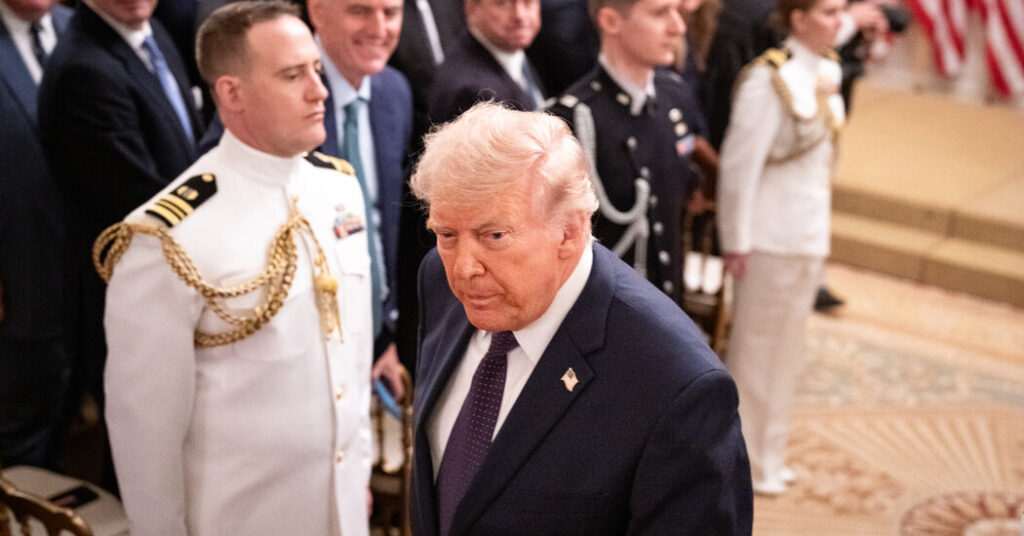
President Trump was in the Oval Office on Friday morning with his defense secretary, Pete Hegseth, in what appeared to be a review of military options for potentially resuming the bombing campaign against Iran.
The existence of the meeting was revealed by Gen. Dan Caine, the chairman of the Joint Chiefs of Staff, during a graduation ceremony at the Naval Academy. While he said nothing about the substance of the meeting, the timing was notable, as negotiations with Iran over its nuclear program and its blockage of the Strait of Hormuz appear to have hit a dead end.
There is no shortage of targets, should Mr. Trump, in coordination with Israel, decide to resume the assault on Iran that paused on April 8. There are energy facilities left untouched after about 38 days of bombing, the deep underground nuclear storage site at Isfahan where Iran’s supply of near-bomb-grade uranium is already under rubble, and missile sites that were attacked back in March but appear to have been dug out.
And after weeks of declaring that an agreement was near, and then that the Iranians were “dangling” him, negotiations seem to be at a standstill. Mr. Trump announced on Friday that he was skipping the wedding this weekend of his son and namesake, Donald Trump Jr., because of “circumstances pertaining to the Government, and my love of the United States of America.”
For Mr. Trump, the risks of resuming combat operations appear far greater now than they were in late February, when he ordered the first strikes in Operation Epic Fury, in coordination with Israel.
Now he has to deal with the reality that after five weeks of war and six weeks of cease-fire, he has failed to force Iran’s leaders to relent. Mr. Trump frequently notes — accurately — that Iran’s navy has been sunk and its air force destroyed, and that many of its missile sites and military bases have been reduced to rubble or badly damaged. But the destruction has not translated into victory.
Crucially, the near-bomb-grade nuclear uranium remains where it has been since Mr. Trump ordered a bombing raid on three nuclear sites nearly a year ago, deep underground at Isfahan. Iran’s missile capability has been degraded, but not destroyed. And the Strait of Hormuz has fallen under Iran’s control, even as the U.S. Navy intercepts shipments headed into or out of Iranian ports.
If Mr. Trump orders new combat operations, the political risks are high. Already gas prices are over five dollars a gallon in some parts of the country, and renewed military activity could send them even higher. Popular sentiment is clearly against the war, a range of public opinion polls show, and Mr. Trump’s approval ratings have plummeted to around 37 percent.
Still, he remains under countervailing pressure not to give in. “Further pursuit of an agreement with Iran’s Islamist regime risks a perception of weakness,” Senator Roger Wicker, a Mississippi Republican and the chairman of the Senate Arms Services Committee, said in a statement on Friday. “We must finish what we started.”
Here is what renewed action might look like, and the risks:
The Energy Sector
One clear option is to pick up where American airstrikes left off when the cease-fire took effect on April 8 by ramping up attacks against power plants, desalination stations, oil wells, roads, bridges and other infrastructure.
If Mr. Trump chose that route, it would mark a return to the strategy he considered in April, just before the pause. It was then that he warned, in a startling Truth Social post, that “a whole civilization will die tonight, never to be brought back again.”
The reaction was harsh. Many of Mr. Trump’s critics noted that striking largely civilian targets could constitute a war crime and mimic the kinds of attacks on Ukraine that President Vladimir V. Putin of Russia began in 2022. Pentagon officials say that military lawyers have reviewed hundreds of such targets and approved targeting only those with clear ties to Iran’s Islamic Revolutionary Guards Corps, to weaken and disrupt that pivotal pillar of power in Iran’s leadership hierarchy.
Bombing legitimate targets linked to the Revolutionary Guards, the administration’s thinking goes, would force the Iranian power brokers to make deeper concessions at the bargaining table.
The legal argument about what constitutes a legitimate target and an illegal one is complex. But there is no question that destroying power plants, bridges and desalination facilities could cause widespread suffering among the country’s population of 93 million. And it carries no guarantee that the Iranian government, known for its own brutal suppression of its people, would crack under the pressure.
Missile Sites
Trump’s military planners have weighed an intensive bombing campaign along the Strait of Hormuz to loosen Iran’s hold on the waterway, which carried roughly a fifth of the world’s daily oil supply before the war.
U.S. forces struck targets along the strait earlier in the war, but Pentagon planners faced hard trade-offs over which munitions to use. Senior military officials have privately raised alarm about critically low American reserves of long-range missiles and other heavy ordnance — the very weapons needed to destroy Iran’s hardened underground missile sites.
Instead of pursuing full destruction, the Pentagon opted for lighter munitions intended to seal off the entrances to those sites. But even that more modest objective has slipped out of reach. Classified U.S. intelligence assessments from earlier this month found Iran had regained access to 30 of the 33 missile sites it operates along the strait.
The picture beyond the waterway is no better. Intelligence reporting indicates that roughly 90 percent of Iran’s underground missile storage and launch facilities nationwide are now “partially or fully operational.”
Mr. Trump angrily refused to discuss those intelligence reports when questioned about them on Air Force One last week, as he returned from China. Yet as he weighs whether to reopen the war, Trump must decide whether to draw further from America’s thinning stockpiles in pursuit of more lasting damage to Iran’s missile program.
Highly Enriched Uranium
Among the military options Mr. Trump is weighing is whether to attempt a direct strike on Iran’s stockpile of highly enriched uranium, which as recently as this week he has said should leave the country, bound for the United States or another nation.
“We will get it,” Mr. Trump vowed to reporters on Thursday. “We don’t need it, we don’t want it. We’ll probably destroy it after we get it, but we’re not going to let them have it.”
But behind closed doors, officials say, he is debating another, less risky option than trying to seize the material: using massive bombs to destroy the stockpile, deep underground at a major nuclear site near the city of Isfahan, or to bury it further.
The New York Times reported in March that Iran had regained access to the stockpile, which had been buried under the rubble of the Tomahawk missile strike on Iran’s Isfahan nuclear complex in June. But at the time, there was no evidence any of it had been moved.
At the opening of the war, the United States and Israel refined a complex plan to put teams of commandos on the ground to retrieve the uranium. American Special Operations forces deployed to the region for the mission, and commando teams built a rough airstrip in Iran to haul out the canisters containing the material, which is enriched to 60 percent purity, just below what is ordinarily used in a nuclear weapon.
But the operation looked highly risky. If any of the casks, which could fit in a car trunk, were pierced and moisture entered, the material would become highly toxic to the commandos tasked with retrieving it.
Mr. Trump eventually vetoed the commando raid, over concerns about casualties and the clear possibility that extracting the uranium could be more difficult than military planners first assessed.
Now there is discussion of using the most advanced, deep-penetrating bunker buster bombs in an attempt to destroy the uranium in its underground storage bunkers.
The advantage of bombing the site is that presumably there would be no humans in the storage area deep underground if the casks are pierced. (Perhaps surprisingly, the material in the casks is only modestly radioactive, reducing the chances of widespread radiation contamination.)
But any strike would make it difficult to account for the stockpile, and thus to determine whether Iran had siphoned some of it to another location.
And if the airstrike merely sealed the enriched uranium underground again, it could complicate the process of handing over the 900 or so pounds of material in any final peace deal.
Targeting Iranian leadership
The United States and Israel could also decide to target Iran’s new leaders. In previous strikes, the Israeli military killed scores of Iranian leaders, their families and others involved in the country’s nuclear program.
Mr. Trump celebrated the death of Ayatollah Ali Khamenei, the supreme leader Israel killed at the start of the war, and has suggested the new regime is more moderate and willing to work with the United States.
But that has not been the case so far, and Mr. Trump has grown frustrated with the new Iranian leaders.
Mr. Khamenei was replaced by his son, Mojtaba Khamenei, a hard-line cleric considered the preferred choice of the Revolutionary Guards. Even as Mr. Trump has said the new regime is “very reasonable,” he has called the new leader an “unacceptable” choice, derided him as a “lightweight” and said he was “not happy” Iran had elevated him. The president has made it clear he thought he should have a choice in selecting the new leader.
Mr. Trump has also offered veiled threats against Mohammad Bagher Ghalibaf, the speaker of the Iranian Parliament who met with Vice President JD Vance in Islamabad for peace talks.
“We know where he lives,” he told ABC News in March. “Let’s put it that way.”
David E. Sanger covers the Trump administration and a range of national security issues. He has been a Times journalist for more than four decades and has written four books on foreign policy and national security challenges.
The post As Trump Weighs Return to Conflict in Iran, Here’s What Could Be Targeted Next appeared first on New York Times.