Vadim, like many other Russians, has relatives in Ukraine. Four years ago, as Russian troops besieged the city in the Sumy region where his cousins lived, he checked in with them regularly to ask about their safety.
Now, they are the ones checking in with him.
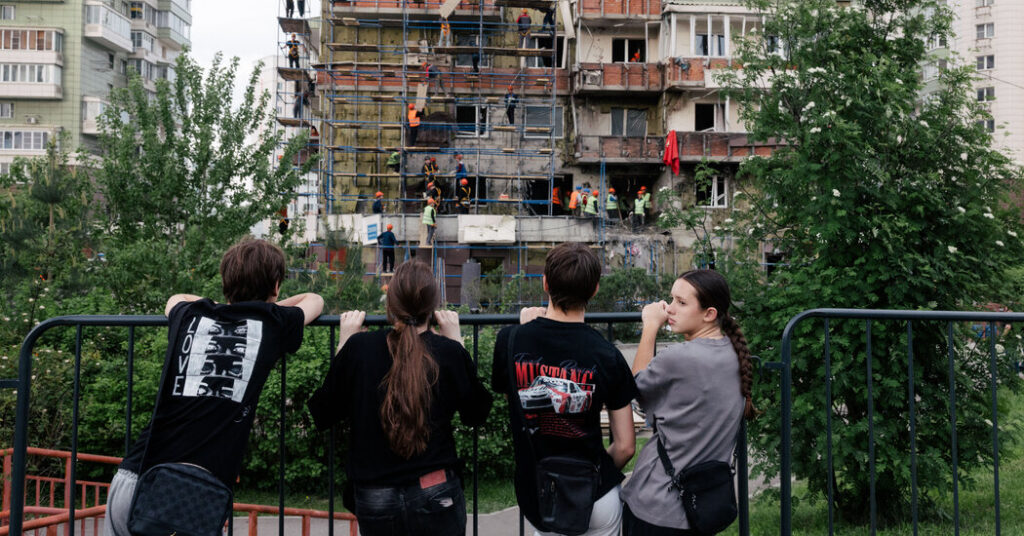
As Ukraine ramps up a campaign of long-range strikes on Russia, the war arrived this week for Vadim, if not on his doorstep, then on his roof. An exploding Ukrainian drone struck the top floor of his high-rise in the Moscow suburb of Khimki. Four people in all were killed and at least 15 were wounded in Ukraine’s attacks there on Sunday.
When I visited the suburb afterward, the broken glass had been swept into a corner. But residents were reeling as the conflict comes home to the capital region, the seat of the Kremlin’s power, which previously had been largely shielded from it.
Before now, “we didn’t really take the war seriously,” said Vadim, 21, who, like some others I spoke to, asked that his last name not be published for fear of official repercussions. “When it happens over there, it’s one thing. But when it happens to your house, of course it is real in a different way.”
Ukraine is using the large numbers of long-range drones and cruise missiles it now produces to conduct strikes up to 1,000 miles into Russian territory. With these attacks, Kyiv is turning the tables after Russia has targeted Ukraine’s civil infrastructure and killed thousands of Ukrainian civilians over more than four years of war.
The Ukrainian campaign is focused primarily on Russian oil infrastructure, aimed at cutting the main source of revenue for the Kremlin’s war machine, and factories that produce technology critical for weapons. While Ukraine says it targets only military-related sites, residential buildings both inside Moscow and in its suburbs have been hit in recent weeks, giving residents a taste of the much greater suffering civilians have endured in Ukrainian cities.
“It’s a total nightmare,” said Letizia Lorans, 53, a salon owner in Khimki. “Even now, when I remember it, my palms are sweating.”
She described running out of her house when she heard the first explosions overhead, fearing that she could be trapped in her basement if she stayed inside.
“It felt like they were swarming above us, and then exploding, for so long,” she said of the Ukrainian drones.
“I think I had a panic attack, and now when I go to bed I still have the thought of whether we will wake up or not,” she added.
She said that residents did not have a good way to receive warnings about incoming Ukrainian strikes, with no sirens or alert system, and with the widely used Telegram messaging app restricted by the authorities.
Instead, she watches whether air traffic has been closed at the nearby Sheremetyevo Airport, which she acknowledged was not an ideal way to stay safe or sane.
Outside Ms. Lorans’s salon, another resident said the drone strikes were among the reasons she was starting to change her mind about the war.
“I have already started wondering if it was really necessary to start this war, which has already lasted longer than the Great Patriotic War,” said Tamara Aleksandrova, 84, referring to the Soviet Union’s involvement in World War II.
Ms. Aleksandrova, who lives in a Stalin-era apartment building a few minutes’ walk from Vadim’s, gestured to a recently installed memorial dedicated to soldiers killed in World War II and in Ukraine.
President Vladimir V. Putin still calls the current war a “special military operation,” even after it has claimed the lives of at least 352,000 Russian soldiers, according to independent researchers.
Families of the fallen had brought photographs, some of which were already fading, and carnations to the memorial, which bears the inscription, “By protecting the past, we defend the future.”
“Look at how many young men died, and more and more are joining them,” Ms. Aleksandrova said.
Before the recent spate of drone strikes, discontent was already bubbling to the surface over war-related internet restrictions and increases in prices and taxes.
Across the country, 62 percent of respondents in an April poll by the independent Levada Center said they preferred imminent negotiations to end the war. That number was lower for residents of Moscow, at 36 percent, because of their relative isolation from the conflict, but the polling was conducted before the recent strikes.
“Ask anyone, and they all want the war to end as quickly as possible,” Vadim’s girlfriend, Masha, said as she puffed on a cigarette outside her building.
Masha, 19, described a youth interrupted first by the Covid-19 pandemic and now the war in Ukraine. “We can’t stop this war,” she said. “We can only hope that it ends as soon as possible.”
In the nearby village of Starbeyevo, where a drone strike caused a house to collapse, killing a woman and severely injuring a man, a young man described to me the evolution in his thinking about the war.
“When all this started, I was feeling patriotic, and rooting for my country,” said Danil, 19, a university student.
Now, he added, his pride is diminished. His hands trembled as he described hearing the explosions overhead during the previous weekend.
“I don’t want to think about who is guilty and who isn’t,” he said. “This feels like a big game, and we are just low down on the totem pole. I am just a simple person, and the only thing I have from this shitty war is constant nerves.”
Choosing his words carefully so as not to “discredit” the Russian armed forces, which can bring a prison sentence, he said he was developing a sense of “mistrust toward the state.”
In September, Russia is scheduled to hold its first parliamentary elections since the full-scale invasion of Ukraine, a stage-managed affair that will ensure a predetermined outcome.
The ballot box offers little outlet for Russians’ frustration, Konstantin Remchukov, the editor and publisher of the independent Nezavisimaya Gazeta, told me, “precisely because we lack the fine-tuned mechanisms to convert that anxiety into a political statement.”
Half an hour’s drive northwest of Khimki lies Zelenograd, one of Russia’s primary hubs for microelectronics, semiconductors and high-tech research. In the recent Ukrainian attacks, several facilities and residential complexes were struck there.
On Sunday, as black smoke billowed from a petroleum storage facility, a group of boys and girls gathered on the grounds of a church. They were there to practice their combat skills in a military-patriotic competition. They would see who could take apart a Kalashnikov rifle and throw grenades the fastest.
The rector, Father Dmitri Poleschuk, led a prayer before the competition. He said he believed that the strikes would remind people of the need for faith.
“When life brings trials — when drones are flying directly over your head — that is precisely when you begin to recall every prayer you know,” he said.
Near a high-rise that was struck, Maria, 44, said that in the past, drones flying toward Moscow had usually been shot down before they reached Zelenograd. Residents discussed whether they should take out special insurance policies against drone strikes.
Some in the city said Russia should not be deterred by the attacks. Aleksandr, 62, who lived for 35 years in the Ukrainian city of Odesa, where his pro-Russian older brother still resides, said he wanted Russia to fight on.
He spoke like the host of a state television program, denying the existence of a Ukrainian people and blaming the United States and Britain for inciting a war “to force Slavic brothers to kill each other.” The war is taking so long, Aleksandr said, only because Moscow is showing care for Ukrainian lives.
His solution? “We need to be tougher.”
Valerie Hopkins covers the war in Ukraine and how the conflict is changing Russia, Ukraine, Europe and the United States. She is based in Moscow.
The post ‘A Total Nightmare’: Voices From a Moscow Hit by Ukrainian Drones appeared first on New York Times.