Americans’ confidence in the economy is at a nearly four-year low, a new poll finds. Here’s what else happened under President Donald Trump and his administration this week.
You’re reading The 5-Minute Fix newsletter, a free analysis of the day’s biggest political news. Get it in your inbox every weekday.
Trump’s candidates are winning primaries
In Washington, Republican lawmakers are starting to resist some of Trump’s most controversial policies, like his new $1.8 billion payout fund. But Trump is commanding near-ultimate loyalty among Republican primary voters across the country.
Last month, voters ousted several Indiana state lawmakers who resisted Trump’s push to gerrymander congressional seats in that state. Last week, Sen. Bill Cassidy (R-Louisiana) lost his primary five years after having voted to convict Trump in his impeachment trial in the Jan. 6, 2021, attack on the Capitol. And this week, Rep. Thomas Massie (R-Kentucky) lost his primary after voting against Trump’s signature legislation and leading the effort to force the Justice Department to release the files on convicted sex offender Jeffrey Epstein.
“This is @realdonaldtrump’s Republican Party,” Rep. Randy Fine (R-Florida) wrote on social media after Massie’s loss. “The rest of us get the privilege of living in it.”
But Trump also took a big electoral risk this week by endorsing a controversial candidate in a bitter and competitive Republican Senate primary in Texas. He endorsed Attorney General Ken Paxton, who is challenging Sen. John Cornyn, ahead of a runoff next week. Paxton has been a loyal Trump supporter but the prevailing political wisdom is that if Paxton is the Republican nominee, Democrats have a real shot at winning a Senate seat in Texas this November — which would go a long way to helping them take back the Senate.
Trump is racing to build a giant arch, with questionable authority
Over opposition from courts, architects, preservationists and some military veterans, Trump is moving at warp speed to build some of the largest monuments and structures in all of Washington.
“The thing I do best in life is build,” Trump told reporters this week. “I’m a great builder, and I build beautiful product.”
He’s trying to build a massive White House ballroom despite a legal battle about whether he can do it without approval from Congress.
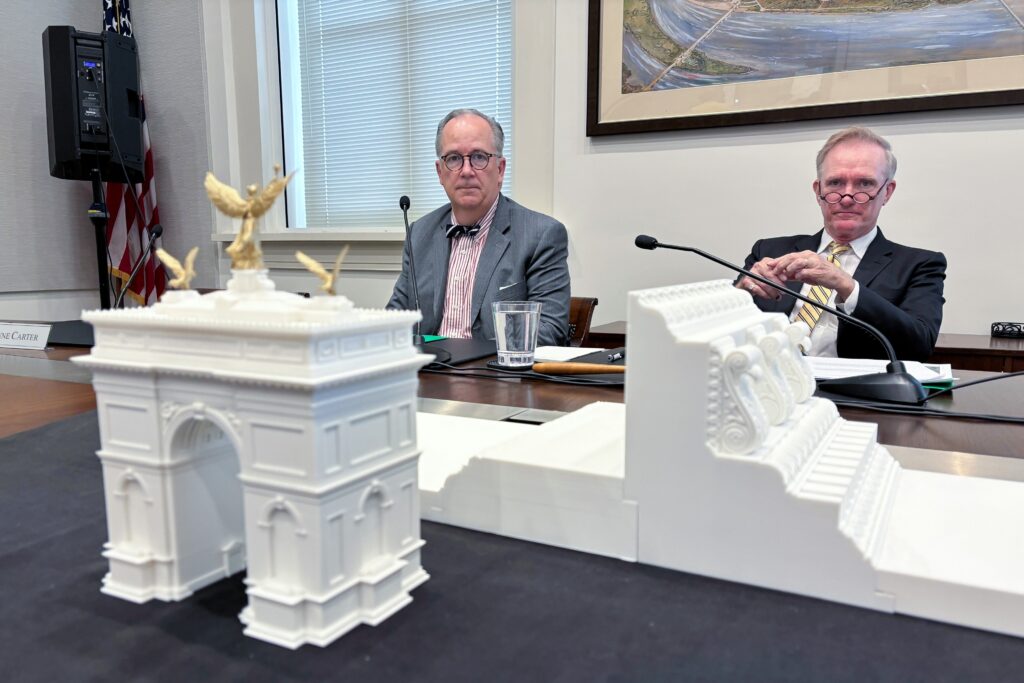
And this week, an arts commission stocked with Trump loyalists approved a towering arch near a famous entrance to the National Mall. The arch would be almost as tall as the U.S. Capitol and one of the largest in the world — Trump wants it to be 250 feet tall for the nation’s 250th birthday. A group of veterans have sued, concerned it could block view of the nearby Arlington National Cemetery.
Trump says he also doesn’t need congressional approval to build the arch, but federal law says otherwise because the location Trump wants to build it on is considered protected land, The Washington Post’s Dan Diamond reports. “We don’t need anything from Congress,” Trump said.
So this week, the Trump administration pointed to Congress approving an arch-like structure more than a century ago on the same site as the authorization they need, Dan reports.
He’s loosening regulations on forever chemicals and super polluters
Since he got back in office, Trump and his administration have systematically rolled back environmental regulations and efforts to limit greenhouse gases that warm the planet.
This week was a big one for those efforts. The Environmental Protection Agency proposed repealing limits on several toxic “forever chemicals” in many Americans’ drinking water, drawing criticism from the Make America Healthy Again movement aligned with Trump. (The EPA says it may reintroduce the regulations.)
And Trump announced he is rolling back regulations on refrigerantsused in grocery stores and many air conditioning units. The refrigerants are known as climate super polluters because they trap heat at a rate hundreds or thousands of times as high as carbon dioxide does, my Washington Post colleagues report.
Trump claimed this could lower food prices amid rising inflation but industry experts told my Post colleagues that costs could actually rise because the industry had already been moving away from using these potent chemicals. The Biden administration pushed to phase out the pollutants.
Climate change experts say that the Trump administration will slow America’s transition to renewable energy but not be able to stop it entirely.
“This will just make it all more expensive,” Leah Stokes, a political scientist at the University of California at Santa Barbara and co-host of the climate podcast “A Matter of Degrees,” told me last year. At the time, Trump and Republicans were ending popular tax credits for solar and electric vehicles, despite the jobs they produced in rural communities and the potential to ease Americans’ reliance on oil, which can be roiled by geopolitics — like Trump’s war in Iran.
The post What else happened under Trump this week appeared first on Washington Post.