He didn’t land the pope, but he got a Beatle. He didn’t have a new project to announce, but he left us with a song (in fact two). He didn’t choose to end his show, but he ended it his own weird, wonderful way.
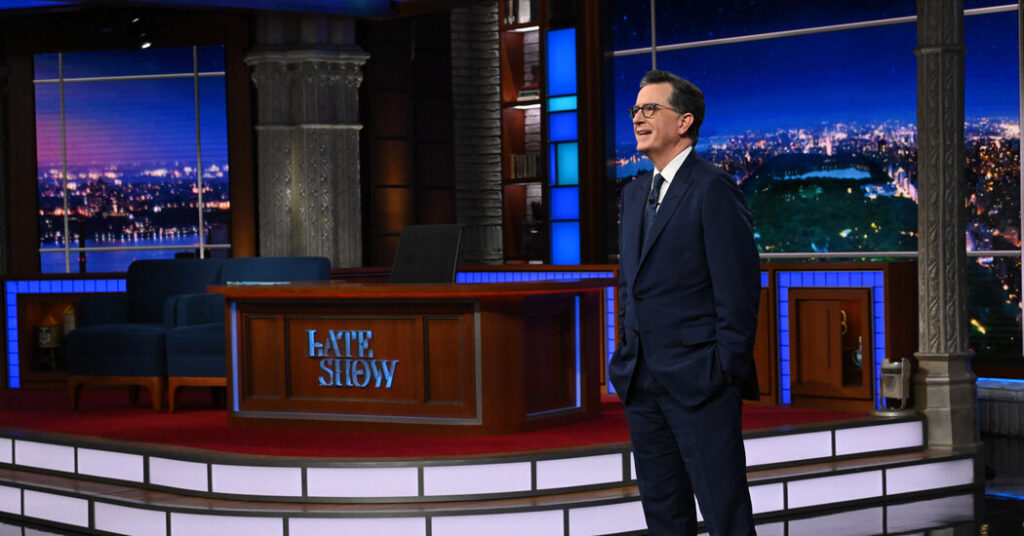
Stephen Colbert hosted his final “Late Show” on Thursday night, completing the story of the TV year’s most notorious and rancorous cancellation. But his final hour-plus — an emotional and delightfully bizarre wake for a comedy institution — turned it into a cancellebration.
Colbert began the night not with a monologue but what felt like a pep talk. The “Late Show” crew, he said, always referred to the program as the “joy machine” (also the name of the current house band, led by Louis Cato). The daily grind means the production has to be a kind of machine, he said, “but if you choose to do it with joy, it doesn’t hurt as much when your fingers get caught in the gears.”
“The Late Show” suffered its fatal on-the-job injury courtesy of CBS, which announced its cancellation a year ago. The network said that the decision was purely financial. But it coincided with the sale of its parent corporation, Paramount, to the studio Skydance, a deal that required the approval of an administration whose leader did not approve of Colbert’s comedy.
Colbert’s fans smelled a rat. But for the most part, the host himself has gone out with a grin. Yes, there have been shots at CBS these closing weeks — they got what they paid for. But the vitriol has mainly been outsourced to guests, like Bruce Springsteen, who called Colbert “the first guy in America who’s lost his show because we’ve got a president who can’t take a joke.”
We got a hint of the spirit in which Colbert would bow out in his acceptance speech at last year’s Emmys. He said that he began “The Late Show” thinking he wanted to make a comedy show about love but realized at a certain point —“You can guess what that point was” — that he was making one about loss. But he closed on a note of hope, paraphrasing Prince: “If the elevator tries to bring you down, go crazy and punch a higher floor.”
There has always been an energy to Colbert’s satire that I think of as “hopeful despair.” It’s a worldview and an aesthetic. In a 2009 interview on “The Colbert Report” with John Darnielle, of the band the Mountain Goats, he talks about how he admires the way Darnielle sets desolate stories to upbeat music. The effect, Colbert says, is one of saying, “’Is that all you’ve got, old man?’ as you shake your fist at God.”
So when you suffer a loss, you pull yourself out of the rubble, you dust off your clown suit, and you put on a show. Which is what Colbert did Thursday night. Indeed, the finale started off as a fairly normal, if valedictory, “Late Show,” with a topical monologue interrupted by celebrity guests including Bryan Cranston, Paul Rudd and Ryan Reynolds.
In fact, the episode gradually revealed a story arc, more like the closing episode of a surreal comedy than of a talk show. The running joke was that the final guest would be Pope Leo XIV, whom the devoted Catholic host has in fact called his “white whale.” After a scripted snafu — in which the Chicago-born pope was miffed at being given a hot dog not properly dragged through the garden — Colbert introduced his actual last guest, Paul McCartney.
Final talk-show guests can sometimes appear like trophies — the bigger the get, the bigger legacy. But the choice of McCartney, still boyishly charming with his voice etched by age, was itself a callback to TV history.
“The Late Show” broadcasts from the Ed Sullivan Theater, where The Beatles stormed American living rooms in 1964. It was a monumental moment not just for music but for television; “The Ed Sullivan Show” was a mass-media platform that could tell America at once that the culture had changed. Now, one more of our few remaining mass-TV institutions — a late-night show founded by David Letterman in 1993 — was disappearing.
And the episode rendered that disappearance literal in a climax that managed to be at once absurdist, hilarious and sweetly philosophical. The episode was repeatedly interrupted by flashes of green light, emanating from a massive space-time wormhole that, as explained by guest Neil deGrasse Tyson, was caused by the logical contradiction of CBS canceling the most popular show in late night.
Joined by his old Comedy Central chum Jon Stewart and a quartet of his late-night peers — John Oliver, Seth Meyers and the Jimmys Fallon and Kimmel—Colbert faced the green vortex. It was, of course, a metaphor for the cancellation, as well as for anything that must ultimately have an end. It was also hilarious. “You get out of here, hole,” Kimmel said. “For the next 12 minutes, Colbert’s the only one in this theater who’s going to suck!”
We know Colbert as a political comic, but he’s always been an experimental absurdist as well. The episode recalled the 2014 finale of his previous talk show, “The Colbert Report,” which ended with him killing death and becoming immortal, then flying off with Santa Claus, a unicorn-horned Abraham Lincoln and Alex Trebek.
At that point, of course, he was flying off to host “The Late Show.” Here, the bit was bittersweet, yet oddly beautiful.
That green vortex was a physical manifestation of the sense of loss that Colbert described at the Emmys. And it finally vacuumed Colbert into some cool purgatorial dimension, where he joined Elvis Costello and his former bandleader Jon Batiste, along with Cato, for a singalong of Costello’s “Jump Up.” Finally, he returned to the “Late Show” stage, to back up McCartney on a lyrically apt Beatles song: “Hello, Goodbye.”
What’s left for us after “The Late Show”? What’s left in a media environment in which broadcasters are increasingly hesitant to stand up to power or to invest in ambitious entertainment? We don’t know. But, Colbert, seemed to be saying, you’ve got to believe that there are friends on the other side, and a song, and maybe a new start. This was goodbye; let it also be hello.
James Poniewozik is the chief TV critic for The Times. He writes reviews and essays with an emphasis on television as it reflects a changing culture and politics.
The post Stephen Colbert’s Last Show: Laughing Well Is the Best Revenge appeared first on New York Times.