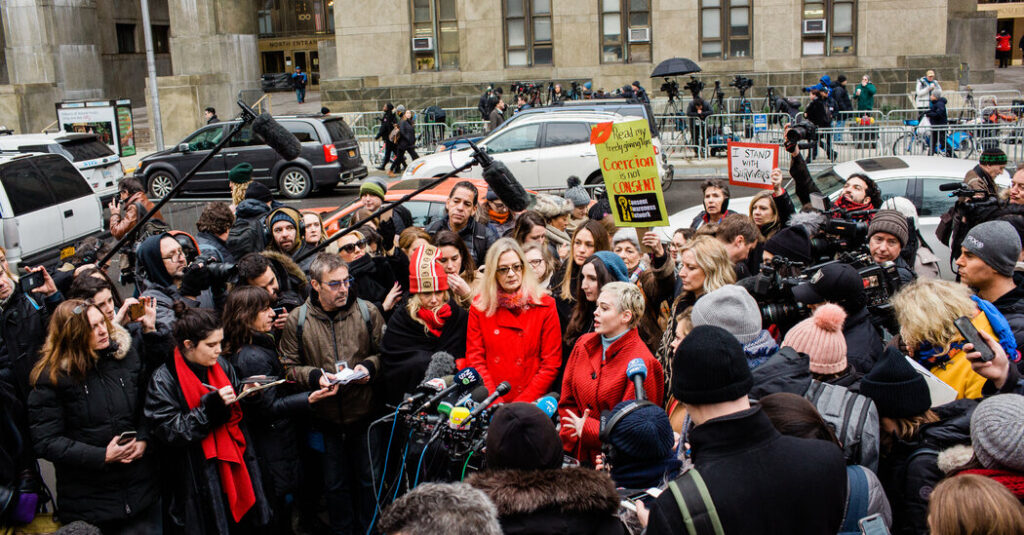
A decade ago, the #MeToo movement upended American discourse about sexual assault, and the age-old defense strategy of shaming those who came forward was challenged. Blaming women gave way to believing women, and court testimony led to convictions.
Harvey Weinstein, whose plummet from power had catalyzed the movement in the first place, was found guilty of both rape and a criminal sexual act in 2020 in a New York court, and then guilty of rape and two more counts of sexual assault in 2022 in a separate trial in Los Angeles.
But in April 2024, Mr. Weinstein’s conviction in the rape of Jessica Mann, a former actress, was overturned. A second trial in June 2025 ended in a mistrial with a deadlocked jury. And last Friday, in State Supreme Court in Manhattan, Mr. Weinstein faced a jury for a third time on the same charge, and the judge declared another mistrial when the jury deadlocked.
The case hinged on he-said, she-said, and as it closed, it became yet another sign that the mantra of “believe women” may have lost the power it had in the immediate wake of the #MeToo movement.
In recent high-profile cases, defense lawyers have reverted to familiar tactics and have sharpened them, experts who study sexual assault and the legal system say. Results have been mixed. The methods appear to have helped Mr. Weinstein, as well as Sean Combs, known as Diddy. But in the sex-trafficking case of three high-profile real estate brothers earlier this year, a jury was not swayed.
The line of defense generally tries to shift the narrative by describing sexual encounters as consensual and painting accusers as liars seeking money and fame.
The questions push limits.
When Ms. Mann took the stand earlier in May, Mr. Weinstein’s lawyer, Marc Agnifilo, looked her directly in the eye. “You went to his hotel room for the reason that other adults go to other adults’ hotel rooms,” said Mr. Agnifilo. “You wanted to.”
At the end of the 31-day trial, the jury was split 9 to 3 in favor of acquitting Mr. Weinstein.
“This is the unintended consequence of #MeToo — an increased focus on saying ‘she’s only making the allegation for attention,’ or if it’s a high-profile case, that it’s all about the money,” said Dr. Barbara Ziv, an authority in sexual assault and trauma. She has served as expert witness in a number of high-profile rape cases, including those of Mr. Weinstein and Bill Cosby, whose conviction for sexual assault was vacated in 2021.
‘The Hardest Moments’
Ms. Mann, 40, was an aspiring actress when she met Mr. Weinstein. She is now a hairstylist. For a third time in this recent trial, she described how she had planned to meet Mr. Weinstein for breakfast at a DoubleTree hotel in Midtown Manhattan in 2013, but he instead got a hotel room over her objections. After they entered the room, she said, he injected himself with medication to produce an erection and then raped her.
Prosecutors focused on the immense disparity in power between Ms. Mann and Mr. Weinstein, describing a dynamic where Ms. Mann’s career was in Mr. Weinstein’s hands and he used his clout to manipulate her. As in previous trials, they presented no physical evidence.
Mr. Weinstein’s defense lawyers used Ms. Mann’s own history against her — that she gave him a massage and performed consensual sex acts with him shortly before the alleged rape; that in the years that followed, she entered into a complex relationship with the disgraced producer and had consensual sex with him on several occasions.
Over five days of questioning, she frequently broke down in sobs and told the court she was having difficulty concentrating. (In Mr. Weinstein’s 2020 trial, she began hyperventilating while on the witness stand, and then could be heard screaming from a back room.)
She released a statement that was equal parts proud and pained last Friday. “For years I have had to relive some of the hardest moments of my life while facing attempts to shame, humiliate and discredit me in open court,” she said, adding that she had chosen “integrity even when the process flayed me open.”
‘It’s About Money’
Defense lawyers “are starting to realize you have to fight dirty,” said Juda Engelmayer, a public relations executive whose niche is representing high-profile men accused of assault, including Mr. Weinstein. Men can be falsely accused, he said, and in court, if the accused are under scrutiny, their accusers should be too. “It’s a game you play,” he said. “The prosecution can play games, and the defense can play games. This kind of trial is a big production anyhow. It’s based on performance, and some of that is bringing in this language.”
The backlash against the #MeToo movement has had staying power, the movement’s supporters say.
“Each time we get closer as a movement to more cultural acceptance of this, it always flips back to, ‘you enjoyed it, you misunderstood it, it was consensual,’” said Dr. Rebecca Campbell, a psychology professor at Michigan State University who is an expert in gender-based violence and the psychological impact of sexual assault.
In last year’s trial of Mr. Combs, Mr. Agnifilo told the jury that accusers were simply looking for a payout. “This isn’t about crime. It’s about money,” he said. Teny Geragos, who also represented both Mr. Weinstein and Mr. Combs, said in her opening statements during Mr. Combs’s trial that the women were facing regret, not rape.
“This case is about voluntary, adult choices made by capable adults in consensual relationships,” she said.
Mr. Combs was found guilty on two counts of transportation to engage in prostitution, but avoided convictions on all of the more serious charges he faced, including sex trafficking and racketeering.
‘A Real Milestone’
Both Mr. Agnifilo and Ms. Geragos also worked on the defense team for Oren, Alon and Tal Alexander, the brothers who had been powerhouses in the real estate world and earlier this year went on trial for sex trafficking. The three brothers were arrested in 2024 after dozens of women came forward to accuse them of sexual assaults tracing back two decades. They pleaded not guilty to all charges, and their lawyers insisted that while they were womanizers, all their affairs were consensual.
Some women had matched with them on dating apps. Others had met them on boats or beaches while wearing bikinis and drinking or taking recreational drugs. The defense lawyers for the brothers used the women’s statements and characterizations to question their accounts and their motives.
Alon Alexander’s lawyer, Howard Srebnick, stood before the jury and ticked through the women who had accused the brothers of rape. He called the pseudonyms several women took for protection “stage names,” insinuating that they were reciting memorized lines, rather than telling the truth.
He said that the woman using the pseudonym Katie Moore, who had told the jury she awoke naked after a night out to find Alon Alexander standing over her, had cried “rape” so her boyfriend wouldn’t think she had cheated.
He said that Maylen Gehret, a woman who swore under oath that she was so drugged she struggled to hold her head up, had never said “no.”
Ms. Geragos, who represented Oren Alexander in the trial, said the women who accused the brothers felt “shame and regret” for drinking heavily and cheating on their boyfriends. They did the “convenient thing,” she said in her opening statement, by fabricating events and pressing charges of rape.
Milton Williams, a lawyer for Tal Alexander, cross-examined a victim in the trial who said she had been raped by Tal Alexander in the bathroom of a Hamptons vacation house. He asked her several times if the friend she had traveled with would also have been considered pretty. He implied her story had holes because she went for tea at the Plaza in Manhattan the next day. And he repeatedly pressed her about the fact she had sent an email to Tal Alexander in the weeks before the attack, mentioning her “cute girlfriends.”
“You didn’t say I have a few smart girlfriends, correct?” he asked her. “You didn’t say you had girlfriends with nice personalities or aura?”
The women on the stand, many of whom had told their stories of assault while crying or visibly shaking, said they had each initially been attracted to the handsome, wealthy brothers.
“The way I was questioned by the defense counsel is exactly the reason I didn’t report 14 years ago,” said Lindsey Acree, 40, a Brooklyn artist and gallery owner who testified during the trial about being drugged and raped by Tal Alexander in 2011. “All the defense was doing was trying to bully and shame women into silence.”
While Ms. Acree and the other 10 women who testified as victims were questioned by the defense, several jurors were visibly exasperated. At least one turned her body in her chair so she no longer had to look at the brothers.
Legal scholars say the defense team’s posture may have influenced the jury further against the brothers. They faced 10 counts and were found guilty on every one of them.
For Catharine MacKinnon, the legal scholar who wrote several landmark assault and harassment laws, including defining sexual harassment as a form of illegal sex discrimination, that verdict was a ray of light.
“It’s a real milestone,” she said. “It’s quite extraordinary that nothing they tried to do in their defense worked. It usually does.”
The Alexander brothers now each face 15 years to life in prison.
Kate Christobek contributed reporting.
Debra Kamin is an investigative reporter for The Times who covers wealth and power in New York.
The post In #MeToo Cases, Has ‘Believe Women’ Lost Its Power in Courtrooms? appeared first on New York Times.