Senate Republicans began the week giving a closed-door standing ovation to Senator Bill Cassidy of Louisiana, whom President Trump had just vanquished in a primary as retribution for voting to convict Mr. Trump for his role in the Jan. 6, 2021, attack on the Capitol.
They finished it by making a sharp break with the president, rebelling against his plan to use federal money to pay people who claim to have been victimized by the government, potentially including the rioters who assaulted their workplace on that violent day more than five years ago.
The G.O.P. senators’ resistance to a president they have rarely challenged and frequently excused reflected how the legacy of the Jan. 6 attack by a pro-Trump mob still hangs over the party. And it showed the limits of the uneasy political truce that many Republicans reached with Mr. Trump after the deadliest assault on Congress in American history.
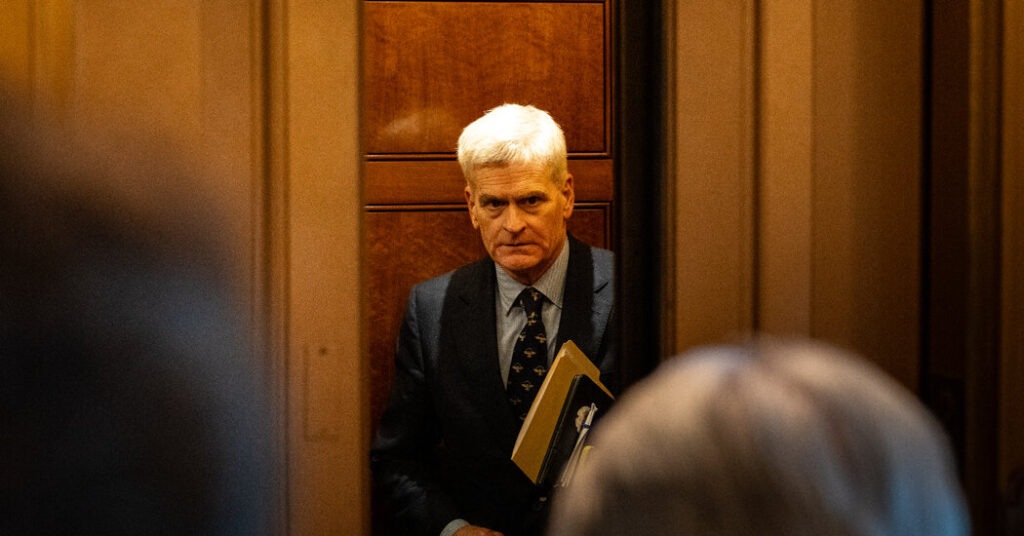
In cheering Mr. Cassidy, who was defeated by a Trump-backed challenger in his Senate primary, Republicans were rallying around a senator who did what most of them had been unwilling to at Mr. Trump’s second impeachment trial.
In the immediate aftermath of the riot, many Republicans who had feared for their safety on that day blamed Mr. Trump for the violence. But as it became clear that the president’s dominance over their party would not fade, most reversed course and fell in line behind him, forgoing a chance to disqualify him from holding office again.
In the time since, Republicans in Congress, often including Mr. Cassidy, have tolerated and even defended a host of extreme and norm-breaking actions by Mr. Trump. That only appeared to change this week, as Republican senators came to terms with a growing sense that the president’s campaign to use his power to settle personal grievances had become a major political liability, consuming their agenda and imperiling their chances of holding the party’s majorities in Congress.
Mr. Cassidy, unburdened by a thorny political dynamic, was among the first to express outrage this week at the idea of compensating Mr. Trump’s aggrieved loyalists.
“People are concerned about paying their mortgage or rent, affording groceries and paying for gas, not about putting together a $1.8 billion fund for the President and his allies to pay whomever they wish with no legal precedent or accountability,” he wrote on social media.
At the Capitol, he did not hold back in expressing dissent that he had apparently held at bay while courting the president’s favor.
“The way our Constitution is set up, Congress should hold the executive branch accountable,” Mr. Cassidy said. He added: “We are a nation of laws. You can’t just make up things whole piece.”
His comments set the tone for a day of spectacular chaos on Thursday, when Republicans erupted behind closed doors at Todd Blanche, the acting attorney general, over the president’s fund. Their anger and the White House’s failure to quell it forced Republican leaders to abruptly postpone a bill to fund Mr. Trump’s immigration crackdown.
By then it had become clear that Republicans were infuriated at the thought of giving federal funds to rioters who sent them fleeing for their lives on Jan. 6, and who assaulted the law enforcement officers sworn to protect them.
“So the nation’s top law enforcement official is asking for a slush fund to pay people who assault cops?” Senator Mitch McConnell, the Kentucky Republican and former majority leader, said in a statement. “Utterly stupid, morally wrong — take your pick.”
It was a stark judgment from Mr. McConnell, who despite privately telling associates that he believed Mr. Trump’s actions on Jan. 6 were impeachable offenses and publicly declaring them reprehensible, still orchestrated and voted for his acquittal.
Later, Mr. McConnell thwarted the creation of an independent inquiry into the Capitol attack, telling Republicans privately that it could hurt the party going into the 2022 midterm elections.
Now, with Republicans again staring down a difficult midterm battle, the calculation looks different. Republicans fear that Mr. Trump’s focus on personal retribution could harm them politically, and they appear more willing to question him.
Such bursts of dissent in the G.O.P. have been fleeting, and some Democrats — gleeful as they watched the disarray — wondered aloud how long the indignation would last.
“Is it possible on May 21, 2026, that Republicans finally found an ethical bridge too far?” said Senator Richard J. Durbin of Illinois, the No. 2 Democrat. “I wonder.”
Still, there were signs that Mr. Trump may have trouble corralling Republicans to do his bidding in the coming months.
Many G.O.P. senators were livid on Tuesday when Mr. Trump endorsed a challenger to Senator John Cornyn of Texas, a 24-year veteran with enough support among his colleagues that he narrowly lost an election for majority leader in 2024.
In his announcement, the president said Mr. Cornyn had been insufficiently supportive of him, a likely reference to the senator’s criticism in 2023 that Mr. Trump’s time “has passed him by.” That assessment reflected fears many Republicans harbored at the time about Mr. Trump’s electability given his role instigating the Jan. 6 attacks and the criminal cases against him.
In public comments in Capitol hallways and in their internal meetings, senators blasted Mr. Trump for an endorsement that, in their view, put his personal aims over the party’s political hopes. For many of them, the $1.8 billion fund announced by the Justice Department only confirmed the theory.
And in this case, they worried that Mr. Trump’s priority was rewarding people who threatened their lives.
“Imagine that: a fund that is set up to compensate people who assaulted Capitol Police officers and other responding agencies,” said Senator Thom Tillis, Republican of North Carolina.
Mr. Tillis, who voted to acquit Mr. Trump in 2021 but opted to retire last year after the president threatened to back a challenger to remove him, added: “How absurd does that sound coming out of my mouth?”
Privately, Republicans told their leaders they were concerned that the fund would refresh for voters the associations between their party and the violent assault on the Capitol.
Democrats planned to reinforce that link, according to two people familiar with their planning, by offering amendments to the immigration measure that would force Republicans to go on the record on the topic. One would stop the fund from being used for people accused of assaulting police officers. Another would target people Mr. Trump pardoned for their offenses on Jan. 6 but who were later charged with or convicted of other crimes.
Such votes, which could still come up when the bill reaches the floor, would be politically difficult for many Republicans, given that Mr. Trump views the defendants in Jan. 6 cases as the victims of a weaponized government pursuing a political vendetta.
In a contentious two-hour meeting on Thursday, Republicans asked Mr. Blanche a series of pointed questions on guardrails he could impose to keep the fund from being used to pay out Jan. 6 assailants.
Few of them left satisfied with his answers.
After the meeting, Senator John Thune, Republican of South Dakota and the majority leader, acknowledged the hostile questioning.
Mr. Blanche, he said, left the meeting with “an appreciation for the depth of feeling on the issue.”
Michael Gold covers Congress for The Times, with a focus on immigration policy and congressional oversight.
The post G.O.P. Break With Trump Reflects Limits of Party’s Post-Jan. 6 Truce appeared first on New York Times.