Despite all the grousing and heavy sighing it inspires, the Cannes Film Festival always comes through — finally. That’s true even this year, which is widely seen as a disappointment, a perception that, at least in part, has been colored by last year’s exceptionally strong lineup. In 2025, everyone here knew just how good we had it, as one after another critical beloved — “Sirat,” “The Secret Agent,” “Sentimental Value” and “It Was Just an Accident” — rolled out to heartfelt standing ovations before heading to other festivals, art houses and even the Oscar race.
It’s been quieter this year. I didn’t turn down as many parties that I had no plan on attending but wanted to be invited to anyway. Even so, it hasn’t been as dead as some reports suggest. The major studios may have opted to skip the proceedings, but the rest of the film world has shown up in force with an estimated 40,000 professional attendees from 140 countries. Jane Fonda helped get the party started at the opening ceremony, and the Nobel laureate Annie Ernaux appeared at the premiere of Judith Godrèche’s “A Girl’s Story,” a coming-of-age drama based on one of Ernaux’s memoirs. The jurors who will select the winner of the Palme d’Or have been out and about, including Demi Moore, who has been putting in some serious time on the red carpet.
With just a few days left, the strongest titles at this point include Ryusuke Hamaguchi’s “All of a Sudden,” James Gray’s “Paper Tiger” and Pawel Pawlikowski’s “Fatherland.” I also dug Pedro Almodóvar’s witty if overly baggy “Bitter Christmas,” about two filmmakers, one of whom is being invented by the other — typed and revised word by word — in a screenplay. It’s one of several movies about the artistic process that restlessly toggles between creators and their creations. There’s nothing new about characters who come to some kind of life, but it’s hard not to wonder if some of the more unruly ones in these movies have been inspired by worries about A.I.
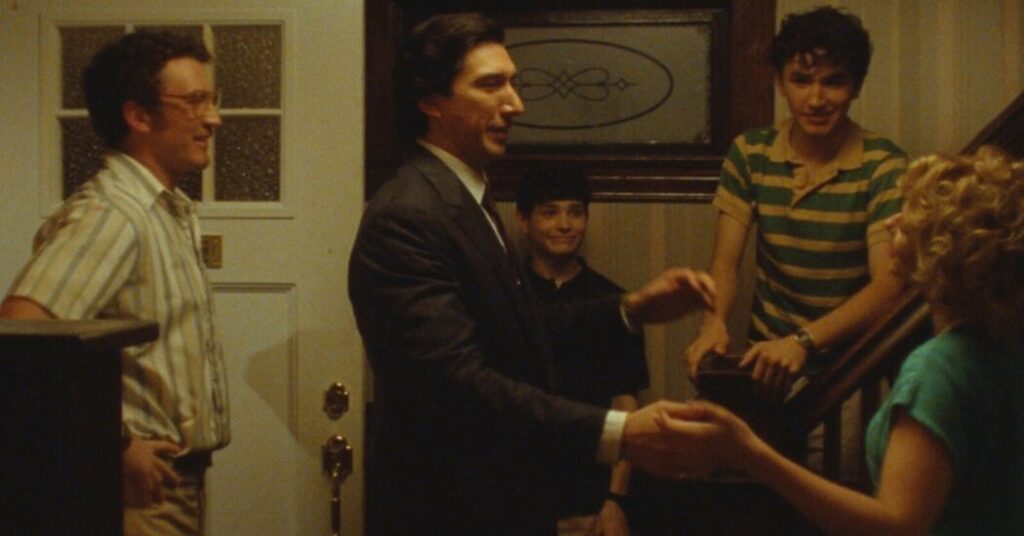
As the leading event of its kind, Cannes has a certain discretion in what it programs, though there’s always more at play than programmer taste and a movie’s availability. There’s also coincidence, which may explain why the only two American movies in the main competition are set in New York in the 1980s: “Paper Tiger” and “The Man I Love.” Neon will release “Paper Tiger” so you’ll be hearing a great deal more about it later in the year, particularly as awards season goes into overdrive. “The Man I Love” doesn’t yet have American distribution, but its star, Rami Malek, who won an Oscar for his starring turn in “Bohemian Rhapsody,” is enough of a name to secure some kind of deal.
Few movies here have inspired the kind of delirium that sometimes overtakes this event, as critics start lobbing superlatives. That said, “Paper Tiger” is a beautifully directed drama about a family that terrifyingly comes up against Russian mobsters. Adam Driver and Miles Teller play brothers; Scarlett Johansson plays Teller’s wife. Their characters inhabit a world far from that of “The Man I Love,” from the American independent filmmaker Ira Sachs. Malek leads a fine cast (Tom Sturridge, Rebecca Hall, Ebon Moss-Bachrach) as a performance artist who, amid tears, tantrums and health crises, somehow seduces everyone in his orbit. I wanted to watch a movie about his satellites.
“Parallel Tales” is a startlingly bad movie from the Iranian filmmaker Asghar Farhadi (“A Separation”). Crammed with wasted talent, it stars Isabelle Huppert as a writer who spies on other people to fuel her imagination. One unlucky inspiration is a sound-effects artist (Virginie Efira), who’s subjected to much male slobbering. Catherine Deneuve pops up briefly to remind you of all the far better films that she’s appeared in. She performs a similar sorry function in Marie Kreutzer’s unconvincing “Gentle Monster,” about a musician (Léa Seydoux) whose male partner is accused of an unspeakable crime. It’s hard to believe that either movie was selected for the main competition on merit alone.
The French movie industry is also very well represented. This isn’t remarkable in itself. France pours a lot of money into cinema, which is integral to its national economy and seen as contributing to the country’s soft power. Even so, this year stands out. Five of the 22 movies vying for the Palme d’Or are from French filmmakers, and the majority of the other contenders were made with financing from French organizations. You can see the results everywhere onscreen. “All of a Sudden,” for one, an argument for empathy in unempathetic times, may have a Japanese director, but it has a French star (a wonderful Efira) and largely takes place in France.
Given how both private and government money flows throughout the movie world, it can seem almost nonsensical to invoke national cinemas. “All of a Sudden” was also made with funds from Japan, Germany and Belgium. Some scenes are set in Japan, and Efira speaks Japanese for her role as a caretaker in a rest home. But like many movies, “All of a Sudden” is also from a filmmaker whose work successfully transcends borders. Hamaguchi is, in the end, a global auteur, an identity that has been burnished by Cannes. His “Drive My Car” screened at Cannes in 2021, which elevated the profile of a talky, three-hour movie that went on to win the Oscar for best international feature.
The most harrowing drama this year hands down has taken place offscreen and found some festivalgoers booing the logo for the French film financing behemoth Canal Plus whenever it’s popped up in credits. Before the festival opened, some 600 French movie professionals, including some with films here, signed a petition condemning the influence of the media mogul Vincent Bolloré, who controls Canal Plus and whose news outlets have promoted the far right. The letter warned that his influence would lead to “a fascist takeover of the collective imagination.” On Sunday, the head of Canal Plus, Maxime Saada, said at an event that the company would no longer work with the signatories.
The threat of a boycott in the arts is gravely unsettling; it also could be calamitous given how many movies rely on French financing, including from other countries. “Congo Boy,” Rafiki Fariala’s touching, intimately scaled drama, focuses on a sweet, unsinkable teenage refugee in the Central African Republic who finds his voice while struggling to support his siblings. It has French backing and so does “Ben’imana,” from the Rwandan writer-director Marie-Clémentine Dusabejambo. Set 18 years after the genocide in her country, it revisits the horrors of the past through the lives of survivors whose trauma is inscribed in their haunted faces, broken bodies and crushing memories. Both movies are in Un Certain Regard, a festival section largely for young and first-time filmmakers.
The French model of financing movies is complex and has been routinely criticized, including by the Trump administration. When Justine Triet won the Palme for “Anatomy of a Fall” in 2023, she took aim in her acceptance speech at the French government for some of its economic policies while also extolling the country’s “cultural exception,” a policy that protects cinema with subsidies, robust theatrical releases and other measures. As Triet explained that evening, “Anatomy of a Fall” had profited from this policy, with some of its budget coming from the state. The cultural exception benefited her and moviegoers, including those in the United States, where the film became yet another Cannes winner to significantly factor in the Academy Awards.
Triet and her partner, Arthur Hariri, ended up winning the Oscar for best original screenplay for “Anatomy of a Fall.” Hariri signed the Canal Plus letter; he’s also a director, and his latest, “The Unknown,” a darkly moody body-swapping fantasy, is in the main competition. It focuses on several characters who mysteriously find that their consciousnesses and maybe their souls have taken up residence in other bodies. It’s an absorbing, irritating, at times touching movie, and while I’m not wholly convinced by it — or how it skitters around identity, trans included — I’m glad to have seen it at Cannes, where an exceptional attitude toward cinema reigns supreme.
Manohla Dargis is the chief film critic for The Times.
The post At a Disappointing Cannes, the Standouts Include an American Auteur appeared first on New York Times.