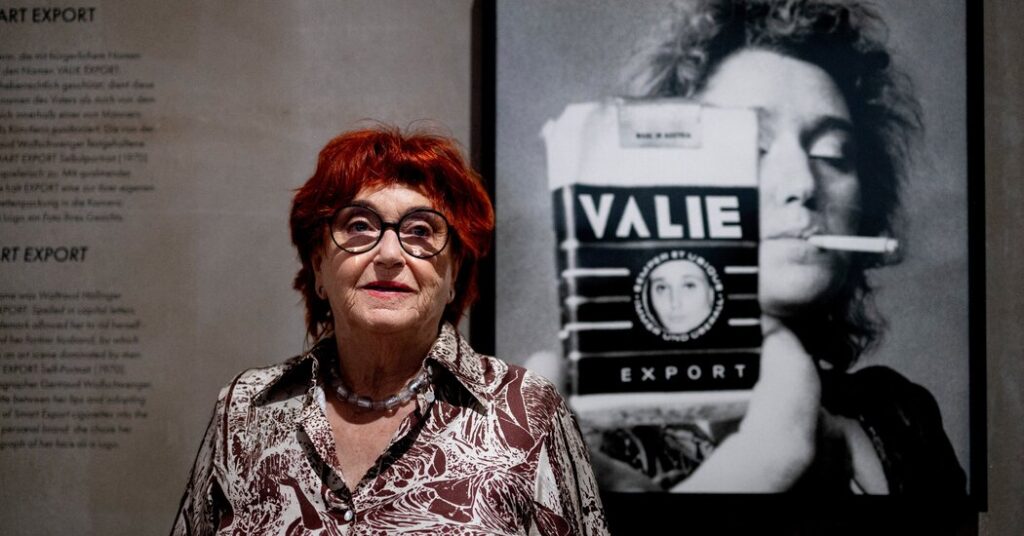
Valie Export, a provocative performance artist and filmmaker who confronted the misogyny of mass media and society at large with the undeniable truth of her own body, died on May 15 in Vienna. She was 85.
Her longtime gallerist, Thaddaeus Ropac, said her death, at a hospital, was caused by complications of a fall at her home in the Austrian capital.
Ms. Export was best known for two pieces she staged in the late 1960s and early ’70s.
In the first, “Action Pants: Genital Panic,” she walked into a movie theater in Munich in 1968, wearing crotchless pants that put her exposed genitals directly in the sightline of seated theatergoers. The intention, she said, was to “challenge the voyeurism of cinema.”
As she walked down the aisle, she announced, “Now you will see in reality what you normally see on the screen.”
In a photo taken a year later to commemorate the piece, Ms. Export underscored the radically confrontational nature of the work by accessorizing her all-black, crotchless outfit with a machine gun.
For “Tap and Touch Cinema,” first staged at a film festival in Vienna in 1968 and then in nine other cities throughout Europe, Ms. Export (or sometimes a collaborator) wore a cardboard or aluminum “cinema” — an empty box with curtains at the front — strapped to her chest.
Walking down the street alongside the artist Peter Weibel, who drummed up interest with a megaphone, she invited passers-by to “visit the cinema” by reaching through the curtains to touch her bare breasts. She made a point of maintaining eye contact while they did so.
In addition to these and other boundary-breaking performances, Ms. Export practiced what she called expanded cinema, producing numerous photographs and films.
They included “Facing a Family,” a short film of a middle-class family eating dinner that was broadcast on Austrian television, at dinner time, in 1971; “Abstract Film No. 1,” a 1967-68 installation in which a film projector shines light through water running down a mirror; and “Invisible Adversaries,” a 1976 feature in which a woman in the grips of an alien invasion is repeatedly told she’s mad. For “Body Sign B” (1970), Ms. Export had a garter belt tattooed on her thigh.
In “Body Transformations,” Ms. Export photographed herself, over a number of years, lying along a curving sidewalk curb or otherwise adjusting her body to surrounding architecture. In the “Madonna” series, women pose in various domestic settings — for example, astride an open washing machine out of which emerges a train of red towels.
What distinguished Ms. Export’s work, beyond its aggression and sheer volume, was its lucidity. It is not easy to make art that is at once so freighted with difficult questions — aesthetic and philosophical, as well as political — and so easily read.
Waltraud Lehner was born on May 17, 1940, in Linz, Austria. Two years later, her father died fighting for the Nazis in Africa, and her mother sent her and her two sisters to board at a convent. As a child, she was repeatedly kicked out for breaking the rules.
At 14, she transferred to Linz’s art school. At 18, she married Ernst Alois Höllinger and had a daughter. By 20, she was divorced and living in Vienna, studying at the National School for Textile Industry while her sister cared for her daughter.
“Marriage, the Christian church, religious themes and the traditional side of Vienna at the time — this fossilized Nazi realm, really — all this influenced the work I wanted to do,” she told the critic Hettie Judah in The Guardian in 2019.
Speaking in 1982 with the critic Gary Indiana for Bomb magazine, she described the circumstances that shaped her early work more viscerally: “I had it really very hard and I felt all these things on my skin.”
Around 1967, she decided that instead of bearing the name of her father or ex-husband, she wanted a trademark of her own. She arrived at Valie Export, a name she styled in all capitals, combining a nickname for Waltraud with a word borrowed from the Austrian cigarette brand Smart Export.
Though she worked in Vienna at the same time as Hermann Nitsch and the other so-called Viennese Actionists, and was friendly with them, she wasn’t one of them. Her work was film-based, and funny, and addressed a form of oppression that the otherwise radical Actionists overlooked: sexism.
Indeed, writing in The New York Times in 2000, the critic Roberta Smith described Export’s work as having developed “largely in opposition to the extravagance, violence and misogyny of the Viennese Actionists.”
In the late 1960s, Ms. Export was a founder of the Austrian Filmmakers Cooperative, and in 1972, she published “Women’s Art: A Manifesto.” The society women lived in and the structures they worked in — mass media and architecture included — had been designed by men and for men, she wrote. In order to liberate themselves, women would have to remake the world.
Initially, Ms. Export was often ignored or dismissed, but over time she garnered the recognition and respect she was due. She participated in the prestigious group exhibition Documenta, in Kassel, Germany, twice, in 1977 and 2007, and was (with Maria Lassnig) one of the first two women to represent Austria at the Venice Biennale, in 1980.
In 2005, when Marina Abramovic restaged seven key works of 20th-century performance art at the Guggenheim Museum in New York, “Genital Panic” was among the featured pieces. The Museum of Modern Art presented a retrospective of Ms. Export’s films in 2007.
In 2016, the Hessel Museum of Art at Bard College put on a show of work by Ms. Export alongside artists for whom, as Randy Kennedy put it in The Times, her work “blew open doors,” including Lorna Simpson, K8 Hardy and Hito Steyerl. The exhibition included daily screenings of “Invisible Adversaries” and borrowed its title.
Ms. Export is survived by a sister, Elisabeth Wiener, and a grandson, Patrick Chan. Her second husband, Robert Stockinger, died in 2016, and her daughter, Perdita Chan, died earlier this year.
Ms. Export was unusually forward-thinking about her legacy. In 2017, after extensive negotiation with the Austrian state, she opened the Valie Export Center Linz, a research center for media and performance art that also holds her archives.
“She was, up to the end, a fighter,” Mr. Ropac said. “But for so many years and decades, she had to fight.”
The post Valie Export, Who Made Art With Her Naked Body, Dies at 85 appeared first on New York Times.