When President Trump announced late last year that Nvidia could sell one of its most powerful chips to China, the deal looked like a rare win-win in a fraying geopolitical relationship. It would provide a major boost for China’s artificial intelligence ambitions, while handing a win to America’s leading chipmaker.
Cutting-edge A.I. systems run on staggering amounts of computing power, and Nvidia’s chips are considered the gold standard worldwide. Chinese competitors have yet to build anything that rivals Nvidia’s best, and Mr. Trump’s decision undercut years of U.S. policy designed to keep those chips out of China’s reach.
Former Biden and Trump administration officials warned the move could squander the lead that American A.I. companies held over Chinese rivals, by helping China close the gap until its own chipmakers could catch up to Nvidia.
But six months on, Beijing has not allowed any of its companies to buy a single one.
The impasse lays bare the depth of the mistrust between the world’s technological superpowers. For decades, U.S. and Chinese companies worked side by side to create products like the iPhone that upended industries. But the relationship has soured over the past decade as both governments came to see technology as the fulcrum of economic supremacy.
Nvidia is trapped in the middle. The chipmaker became the world’s most valuable company by making its semiconductors indispensable to running A.I. systems. But Washington and Beijing increasingly view that technology as a matter of national security, especially after watching how it has been used to coordinate attacks in Gaza, Ukraine, Venezuela and Iran.
Rather than turn to Nvidia, Chinese officials have pushed domestic companies toward homegrown alternatives from chipmakers like Huawei and Cambricon. After meeting last week in Beijing with Xi Jinping, China’s leader, Mr. Trump said that China’s lack of interest in the chip he had approved, known as the H200, had been driven in part by this push for industrial self-reliance.
“They chose not to. They want to try to develop their own,” he said.
Chinese A.I. companies are hungry for more computing power. Kevin Xu, founder of Interconnected Capital, a hedge fund that invests in artificial intelligence technologies, recently spent nine days in China meeting with leading A.I. start-ups. Every one of them, he said, pointed to the lack of computing power as the biggest factor holding them back.
But Chinese companies are now starting to build their A.I. systems around those constraints rather than waiting for them to ease. And Beijing wants them to keep doing exactly that.
“It’s a balancing act,” Mr. Xu said. The government knows its companies need more computing power, but it also wants to push domestic chipmakers to get better and faster.
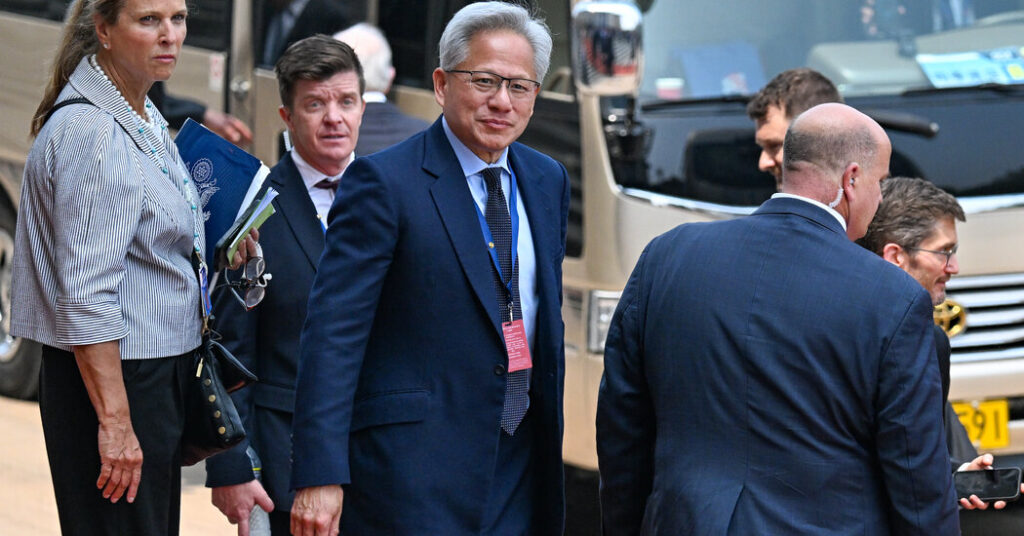
Jensen Huang, Nvidia’s chief executive, who traveled to Beijing last week as part of Mr. Trump’s delegation, said he didn’t bring up the H200 chip with Chinese officials. But he remains optimistic that the market will eventually open, given China’s enormous appetite for A.I. chips.
“The Chinese government has to decide — how much of their local market do they want to protect and how much of their local market do they want to expand with more A.I. capacity,” Mr. Huang said in an appearance on Bloomberg TV on Monday. “My sense is that over time, the market will open.”
In March, Mr. Xi laid out an ambitious plan to deepen China’s already decade-long push to rely on its own technology. Over the next five years, he wants the nation to pursue breakthroughs in fields like A.I., quantum computing and fusion energy.
The drive for self-sufficiency is becoming more attainable as domestic chipmakers rapidly improve their offerings. Huawei, China’s tech giant, and Cambricon, a start-up, and others are now producing chips that perform on par with the H200.
DeepSeek, the start-up that has come to symbolize China’s rising A.I. capabilities, has also become a sign of the country’s shift away from Nvidia.
When it released its latest artificial intelligence model last month, the company said for the first time that its new system had been optimized to run on chips made by the Chinese tech giant Huawei — a small but meaningful milestone in China’s long-running effort to develop advanced technologies at home.
Although Washington and Beijing have effectively blocked Nvidia’s most advanced products from the world’s largest chip market, the restrictions have done little to slow the chipmaker’s business. On Wednesday, Nvidia reported a quarterly profit of $58.3 billion. The company said it recorded no sales from its signature A.I. chips in China and does not expect that to change anytime soon.
While Chinese tech companies now use domestic chips for some tasks, they still rely on Nvidia chips for training, the demanding process of teaching an A.I. model how to function. Part of the reason is that Chinese chipmakers have struggled to manufacture advanced chips at volumes sufficient to meet demand.
Many Chinese A.I. companies are using a workaround to avoid buying their own Nvidia chips. They are renting remote access to chips housed in data centers operated by other companies, often outside the country. When two A.I. start-ups, MiniMax and Zhipu AI, went public in Hong Kong earlier this year, their disclosures showed the companies were spending several times their revenue to train their models using “cloud services.”
But this approach has drawbacks, said Jiang Tianjiao, an associate professor at Fudan University in Shanghai. It means slower processing times and a higher risk of data leaks. It makes Chinese companies reliant on third-party data center operators, which could cut them off at any time. They also face the risk that the United States could pass regulations to close off remote access to Nvidia chips altogether, a step that some officials in Washington have championed.
Even so, Chinese companies are spending far less on A.I. overall than their American rivals. They are expected to spend $123 billion on A.I. chips and data centers this year, according to Bernstein Research. U.S. tech companies, by contrast, are expected to spend about $1 trillion.
The lighter spending reflects both ambition and means. Chinese companies have been slower than their American peers to bet their futures on A.I. and they have less revenue to put behind it. That restraint might ease the pressure on Beijing to clear the way for Nvidia purchases, said Chris McGuire, a senior fellow at the Council on Foreign Relations who worked on chip export controls under President Joseph R. Biden, Jr.
Beijing may also be wary of allowing Nvidia purchases on national security grounds. Last July, the internet regulator, the Cyberspace Administration of China, summoned Nvidia to explain security risks associated with the chips it had developed for the Chinese market.
Nvidia has said that its products contain no back doors that would give anyone remote access. But Chinese suspicions have made it difficult to restart sales.
Mr. Huang has not given up on China. After a last-minute invitation to last week’s summit, he spent time in Beijing posing for photographs with people on the street and slurping noodles on the sidewalk, part of an effort to keep ties alive in the hope that Nvidia can one day return.
His shuttling between Washington and Beijing underscores the value he places on the Chinese market and the profits Nvidia could reap there, said Wendy Chang, a senior analyst at the Mercator Institute for China Studies, a think tank. But that eagerness, she said, may embolden Beijing to hold out for bigger concessions.
At Washington’s request, Nvidia has held back its most powerful chips from China, restricting sales to the United States and its allies. That chip, which Nvidia calls Blackwell, outperforms anything currently available in the Chinese market.
“By playing hard to get, Beijing may be hoping for more leverage in access to better chips,” Ms. Chang said.
Xinyun Wu contributed reporting from Taipei.
Meaghan Tobin covers business and tech stories in Asia with a focus on China and is based in Taipei.
The post Trump Approved an Nvidia Chip for Sale in China. Beijing Doesn’t Want It. appeared first on New York Times.