The hairy effects of artificial intelligence have been fodder for thrillers and science fiction, white papers and Silicon Valley Substacks — and now a report from New York City’s comptroller, who argues that the city’s economy is on track to be transformed by the technology.
The city must move swiftly to prepare for the job losses that may result, the comptroller, Mark Levine, warned in the report, which was released on Thursday morning. The report marks the first major effort by city officials to engage with the looming question of what A.I. will mean for New York’s future.
“There is no city in America — and perhaps none on earth — more exposed to both the promise and peril of artificial intelligence than New York City,” the report said.
The report outlines five scenarios, which range from rosy to dire, and assigns each one a probability of occurring.
At the sunniest end of the spectrum, A.I. could boost the stock market 9 percent annually and the number of available office jobs nearly 1 percent, over the period between 2025 and 2030; on the darker side, it could cause the private sector to lose roughly 110,000 jobs in 2027.
The most likely scenario in New York City, according to the report, is one in which A.I. moderately boosts jobs and economic growth, leading the private sector to add an average of 52,000 jobs per year between 2025 and 2030.
In the second-most likely scenario, the A.I. bubble would burst, the stock market would decline nearly 35 percent in a year and the city’s private sector would lose 52,500 jobs within a year.
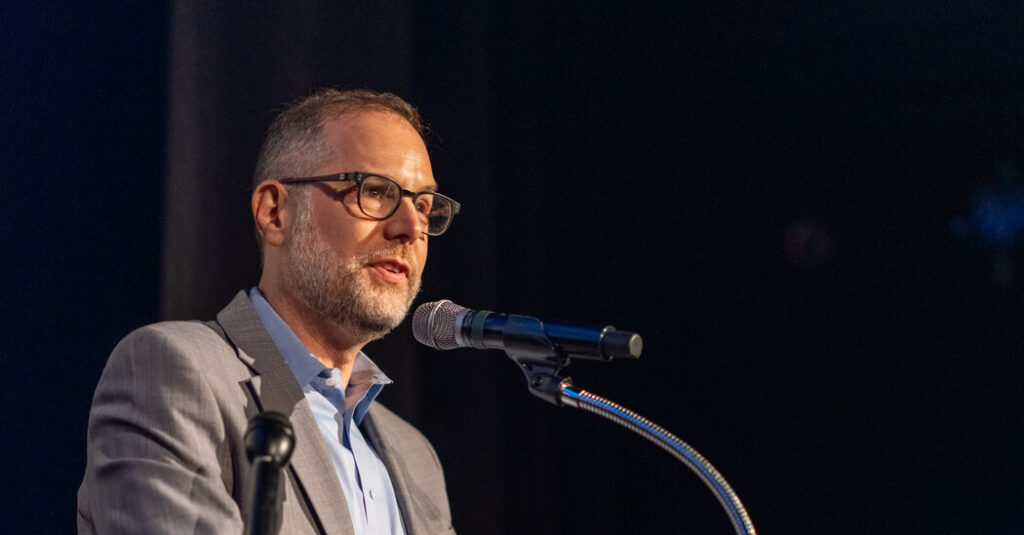
“I don’t think people appreciate how much this is a New York story — this is not just a Silicon Valley story,” Mr. Levine said on Wednesday at a briefing about the report.
The report’s methodology is based on a nationwide analysis that Moody’s Analytics, the ratings agency, did earlier this year, which applied similar scenarios to the U.S. economy.
New York City needs a “rainy day fund” to gird itself for the economic tumult ahead, the comptroller’s report argues, proposing that the fund equal 16 percent of tax revenues. This figure is based on how New York City has weathered previous economic downturns, according to the report.
Former comptrollers have called for bolstering reserves plenty of times. Mr. Levine’s predecessor, Brad Lander, called on the city to do so last year, as President Trump’s tariffs sowed economic chaos. And Mr. Lander’s predecessor, Scott Stringer, warned more than a decade ago that the city was more than $1 billion short of what it needed if it faced a financial crisis.
“We’ve never seen anything like this — the industrial revolution took what, 40 years to play out in New York City. I’m giving you a three to five year timeline here,” Mr. Levine said. “It’s a heavy lift, but this is a long term fight.”
Mr. Levine’s calls for economic prudence land in the final stretch of what has been a bumpy budget fight for Mayor Zohran Mamdani.
Facing a yawning deficit, Mr. Mamdani first proposed closing it, in part, by draining several of the city’s budget reserves. After intense pressure from bond ratings agencies, he ultimately changed course and partially replenished them.
Mr. Levine applauded the mayor’s change in direction, praising him specifically for delaying the expansion of a popular housing voucher program to save money.
Mr. Mamdani’s campaign built steam with calls to make life in New York City more affordable, in part by cutting the cost of essentials like rent and child care.
Mr. Levine’s report argues that the city ought to focus, too, on coming fluctuations in the job market.
“You’re going to get a lot of automation, which means replacing people with algorithms,” said Simon Johnson, a Nobel Prize-winning economist at the Massachusetts Institute of Technology, adding that the A.I. boom is likely to displace at least some white-collar workers and that it is not yet clear who will benefit from any potential job gains.
Historically, Mr. Johnson added, new digital technologies have tended to make inequality worse.
Young New Yorkers are especially vulnerable to the economic uncertainty resulting from A.I., according to the report. This year, for the first time on record, 20-somethings with college degrees are unemployed at higher rates than those without.
“I’m sure you all have heard the anecdotes of people in their 20s who have applied to hundreds of jobs and not gotten a single offer,” Mr. Levine said.
Daron Acemoglu, also a Nobel Prize-winning economist who studies the effects of A.I. on jobs, said he hoped to see more city and state partnerships focused on retraining and relocating workers who were displaced from their jobs because of the technology.
“Being proactive is better than being reactive,” Mr. Acemoglu said. “We’re not seeing huge job losses yet, but being prepared is a good step.”
Emma Goldberg is a Times reporter who writes about New York City and the Mamdani administration.
The post Thousands of N.Y.C. Jobs Could Be Lost to A.I. Boom, Report Says appeared first on New York Times.