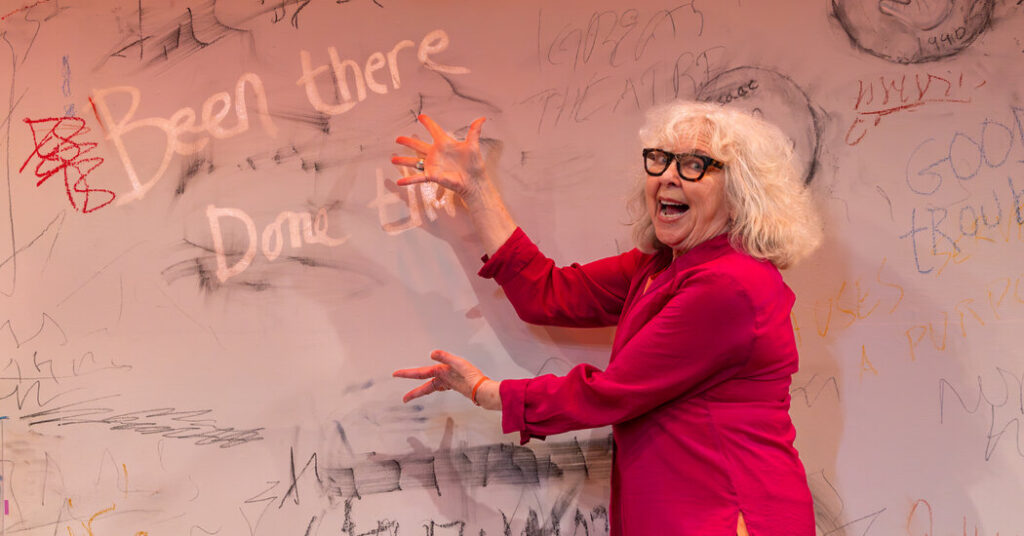
The actor Kathryn Grody identifies with bats, which is not as odd as it might seem.
“They know who they are and where they are going by hearing these pinging sounds off their shared caves and each other,” she tells the audience during “The Unexpected 3rd,” her new autobiographical monologue. Clarifying, she adds: “Echolocation. That’s what people are for me.”
Ping, ping, ping: Isn’t that one of the purposes of art? Not only for those who put it into the world, but also for those who spend time with it?
At New York Theater Workshop’s In the Bricks Festival, solo shows including “The Unexpected 3rd,” Leslie Ayvazian’s “Mention My Beauty” and Liza Jessie Peterson’s “The Peculiar Patriot” (all through June 14) poke and prod at the state of things. Each writer-performer sends out pings, we send our own in response, and in that back-and-forth we find the shape of our shared geography.
Directed by Timothy Near for People’s Light, Grody’s show is only a little bit about the surprise of the fame she stumbled into during the Covid pandemic, when her son Gideon Grody-Patinkin started shooting at-home videos of her and her husband, the actor Mandy Patinkin, and posting them online.
Mainly, “The Unexpected 3rd” is a platform for Grody, at 79, to consider where she goes from here, rail defiantly against ageism, absorb loss and keep embracing the new, while trying not to let the horrors of the present consume her.
“Welcome to my mind!” she says, dressed in fuchsia over melon over sage — a palette that communicates, clearly and elegantly: Look at me. (Costume design is by Naomi Lachter.)
In the audience, a curious thing happens whenever Grody mentions Patinkin, though she never does so by name. You can feel the crowd’s warmth and eagerness intensify. Not, I think, from finding him more interesting than her; rather, out of fondness for them as a pair.
But “The Unexpected 3rd” is about Grody’s identity: as a wife and mother, sure; as a sister, daughter and grandmother; but also as an actor, writer and second-wave feminist who believed, back in her youth, that she was headed for a more radical life.
For rebellion, nothing compares to an acquiescent good girl who wakes up and realizes that there are better, bolder ways to navigate the world. Ayvazian’s “Mention My Beauty” is the story of her life, which, at 77, she tells in slender, piercing shards that fit only jaggedly together. What the show needs is a structural logic to the arrangement of its many parts.
Deeply personal and intrinsically political, the monologue uses a feminist lens to look back on a culture and an upbringing that schooled Ayvazian to value men over women, and to keep quiet about, say, the driving instructor who taught with a girl sitting in his lap, or the college professor who invited her over, told her to call him Alex, got grabby and then ignored her in class.
“To you, Alex, I say: ‘You must be dead by now? Right?’” Ayvazian says, her anger still very much alive.
Directed by David Warren, the staging is as spare as can be, with Ayvazian (“Nine Armenians”) reading her script aloud at a music stand. She has always been funny, and she serves up her young self with a sardonic, sometimes sympathetic mockery. What she doesn’t forgive is the ruthlessness with which she treated other women as competition in the sexual revolution.
But she is compassionate toward her parents, even as she tells some of the secrets that they kept while they were alive. She is ever conscious, too, of the effect the Armenian genocide had on them and on her family.
Peterson’s “The Peculiar Patriot” is different altogether — not new, not a work of autobiography. Of these three shows, it is the funniest and most polished, and the most forceful in the argument it builds, which is about the racist injustices of the justice system and the big business of incarceration.
Directed by Talvin Wilks, with excellent projection design by Katherine Freer, it is presented with National Black Theater, which co-produced its world premiere in 2017. But as Peterson notes in a program insert, she started writing the show in 2001, and this festival run will be her final appearance in it: “My last dance before I hang the jersey up in the rafters.”
Do take the opportunity. Peterson plays Betsy LaQuanda Ross, an utterly endearing New Yorker whose best friend, Joann, is in prison upstate. Across the table on their many visits, the chatty Betsy — a nickname she got in childhood, when she learned to sew — catches Joann up on the lives of people they know, some of whom are also incarcerated.
The show has a different ending than it did in 2017, courtesy of a new wrinkle in tech-aided cruelty that has developed since then. Ping, ping, ping: We are here.
In the Bricks Festival Through June 14 at New York Theater Workshop, Manhattan; nytw.org.
The post Finding Our Shared Geography in Monologues appeared first on New York Times.