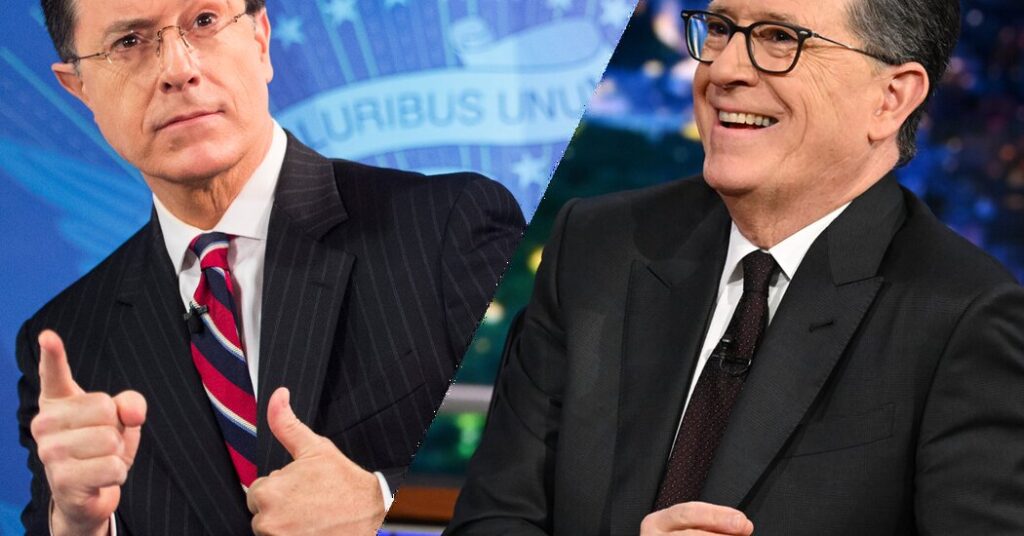
When the CBS “Late Show” dies prematurely on May 21, Stephen Colbert will have been a late-night host for over two decades, long enough that this feels like the end of a cultural era. But what era exactly?
I’m loath to frame Colbert’s cancellation as “the death of late night” — that funeral has been going on for decades. The monoculture is long gone, the ratings smaller, the productions expensive. Yet the end of “The Late Show” still leaves us roughly where we were before David Letterman began the franchise in 1993, give or take a Jimmy Kimmel and sundry basic-cable shows.
Nor can you diagnose this as audience burnout on political comedy. Colbert was the highest-rated host in his time slot for most of his run. Even if you believe his axing was “purely a financial decision” by CBS — you won’t catch me trying to convince you — his exit is reminiscent of the Smothers Brothers, whose political comedy show was a hit for CBS and got replaced by “Hee Haw” in 1969 anyway. End of an era? Maybe the era ended him.
But while his run lasted, Colbert presided over an era when political TV comedy could take a side and still succeed. Or actually, two eras, which almost perfectly coincided with his two shows: one that parodied politics, one made in a time when politics became a parody of itself.
COLBERT ARRIVED AS HOST of Comedy Central’s “The Colbert Report” in October 2005, with an eyebrow pointed like a javelin and a fully formed thesis statement.
“Stephen Colbert,” the conservative commentator Colbert had originated on “The Daily Show,” was the real Colbert’s own Bizarro reflection, a telegenic blowhard who knew nothing and said it as loud as he could. His first monologue introduced “truthiness,” a generation-defining coinage for the idea that it is more important for something to feel true than to be true.
It was a political age’s defining critique, and perhaps its epitaph. You might not have thought, when the “Report” premiered, that the George W. Bush era was over. The president had been re-elected with a popular-vote majority and had three more years in office. Culturally, cable news was in its bunting-draped post-9/11 era, parodied in the show’s screaming-eagle intro credits. Tucker Carlson still had a show on MSNBC.
But eras often end only in retrospect. In fall 2005, the war in Iraq was dragging on and the response to Hurricane Katrina had proved a debacle. When Colbert delivered the “truthiness” monologue — and certainly when he roasted President Bush and the media that covered him at the 2006 White House Correspondents’ Association dinner — it was as sure a sign as any that the culture had turned.
In 2008, Barack Obama, a president much more in line with Colbert’s real-life politics, won election. The nation changed course, but thanks to “the character,” as Colbert referred to his host persona, the show didn’t have to.
The Obama presidency was a boon for conservative commentators, from Glenn Beck working his chalkboard to Sean Hannity mocking the new president for putting Dijon mustard on his hamburger. The great American hot-air machine ensured that the “Report” would never lack for material.
What made the show enduring was that it was above all a satire of a political-media industry unconstrained by term limits. Like “The Daily Show,” it was a work of media criticism. It made fun of the imperative to defend the indefensible, to tie and gag one’s brain and follow one’s talking points right off an intellectual cliff.
The show also kept things interesting through a series of ever-bigger comic-educational stunts (a model later followed by John Oliver’s “Last Week Tonight”). Colbert tried to get on the ballot in the South Carolina presidential primary. (Because how absurd was it that you could go from hosting a TV show to the White House?) He sent viewers to edit the Wikipedia entries on elephants to illustrate “wikiality,” the idea that consensus belief in a lie could overrule facts. Most audaciously, he created an actual SuperPAC, an extended satire-seminar on the mechanisms by which money controls politics.
In 2014, when Colbert was named to succeed Letterman at “The Late Show,” it seemed like one of those cultural handoffs in which the alternative goes mainstream. He would leave basic cable for the major leagues, becoming a normal host of a normal show in normal times. One of his first guests, it was announced, would be the early Republican presidential front-runner Jeb Bush.
But when late-night comics make plans, God laughs hardest of all.
A FUNNY THING HAPPENED while Colbert was between shows: Donald Trump rode down an escalator in Trump Tower and transacted his hostile takeover of the national spotlight. The run of Colbert’s “Late Show” would coincide with, as he described it on a recent episode, “10 years of Donald Trump worming his way into our brains.”
When he debuted in September 2015, Colbert resisted going wholeheartedly political. His first show included a run of Trump gags, but Colbert capped off the routine by dumping a package of Oreos over his face, a spin that suggested these jokes were comedy junk food, an empty-calorie, cheap sugar high.
Who could blame him? He’d spent years marinating in partisan commentary to satirize it. “To model that behavior, you have to consume that behavior on a regular basis,” he told me at the time. “It became very hard to watch punditry of any kind.” He seemed good and done with it, ready to show another side of himself as an entertainer and a person.
Besides, the wisdom of TV for decades was that political points of view were deadly on big-network late night. People liked “equal-opportunity offenders” like Johnny Carson or Jay Leno, but if you took a side, you’d lose half your audience — especially on Middle America’s TV home, CBS.
But for the first year or so, Colbert’s “Late Show” felt rudderless, avoidant. It wasn’t for the host’s lack of talent as a performer or interviewer. The show was upbeat and playful, but it lacked a focus.
President Trump gave it one. By early 2017, he was the star of every late-night show’s monologues. But there was a difference between Colbert’s jokes and his “Tonight Show” competitor Jimmy Fallon’s. Fallon seemed desperately to hope everyone could just laugh about the president’s hairdo and move on. Colbert’s jabs had a take guided by a moral compass. (That, incidentally, also helped define for viewers the “real” person hidden for years behind a persona.)
And that’s when another funny thing happened: “The Late Show” pulled ahead and away from “The Tonight Show” in the ratings. Credit Colbert’s talent but also a shift in the culture and media environment. The idea that political stances were poison in late night, it turned out, was a holdover of pre-cable, pre-internet TV. Carson could speak to everyone because there was an “everyone” to speak to.
Donald Trump was polarizing — that was the point of him — a figure of a fragmented culture with few common spaces left. Conversely, he was also essentially the only American monoculture left, the one reference everyone would get, more than sports or music or niche entertainments. Talk shows couldn’t credibly choose pop culture over politics now that politics was pop culture.
This time, however, Colbert’s satire came in a different package: through himself, Stephen Colbert, no air quotes.
Hosting “The Late Show” as himself was not an innovative idea; it was the conventional host mode since the days of black-and-white TV. But if only for its accident of timing, it was striking that Colbert was dropping his mask at a time when actual political rhetoric was increasingly weaponizing the use of memes and a joking-not-joking stance. (Among the things for which the president has claimed comic license: inviting Russia to hack Hillary Clinton, injecting disinfectant to kill the Covid virus, wanting a third term.)
If “The Colbert Report” was a lampoon of pundits who took themselves insufferably seriously, then “The Late Show” proved the right vehicle to make comedy of a politics of trolling and taunting. It was an old-fashioned talk show — with celebrities, musical guests and a band — taking on an era whose rhetoric was so extreme and aesthetics so garish as to be almost beyond parody. (Today, the White House social media regularly posts A.I. slop that makes the “Colbert Report” screaming eagle seem tasteful.)
It was not as innovative as “The Colbert Report.” Nor was it as gaspingly funny. Great comedy is about surprise, and political audiences want to be affirmed. The show felt less urgent in the Biden years (see the dancing syringes celebrating the Covid vaccine in 2021). The crowd’s fervor can get in the way of the comedy, as when a photo of JD Vance (“vice president and scornful hamster”) pops onscreen during Colbert’s monologue and the audience boos, muddying the rhythm and stepping on the joke.
I suspect this was not the show Colbert imagined doing when he started it in 2015. But then these are not the times many of us imagined we’d be living in, and the host stepped up to them. You can’t say his words didn’t leave a mark on the critic-in-chief, who celebrated Colbert’s cancellation on Truth Social: “I absolutely love that Colbert’ got fired.”
AS IT IS, COLBERT’S “Late Show” will be defined largely by its chief antagonist. Indeed, since the cancellation was announced, President Trump’s second term has given “The Late Show” a glut of material and the kind of feisty energy that “The Colbert Report” had in its early days under President Bush.
The administration handed Colbert, a devoted Catholic, a parting gift for the show’s final weeks: an honest-to-God presidential feud with the Pope, not to mention the A.I. image President Trump posted that seemed to depict himself as Jesus Christ, though the president later said he thought the image was of him as a doctor.
“If you just woke from a coma and that report was the first thing you saw, you’d ask the doctor to put you back in,” Colbert said. “No, I’m sorry. You’d ask the Jesus to put you back in.”
It was a funny joke, but, like many of Colbert’s Trump zingers of late, it was laced with the exhaustion of having lived too long in interesting times. Colbert began his “Late Show” analogizing Trump jokes to a sleeve of cookies; now we’re all like Homer Simpson in Hell’s Ironic Punishment Division, being force-fed doughnuts for eternity.
Colbert at least will get to undergo a cleanse; his first post-late-night project is writing a script for a Peter Jackson “Lord of the Rings” movie, a fitting escape for TV’s chief Tolkien nerd. Good luck to him in Middle-Earth. Better luck to the rest of us on regular Earth, who must get by, for now, with one fewer comedic wizard beside us.
James Poniewozik is the chief TV critic for The Times. He writes reviews and essays with an emphasis on television as it reflects a changing culture and politics.
The post End of a Colbert-a appeared first on New York Times.