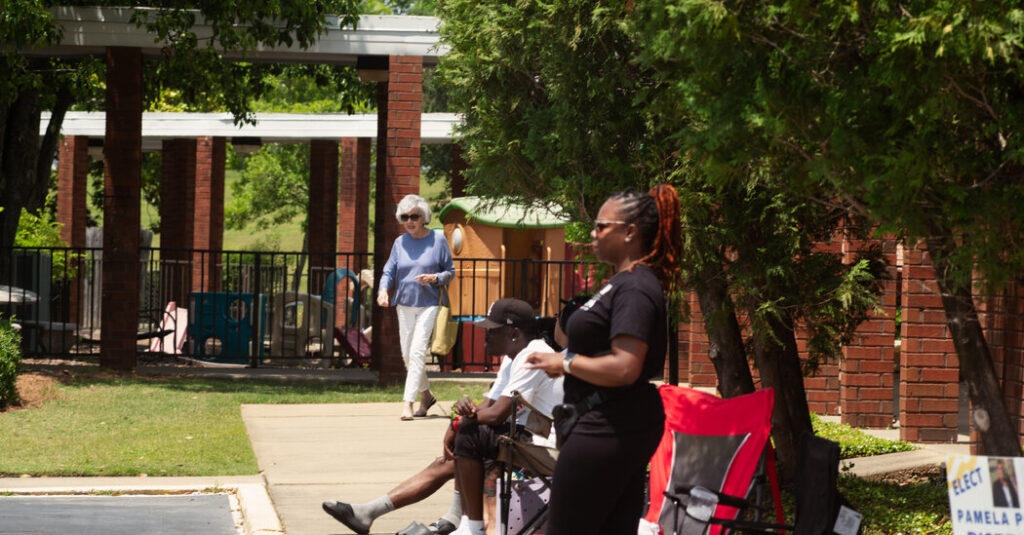
By the time Alabama voters braved the sweltering heat to cast their votes on Tuesday, many of them had heard about the redistricting scramble set off by the Supreme Court’s decision last month to weaken the Voting Rights Act.
But this was the most unusual of primary days, as even the most informed Alabama voters did not know whether they would stay in the same district going forward.
The Supreme Court cleared away a key hurdle as Republicans push to use a map first passed in 2023 that would do away with one of two majority-Black congressional districts in the state. But a federal court must still allow Alabama to go forward with that map.
Confident of the eventual outcome, Gov. Kay Ivey, a Republican, has scheduled a separate Aug. 11 special election for four Alabama House districts that will change under the 2023 map. But with the primaries for governor, Senate and other posts proceeding on Tuesday, voters in the four limbo districts still went to the polls under the existing maps.
“There’s so many ifs, ands and buts,” conceded Senator Tommy Tuberville, a Republican now running for governor, after casting his vote in Auburn on Tuesday morning. “But,” he said, “I am for making sure everybody is represented in this state.”
Some candidates for races elsewhere on the ballot said they had spent the last few days making sure that people still turned out to vote amid the confusion.
“We have spent an enormous amount of energy and time getting out the word that, yes, you still vote,” said Pamela Portis, who is running for re-election to the Montgomery School Board.
The Second Congressional District, which stretches from the capital city of Montgomery to parts of Mobile along the Gulf Coast, is among the four districts that could change under new district lines. Representative Shomari Figures, a Black Democrat, won the seat in 2024 after the federal court ordered the state to use a map that created the majority-Black district.
Devan Flowers, who works in higher education, said he had fielded questions from students about the ruling and its implications.
“It’s about fairness and representation,” he said.
Several voters, speaking Tuesday after they cast their ballots, said they were frustrated or dismayed by the Supreme Court ruling and the Republican response to it.
“I feel like all I can do right now is vote,” said Karla Gier, 63, who is not Black but who said she was sensitive to the history of civil rights in Alabama and what it meant for Black voters to see the Voting Rights Act passed. She added, “Voting is all I got.”
Emily Cochrane is a national reporter for The Times covering the American South, based in Nashville.
The post Under a Cloud of Uncertainty, Alabama Voters Head to the Polls appeared first on New York Times.