On a mid-April day off Germany’s northeast coast, a Peruvian spiritual author and motivational speaker named Sergio Bambarén slipped into the Baltic Sea. He plunged his head into the chilly water and began singing to a humpback whale.
Mr. Bambarén is not a marine biologist. He had just arrived in Germany at the request of one of a pair of millionaires who were funding a private effort to save the humpback. The whale, nicknamed “Timmy” by the news media, had become stranded in March, and public officials had tried and failed to set him free several times.
Mr. Bambarén, who said he was the veteran of five humpback rescues, sang underwater as he touched the young whale. Timmy, he said, sang back: “He immediately felt we were trying to help him.”
At the time, it felt like an entire country was, too.
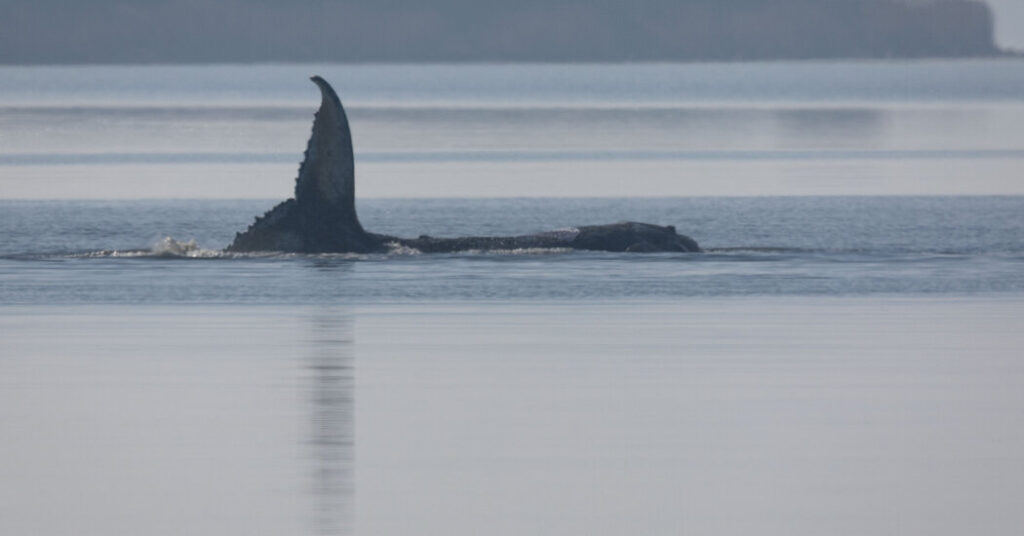
Crowds flocked every day to a sleepy lane on Poel Island, where they watched the whale lie half-submerged and mostly motionless in the water. Thousands more tuned in via livestream. People flooded online message boards and local government meetings, pleading for the whale’s rescue.
In that first month, Timmy seemed to bring out the best in the German public.
By the end, he’d brought out something else entirely.
Two cravings of modern Western life are for community and for conspiracy. In the two-plus months after he first wandered into the Baltic, Timmy satisfied both.
The whale became a tabloid star and a magnet for marine-mammal-adjacent social media influencers. He freed himself but got stuck again. His superfans turned on the experts who had tried, and failed, to set him loose, armed with elaborate theories about why the government wanted him dead. Government officials did, in fact, briefly consider killing him — for humanitarian reasons, they said — but decided against it.
Eventually, the officials allowed a rescue attempt by a private team funded by the two millionaires. One of them, Walter Gunz, the founder of a chain of German electronics stores, told us in a monologue interview that he was on a mission from God to save the whale. That team pulled Timmy from the bay, carried the whale to sea, and dumped him, to the shock of many of the rescuers, into a busy shipping lane. Soon after, the tracking device that rescuers had planted on the whale went silent.
The first reported sighting of the whale, entangled in a fishing net, was March 3 just off the German coast. The Baltic Sea is a rough neighborhood for humpbacks, largely because its waters aren’t nearly as salty as the Atlantic Ocean, and the low salinity impairs their buoyancy and can hurt their skin. Experts weren’t sure why the whale was there. On March 23, the whale got stuck again, on a sandbank near a beach town called Timmendorfer Strand. Inspired by the locale, media outlets, including Germany’s largest tabloid, Bild, began calling it “Timmy.”
The early rescue teams, blessed by the local government, were stocked with the sort of experts you’d expect to try to guide a lost whale back to its home: firefighters, coastal police officers, veterinarians and nonprofit groups that work in animal rescue. They were able to dislodge the whale, but again and again, he kept ending up stuck in the shallows.
On April 1, with the whale now stranded in the bay off Poel Island, the state environment minister, Till Backhaus, called off further the rescue attempts, saying it was clear the whale would die.
“We said, ‘Look, there’s no point,’” recalled Burkard Baschek, the director of the Ocean Museum Germany, who had been scientific director for several of the early rescue efforts. The whale was weak and still had a fish net stuck in his mouth. “It wouldn’t really, in the long run, make a difference,” he said.
“That’s,” Dr. Baschek added, “when everything kind of took a completely different direction.”
The German public was not ready to let Timmy go, and it grew furious with the experts who suggested they should.
Locals had heard the whale crying in anguish. People around the country had watched the rescue efforts play out on livestreams, connecting in the comment sections and forming group chats. They grew attached to main characters from the saga. One was named Robert Marc Lehmann, a charming biologist who fashioned himself as a social media whale-fluencer.
Mr. Lehmann swam with the whale during the early rescue attempts. Then some team members started questioning whether he was just chasing online stardom. Reporters questioned his scientific credentials. He disappeared, then resurfaced days later with an hourlong online documentary film that called the failed rescues unprofessional and uncoordinated. It helped feed the idea that Timmy could be saved if he just had more competent help.
More than 50 onlookers, many of them harboring strong sympathies for Mr. Lehmann, were on hand on April 17, the day another social media star, Mr. Bambarén, went swimming with the whale. Many in the crowd expressed deep distrust of the experts on the initial government-backed rescue teams, not to mention the local politicians.
Tabloids and TikTok fed their anger. Reporters and influencers recounted how Timmy was still breathing. Sometimes he moved his tail or a fin. Sometimes he spouted water. He rolled over. The authorities were watering the whale’s exposed backside with a sprinkler to keep him comfortable, but weren’t doing anything else. A local company was supposedly preparing to turn the whale carcass into biodiesel fuel.
Bild, which was chronicling developments around the clock, said the state environmental minister was facing death threats after nixing further rescues. Someone had reported him and other rescuers to the police for animal cruelty.
The minister, Mr. Backhaus partly bowed to his critics, allowing an amateur rescue plan to proceed, under the funding and direction of the two millionaires. “I’m a believer,” Mr. Gunz told us, explaining his motivations. “When the human ear becomes God’s ear, and the human hand becomes God’s hand — that is when one wants to help.”
Those rescuers operated in secrecy. They gave no news conferences. They had their own headquarters, including their own portable toilets, down the beach from reporters and other onlookers.
The people gathered to watch them were at once sad and hopeful, curious and conspiratorial. A man named Marco Thomas expressed a prevailing theory among Timmy’s fans. He had read online, he said, that Timmy’s skeleton had been promised to a local university and that plans had been made for recovering and transferring the body once the whale died.
Occasionally brushing back tears, Mr. Thomas suggested that was why authorities had not done all they could to save the whale.
“It was clear from the start,” he said.
Some Timmy fans were convinced that the museum wanted the skeleton so it could be displayed to attract more visitors and make more money. “I didn’t want him to die for the museum,” said Marianne Hess, a former financial adviser in Hamburg, Germany.
Ms. Hess, who connected with others via TikTok about Timmy and became part of the privately funded rescue mission, said she was appalled that museum officials were discussing what would happen to the remains of Timmy while he was still alive.
(The museum planned to keep the skeleton if the whale died, but only for research purposes and not for an exhibit, Dr. Baschek said.)
While anger at the authorities festered, the private rescue team struggled. Its leaders had an untested idea to move the whale using inflatable pontoons, then tow him back to the ocean. Their first effort failed.
Jenna Wallace, a veterinarian in Honolulu, said that a team member reached out to her after seeing her social media posts criticizing the initial government-backed rescue attempts. The millionaires flew her to Germany to help.
Dr. Wallace stayed for just four days, but it was enough to convince her the rescue effort was, in her words, a “dumpster fire.” It was run by a 22-year-old student, a YouTuber and Mr. Bambarén. One of the rescuers almost got smacked by the whale’s fluke for standing too close. Others discussed using resin to attach an Apple Watch to the whale.
Hearing Mr. Bambarén talk about how he communicated with whales by song, Dr. Wallace’s concern deepened. “He was literally sticking his face in the water next to the whale, like making noises,” she said in a phone interview. “I’m like, ‘Jesus Christ.’”
(Mr. Bambarén said that Dr. Wallace spent most of her time in Germany sleeping off jet lag in a van, something she denied.)
In late April, Mr. Bambarén and a team of colleagues pulled Timmy, using a soft fire hose, onto a transport barge. He passed through a small channel that the rescuers had dug for him. “He didn’t suffer and he knew we were helping,” Mr. Bambarén said. They boarded boats and sailed with the barge carrying Timmy toward the Atlantic Ocean.
The plan had been to release Timmy far into the North Sea, off the coast of Norway.
But Pedro Baranda, a marine biologist who flew in from Norway to assist with the rescue, said he woke up early on May 2 and found no one in the ship’s dining room where the team congregated for coffee, eggs and fruit each morning. Looking through binoculars from the bridge, he saw a tugboat had taken people to the barge more than 150 yards away.
Jeff Foster, a marine mammalogist, said he had boarded the tugboat to assess the whale’s condition, but not to release him. He was standing on the tugboat’s bridge when he saw a diver — who was part of the crew but had no experience with whales — enter the barge holding Timmy and push Timmy’s head to try to turn him around. Mr. Foster, horrified by the whale’s treatment, filmed the diver. Mr. Foster said the tugboat captain demanded that Mr. Foster stop filming and try to wrestle his phone out of his hand.
“He was a big guy, and I wasn’t wanting to get into more of a conflict with him than I already had,” said Mr. Foster of the captain. Mr. Foster stopped filming.
Eventually, Timmy was dragged out of the barge. “This poor animal,” Mr. Foster said. “He didn’t know what the heck was going on.” (A lawyer for the captain and crew said that they were acting under instructions from the private rescue team and that the captain never threatened to throw Mr. Foster’s cellphone into the sea).
Mr. Baranda watched as Timmy was released into the water, far sooner than was planned, off the northern tip of Denmark. “When I saw the whale breaking free and alive, I wanted to scream of happiness,” he said. “And then I went back into a rage.”
When the team that had released Timmy by surprise came back onto the ship, Mr. Baranda shouted, “What was that?” using an expletive. Mr. Baranda said he was never told who authorized the whale’s release or why it was done in secret.
There was no sign of Timmy for two days. Then a tracker attached to the whale began transmitting data that showing that he had made several deep dives, including one to nearly 500 feet (150 meters). He traveled 150 miles in the next five days, Mr. Foster said. On day seven, the tracker stopped working.
Last Thursday, a humpback corpse washed up on the tiny, windswept Danish island of Anholt, which sits between Denmark and Sweden.
Bild splashed a story. A day later, the tabloid proclaimed a “sad end” to its beloved whale. It published a photograph of sea gulls feasting on the carcass. The headline seemed to answer its own question: “Are they eating Timmy?”
Were they? Even then, many superfans in the rescue team and online held out hope. That Timmy was still out there, swimming happily. “90% chance it’s NOT OUR WHALE,” Mr. Bambarén said by text on Saturday.
For the public, it was likely very hard to understand that there was nothing rescuers could do to save the whale, said Dr. Baschek, who, like others involved in the early rescue attempts, received hateful messages and threats from people who said he wanted the whale dead.
People already skeptical of government were happy to believe that scientists and local ministers were colluding to let the whale die. “It makes a lot of sense in their world,” Dr. Baschek said.
On Saturday, the authorities confirmed that the carcass that washed ashore was Timmy’s because the tracking device was still fastened to the whale’s back.
There were no plans to remove the body from the area or to perform a necropsy, officials said. They warned people to keep their distance. “The whale may carry diseases that can also be transmitted to humans,” officials explained, “and there may also be a risk of explosion.”
Sarah Kaul Hoelgaard, a student at the University of Edinburgh, who happened to be in Anholt at her family’s vacation house, said she went to see the whale for herself on Saturday afternoon.
The beach was almost empty aside from three reporters, she said.
There was a sole camera on a tripod, with no one behind it, pointed at the whale carcass. It was livestreaming.
Tatiana Firsova contributed reporting from Poel Island and Berlin.
Jim Tankersley is the Berlin bureau chief for The Times, leading coverage of Germany, Austria and Switzerland.
The post Timmy the Whale Got Stranded Off the German Coast. Then Things Got Weird. appeared first on New York Times.