Dear reader,
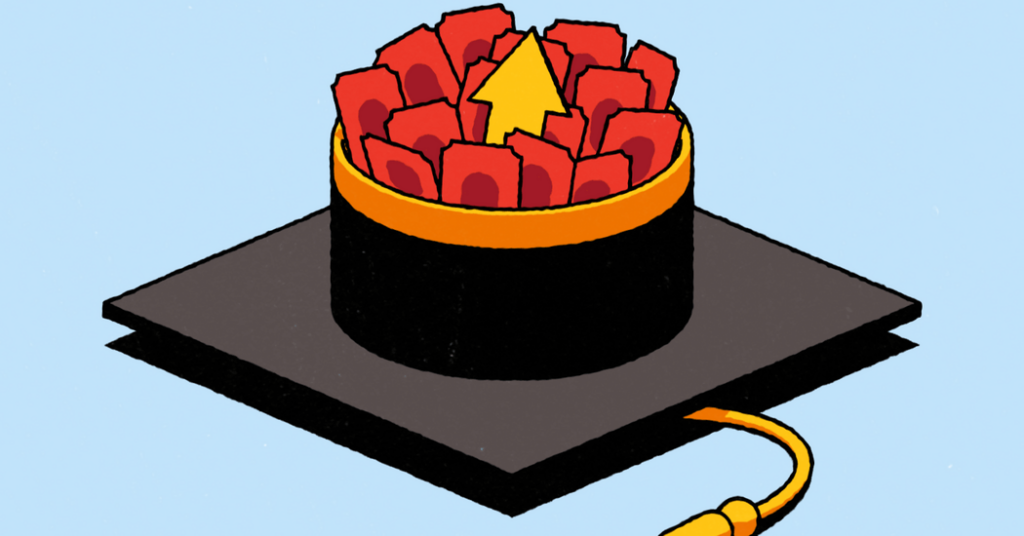
Once again, we return to the subject of the changing experiences of young people in the United States. One of the most significant policy changes sweeping across K-12 education in recent years has been the rise of school vouchers. These have long been a minor feature in the education landscape, but many states have now enacted voucher policies, and the number of students making use of them is shooting up.
We asked Susan Shain to help us quantify the growth of the so-called school choice movement and understand its impact on students and the nation’s school systems. Read on to get a sense of why the nature of K-12 education in different states might be diverging more sharply in the future.
— Matt Thompson
How many students use school vouchers?
About 1.5 million American students are estimated to be using school vouchers, many for K-12 private school tuition. That’s more than twice as many as five years ago, when there were roughly 608,000 students using vouchers.
But private school enrollment hasn’t doubled during that period. In fact, in states with universal voucher programs, it’s only risen by about 3 or 4 percent. So researchers believe that most of the new voucher recipients were already attending private schools.
Not all of the 1.5 million voucher holders are using their funds on tuition, either. While “voucher” is often used as a catchall term for a range of school choice programs, education savings accounts are actually more popular. Unlike traditional vouchers, which give households public funds for private school tuition, education savings accounts can go toward things like tutoring, transportation and learning materials, including for children who are home-schooled. Other school choice programs use tax credits and deductions to help parents pay for private school and other educational expenses.
Voucher participation data comes from EdChoice, an advocacy group. The organization relies on information from state agencies, such as education or revenue departments, in its annual calculation. Because state numbers can lag behind by one to three years, EdChoice said, “Our national estimate is a cautious one by design, and likely underestimates participation.”
How did vouchers come about?
Vouchers were popularized in the 1950s as a way for white families to self-segregate following the Brown v. Board of Education decision.
Later, in the 1990s, vouchers became a way to even the playing field, by allowing children with disabilities or from low income families or from underperforming schools to pay for private schools that they felt better served them. As such, they were available on a very limited basis: only in a handful of cities and states, and only to certain populations.
The movement’s priorities changed again in recent years, according to Huriya Jabbar, a professor of education policy at the University of Southern California. “There’s been a shift from arguments for school choice being for equity and quality to more of a focus on liberty, or the idea of choice for choice’s sake,” she said.
A swirl of factors brought that about. There was the pandemic, with its mask and vaccine mandates that supercharged the parents’ rights movement. There was the release of Project 2025, which champions school choice, and the influence of Christian conservatism, which advocates more religious education, in the Trump administration. And last year, a record-low share of Americans expressed satisfaction with the K-12 system.
In a climate that was suddenly ripe for school choice, 18 states introduced universal vouchers open to any student, regardless of background. Florida and Arizona now have the largest programs, with the former spending almost a quarter of its K-12 education budget on vouchers each year.
How are vouchers changing education?
Vouchers remain divisive. (When put to a vote, most ballot measures that would put public money toward private schooling have failed.)
Advocates say vouchers let parents select the education model that’s best for their children, force public schools to compete and improve their offerings, and lead to better educational outcomes. Critics say they take pupils and funds away from public schools, give money to well-off families whose children already attend private schools and leave students worse off educationally.
Research on the effects of these programs on educational outcomes is limited, and presents a complicated picture. The U.S. is unique in that most states don’t require schools that receive vouchers to administer standardized tests, making comparisons to public schools difficult. Selection bias can also make constructing rigorous studies tough. And the rapid increase in voucher programs has left researchers scrambling to catch up.
What’s next for vouchers?
Next year, the debate will come into starker relief when the Trump administration rolls out the first-ever national voucher program, allowing taxpayers to get a tax credit for donating to scholarship funds that families can use for K-12 educational expenses. The program is optional for states, with some Democratic governors already saying they won’t participate.
Douglas Harris, an economics professor and voucher expert at Tulane, doesn’t foresee the new law having a huge impact, at least not at first. But he does predict the number of voucher users will continue to grow.
Unlike their public counterparts, private schools can turn away students based on almost any factor other than race: gender, disability, sexual orientation, behavior. They can also teach religion.
Those are major draws, Harris said, because research suggests that many families leave public schools not just for academic reasons, but often to find a better religious or cultural fit, or to avoid classmates with disciplinary issues.
In the coming years, Harris thinks the bifurcated nature of education, wherein blue states eschew vouchers and red states embrace them, will become even more pronounced. In voucher-heavy states, Harris said, public schools could eventually become “the schools of last resort.”
“It’s a slow moving freight train in the sense that it’s not moving fast, necessarily, but it’s moving with great force,” Harris said. “It’s very likely you’ll see more and more families leaving public schools.”
What can I check out next?
-
Dana Goldstein, an education reporter for the Times, wrote about how the increase in vouchers is changing both public and private schools.
-
Education Week offered an overview of the school choice landscape and the research surrounding it.
-
Joshua Cowen, an education professor and author of “The Privateers: How Billionaires Created a Culture War and Sold School Vouchers,” said that such programs hurt students in a TIME opinion piece in 2023.
-
In contrast, Jorge Elorza, a leader of Democrats for Education Reform, argued that school vouchers would improve public education in the Times Opinion section earlier this year.
-
In Texas, the last major Republican-led state to pass a universal voucher program, some Islamic schools had to sue to be included. On another note, the Times reports, the state’s billion-dollar voucher program could make child care more affordable.
— Susan Shain
Your turn
Test your knowledge: Nationwide, about how much funding do public schools receive from the federal government?
Tell us your thoughts: What do you think of the increase in school vouchers? If you’re a parent, do you use them for your child’s education? If you’re a teacher, how has your work been affected by them? Please email your thoughts to [email protected].
Following up: Our look into the rising burden of rent struck a chord with several of you. We heard from a few renters and parents of renters who attested to the impact of rising rents on their personal bottom lines. A striking share of respondents were on the other side of the equation — landlords and property developers who bemoaned the long-tail effects of growing property taxes, increasingly demanding building codes and other supply-side pressures on rent. The money-sucking pit of housing costs goes deep, in other words, which compounds the challenge of containing them.
Susan Shain contributed reporting.
The Headway initiative is funded through grants from the Ford Foundation, the William and Flora Hewlett Foundation and the Stavros Niarchos Foundation (SNF), with Rockefeller Philanthropy Advisors serving as a fiscal sponsor. The Woodcock Foundation is a funder of Headway’s public square. Funders have no control over the selection, focus of stories or the editing process and do not review stories before publication. The Times retains full editorial control of the Headway initiative.
The post School Choice Is Creating Two Separate School Systems appeared first on New York Times.