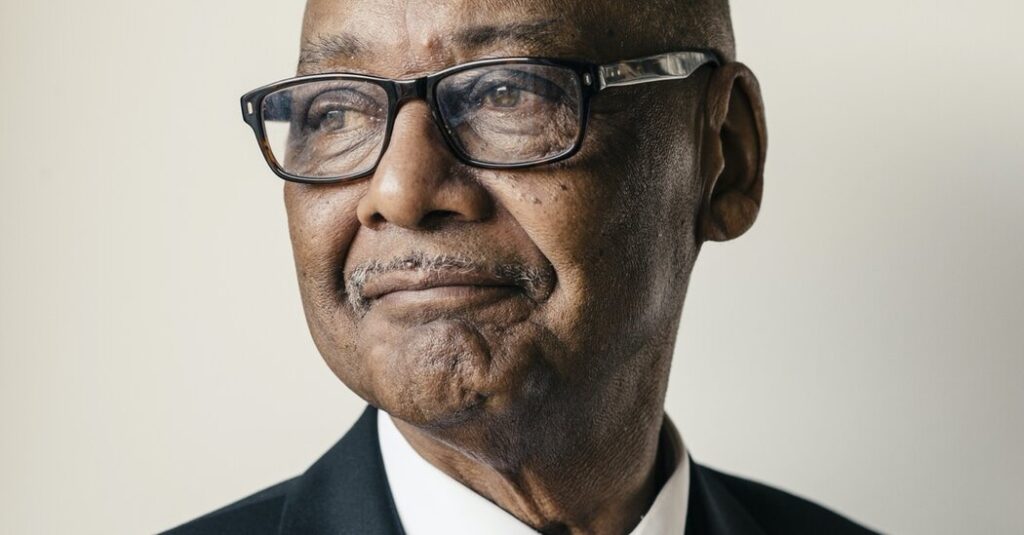
Robert L. Woodson Sr., a leader of the Black conservative movement who for a half-century worked to fight racism, poverty and crime in Black American communities by promoting self-help solutions and opposing government assistance, died on Tuesday at his home in Silver Spring, Md. He was 89.
His son Jamal Woodson confirmed the death.
Mr. Woodson climbed to prominence behind the civil rights protesters of the 1960s and the Black leaders who had struggled for economic and social gains in federal laws and courts. Reaching Washington’s inner circle in the 1980s, he conferred with Republican presidents, was regularly quoted in the news media and was once considered for a deputy cabinet post.
His core agenda opposed affirmative action and racial preference programs and promoted Black economic development and self-reliance. As the founding president of the Washington-based National Center for Neighborhood Enterprise, he created hundreds of programs in blighted areas across America, enlisting grass-roots activists to fight crime, drugs, unemployment, inadequate housing and family conflicts.
Rhetorically, he was a moderate compared with Shelby Steele, the provocative conservative Black author and Stanford professor who argued that the specter of racism had become a crippling fixation for Black Americans, an excuse for failing to cope with problems.
In 2019, though, Mr. Woodson was among the most vehement critics when The New York Times Magazine launched its “1619 Project,” with essays, articles and a campaign to reframe history by marking America’s founding not from the signing of the Declaration of Independence in 1776, but from the arrival of the first enslaved Africans in the Virginia colony in 1619.
The Times said its initiative was intended to place “the consequences of slavery and the contributions of Black Americans at the very center of our national narrative.” The project inspired praise, criticism and debate among historians and political commentators, some of whom challenged the accuracy and historical interpretations of its assertions, including the claim that the Revolutionary War was fought “to protect the institution of slavery.”
Mr. Woodson said The Times project “disparages the American Revolution and Declaration of Independence and insists that America is hopelessly racist.” His renamed Woodson Center and a group of Black scholars, journalists and entrepreneurs formed 1776 Unites, a nonprofit organization that promoted a counternarrative of Black community success stories seeking to refute what it called “the claim that the destiny of Black Americans is determined by what whites do, or what they have done in the past.”
Born into poverty in South Philadelphia, one of five children of a widowed mother, Mr. Woodson saw his best friend stabbed to death outside his grade school. At 17, alienated from his family and failing in high school, he dropped out and enlisted in the Air Force.
After returning to civilian life and attending college, Mr. Woodson joined the civil rights movement, directing community development programs for local and national organizations, including the N.A.A.C.P. These experiences brought him to a turning point, as he recalled in a 1995 guest essay in The Times.
“In the ’60s,” he wrote, “I broke with the established Black civil rights leadership and opposed court-mandated busing of Black schoolchildren. And I have spoken out against a liberal agenda that has trapped millions of low-income Blacks in a state of dependency and used the conditions of poor Blacks to establish race-based policies that benefit middle- and upper-income Blacks.”
Mr. Woodson’s opposition to vesting more power in local and state criminal justice agencies as a solution to crime won the support of Vernon E. Jordan Jr., the president of the National Urban League, and Representative John Conyers Jr., a Michigan Democrat and the chairman of the House Subcommittee on Crime. Called to testify before that panel, Mr. Woodson urged Black empowerment as a solution.
By the 1980s, with the arrival of Ronald Reagan’s presidency and Republican control of Congress, Mr. Woodson’s ideas gained wider traction. Mr. Woodson and Mr. Reagan spoke highly of each other in public, were allies on many aims for Black communities and had meetings on policies and proposed legislation.
In his second term, Mr. Reagan urged a fundamental restructuring of antipoverty programs and social welfare policies to encourage Black families to stay together and welfare recipients to take jobs. “The irony is that misguided welfare programs instituted in the name of compassion have actually helped turn a shrinking national problem into a national tragedy,” he told reporters.
There were prominent Black dissenters to the conservative Black agenda, including Dr. Kenneth B. Clark, the psychologist and educator, who denounced statements by some Black leaders and administration officials that he called tantamount to blaming the “victims for the cause of their own victimization.”
Mr. Woodson said that castigating the Reagan administration for the Black community’s problems was unjustified. “When Black people look back over this period, they may want to thank Ronald Reagan,” he said.
After George H.W. Bush became president in 1989, Mr. Woodson said that Jack Kemp, Mr. Bush’s secretary of Housing and Urban Development and a longtime friend of minorities, had offered him the job of under secretary, but that he had turned it down because he did not want to “go back to race-specific solutions” on housing. Mr. Kemp said he had spoken to Mr. Woodson about the deputy job, but had not explicitly offered it to him.
Robert Leon Woodson was born in Philadelphia on April 8, 1937. He was 9 when his father died, and his mother raised the family’s five children in a neighborhood afflicted with gangs, drugs and crime.
After being discharged from the Air Force, he received a bachelor’s degree in mathematics in 1962 from Cheyney State College, a historically Black school now called Cheyney University of Pennsylvania, and a master’s degree in social work from the University of Pennsylvania in 1965.
He and his first wife, Joyce Woodson, had two children, Robert Jr. and Ralph, before divorcing. Robert Jr., a presidential campaign adviser to George W. Bush and a former chief of staff at the Department of Housing and Urban Development, was killed in a car accident in 2003.
In 1977, Mr. Woodson married Ellen Hylton. In addition to their son Jamal, she survives him, along with his son Ralph; a daughter, Tanya; five grandchildren; and two great-grandchildren.
Mr. Woodson wrote hundreds of newspaper and magazine articles and several books on youth crime and urban policy, including “The Triumphs of Joseph” (1998), on reviving neighborhoods. He also lectured widely at colleges and community centers.
In the 1970s, he worked for the N.A.A.C.P. on community development programs; for the liberal National Urban League on criminal justice in New York City; and for the conservative American Enterprise Institute on neighborhood revitalization in Washington.
He found them all to be ineffective. In 1981, he founded what became the Woodson Center for Neighborhood Enterprise as an alternative to left- and right-wing private groups and government aid programs.
It became his life’s work.
Charlotte Dulany contributed reporting.
Robert D. McFadden was a Times reporter for 63 years. In the last decade before his retirement in 2024 he wrote advance obituaries, which are prepared for notable people so they can be published quickly upon their deaths.
The post Robert Woodson, Leader of the Black Conservative Movement, Dies at 89 appeared first on New York Times.