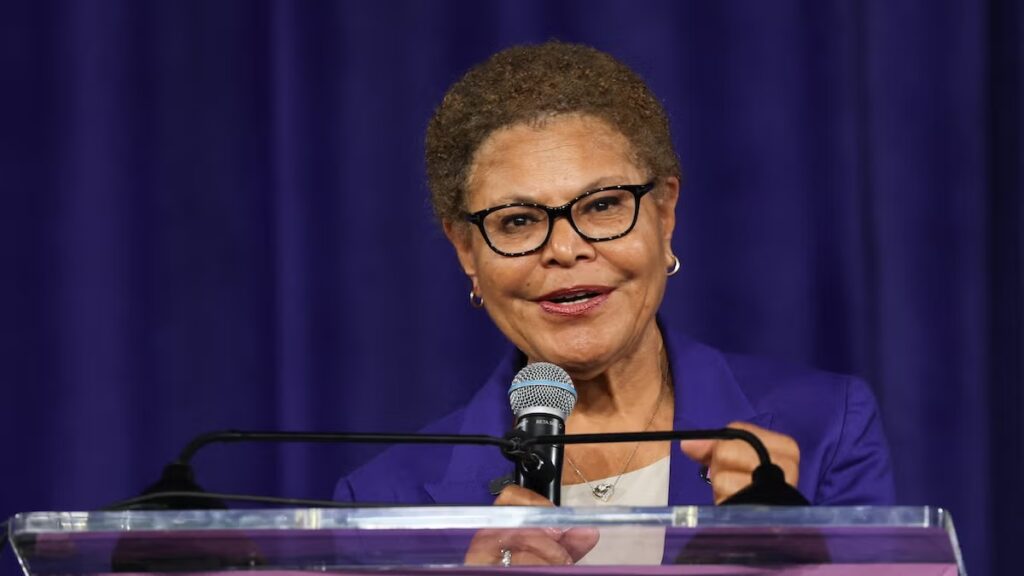
Mayor Karen Bass renewed her dedication to local film and TV production in an interview Tuesday, telling TheWrap that if reelected in November, she will continue to eliminate “onerous and unnecessary” processes that make it difficult to film in Hollywood.
“I’m open to eliminating or changing or waiving whatever is in the way,” the mayor said in a Zoom interview.
Entertainment industry employees had been critical of the mayor for not appointing a film liaison until three years into her term. As she has been campaigning for reelection, her primary opponents, Councilmember Nithya Raman and Spencer Pratt, both criticized her for passing legislation to support production in the last year of her term.
The mayor shot down these accusations, stating that she established an entertainment industry cabinet when she first took her seat as mayor in 2022. She added that since her Sacramento days as speaker of the house she has supported the film and TV industry and introduced the first state tax credits to the budget.
“The industry asked me to expedite permitting and get rid of the red tape. We did that. The industry asked us to lower the cost of filming in the city. We did that,” the incumbent said, additionally addressing her efforts appointing Steve Kang as the city’s film liaison. “The whole goal was to provide a concierge service for the industry, which means if there is a problem, a speed bump or a roadblock, it’s Steve’s job to eliminate that.”
Bass also addressed how her office will work with LA28 to prepare for the upcoming Olympics games. When asked about collaborating with Casey Wasserman, after she publicly called for him to step down as chairman after his Epstein ties, she distanced herself from the committee, saying that her duties are separate from those of the board.
“LA28 is a separate organization that I do not have control over,” she said. “My job is to make sure that the city is prepared for the Games, and so that is my focus.”
The following interview has been edited for clarity and length.
The entertainment industry was critical that it took three years into your term to appoint a film liaison. Now we have Steve Kang. If you’re reelected, how would you build upon what you started with him and what would the film liaison’s office look like?
Mayor Karen Bass: Well, let me just go back a bit because what I did when I first came in [as mayor] was establish an entertainment industry cabinet.
I have worked with the industry from day one of my administration, but I also started working with the industry more than 20 years ago. In terms of the industry, it was their request, so they went back and forth as to whether they wanted a czar, whether it should be somebody in the industry or not in the industry.
I asked them for resumes, and after many, many months, they came to the conclusion that they didn’t want it to be somebody from the industry, they wanted it to be somebody from the city who knew the city process.
I could have made that appointment many, many, many months beforehand, but the industry was not ready for that, and I happen to be a believer that the best way to do policy is to do it with people rather than just coming in and deciding what everybody wants, and so what we have done with the industry has been in that regard.
Anyway, I’m happy to talk about my past with the industry, or to move forward and tell you what work we have done together.
If you’re reelected, how will the film liaison’s office continue to grow and support bringing production back to L.A.?
It’s not just Steve. There’s two people. The whole goal was to provide a concierge service for the industry, which means if there is a problem, a speed bump or a roadblock, it’s Steve’s job to eliminate that.
The industry asked me to expedite permitting and get rid of the red tape. We did that. The industry asked us to lower the cost of filming in the city. We did that. We reduced the price it cost to film. For example, at Griffin Park, the observatory, it used to cost $100,000. We cut that by 70%. We also opened up iconic buildings that the industry wanted to film in to reduce the cost, we cut down the number of staff from the city that has to be on location.
Each and every one of those items we have done have been what the industry requested.
There’s been a lot of discussion about how to navigate special conditions in permitting that can be burdensome for productions. How do you plan on tackling that going forward?
Let me just say that it’s tough because there could be so many examples, but that is again in part Steve’s job. If there are special conditions that are particularly onerous or unnecessary — it doesn’t even have to be onerous, it could just be unnecessary — then we will move those out of the way.
Parking was a particular issue with “Baywatch.” It took us a minute, but we were able to change that. Sometimes something has to come up for us to see that it’s a problem, and when it does, we deal with it. I think you’re giving a perfect example as to why the industry did not want an industry person [as liaison]. They wanted it to be somebody in the city who can advocate the city bureaucracy, so that’s my general comment to that, without knowing which special conditions you’re talking about.
We’ve heard some candidates say that they support this idea of just wiping the slate clean [with regards to red tape at the city level], starting from the beginning. Are you willing to go that far, or is it something that you want to take a more measured approach to?
I’m open to looking at any special condition. There’s a lot of stuff in the city that happens because it’s always happened for no particular reason, or maybe it made sense 25 years ago, and makes no sense right now. Unfortunately, those things kind of have to come up, as opposed to there’s some magic list somewhere that I could just say I’m eliminating all these things.
I’m open to eliminating or changing or waiving whatever is in the way. I have to answer it generally that way without knowing what the specifics are.
You recently announced a temporary pilot program with FilmLA creating lower-cost permits for smaller productions. Are there plans to make it permanent?
The other way that I believe in doing policy is: you start and you evaluate it along the way. It’s still a little bit too new right now to say one way or another, but if it works, we will expand it, and we will absolutely make it permanent.
But I don’t want to rush, because it might have some unintended consequences. There’s any number of problems that could be. I prefer to test things out before making them permanent.
You called on Casey Wasserman to step down as chairperson of LA28 earlier this year over his relationship with Jeffrey Epstein associate Ghislaine Maxwell. Do you still have full confidence in his leadership as we’re looking toward the Olympics?
What’s very important for people to understand — and a lot of people are confused by this — LA28 is a separate organization that I do not have control over. A lot of people think I do. It’s the board decision to retain Casey Wasserman.
My job is to make sure that the city is prepared for the Games, and so that is my focus. I expressed my concern, I expressed my opinion, but now I have to focus on getting the city ready and making sure — and this is so important to me — making sure that the city of Los Angeles, our local businesses, profit off of this.
I don’t want the usual suspects to be the ones that make all the money. I don’t want the usual locations to be the only locations that people visit in our city. I want people from around the world to know about Watts and South L.A. and East L.A. and the San Fernando Valley and the cultural traditions. I want to have murals freshened up, new murals painted around our city. We are a city that is beaming with culture, beaming with diversity. That is my job in regard to the Olympics.
We know the D Metro line opened up, but in what other areas are you making sure that the city is prepared?
My job is to promote our businesses, and let me just give you an example with the World Cup, because we’re not waiting for the Olympics.
The World Cup happens in just two weeks, mid-June. We have organized watch parties and celebrations all around the city, fan festivals, and that is specifically designed for neighborhoods to profit.
The businesses that almost shut down because of the ICE raids, I want them to be able to have a real infusion of cash from these games, because what tends to happen, like most places, a handful of people benefit because they’re the only ones deemed worthy, and everybody else loses. I don’t want that to happen this time, not on my watch.
As you’ve been campaigning for reelection, what accomplishments do you identify from your first term to show voters the momentum your office has to keep moving forward?
For the first time, we have had a reduction in street homelessness by almost 18% while homelessness went up around the country 18%. We have had low rates of crime, especially homicide, a 60-year low. I have fast tracked 42,000 units of housing — 6,000 of those units currently under construction. Our environmental goals, we have already surpassed. I was at a site yesterday around groundwater, where we are basically moving forward to being independent in our water supply. That has been a problem over the last 100 years.
The problems that I walked into have been around for three to four decades. What is true is that I didn’t solve 40-year-old problems in three years.
But I’ll give you an example. Our broken sidewalks, our street lights that are out, the nation’s second largest city has not had a comprehensive plan to deal with its infrastructure. For the last two years, we’ve been working on a comprehensive plan to deal with that, and I rolled it out a few weeks ago. I’m running for reelection because I want to have an opportunity to continue to move forward with all of this.
It’s not good enough to have a plan. I want to operationalize the plan.
Jeremy Fuster contributed to this report.
The post Karen Bass Says She’s Ready to Cut More Red Tape for Local LA Production: ‘Whatever Is in the Way’ appeared first on TheWrap.