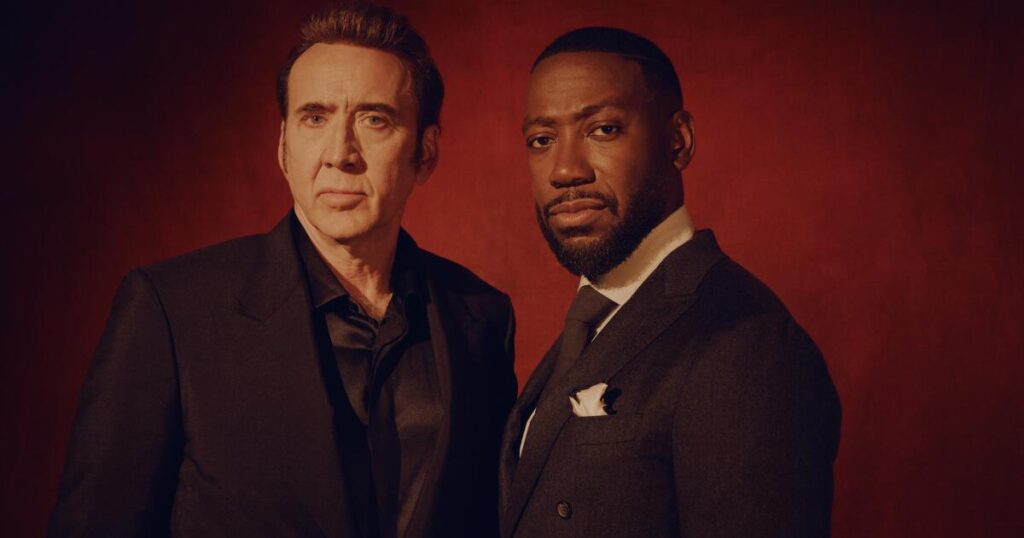
Like a detective connecting with a source in a classic movie from a bygone era, Nicolas Cage met with showrunner Oren Uziel for lunch at Bottega Louie in downtown L.A. back in 2024.
The subject of their midday rendezvous: “Spider-Noir.” In the live-action series, out May 25 on MGM+ channel and streaming May 27 on Prime Video, Cage transforms into a new iteration of the arachnid superhero that he voiced in the Oscar-winning animated film from 2018, “Spider-Man: Into the Spider-Verse.”
For his take on “Spider-Man Noir,” the comic book that’s the basis of the series, Uziel left behind Peter Parker and aged up the character with Cage in mind as the ideal embodiment of a 1930s private investigator in a film noir-inspired universe set in New York City (though filmed in Los Angeles). The hero Cage plays, Ben Reilly, has a masked alter ego, the Spider, who possesses the ability to swing from building to building to fight crime.
“When we first sat down, Nick definitely was feeling me out and my chops in both genres. He loves comic books so much and he loves noir way more than I knew,” says Uziel during a recent video interview. “He has an encyclopedic knowledge that’s similar to mine. I passed that test and we really got comfortable with each other.”
Episodic television represents a new frontier for Cage, an actor who, despite having a fabulously eclectic body of work to his name, had not embraced the small screen. It was important, he says, that he waited for something special to finally make the jump.
“My love was cinema, and I was primarily interested in cinema. But I had done it for 45 years,” Cage says over a video call. “It happened on ‘Dream Scenario,’ I thought to myself, ‘I’ve done what I pretty much wanted to do in terms of film performance. How am I going to stay interested?’ I’m 62 years old now. I need to branch out. I need to go into another format.”
“Spider-Noir” lured him with the promise of coalescing the fast-talking acting style of film noir, for which he channeled iconic stars like Humphrey Bogart and Edward G. Robinson, with the fantastical elements of comic books, in particular the monstrous villains. All via a contemporary superhero like “Spider-Man,” arguably Stan Lee’s most popular creation.
“For me, that mashup was almost like a Lichtenstein painting,” Cage explains. “I like to get ideas from other forms of art, whether it’s music or painting. In this case, it was certainly the Pop art of Roy Lichtenstein.”
Bringing back that seemingly outdated approach to film performance, with its unique speed and humor, for a modern, big-scale series was a risk for the producers, Cage admits, and a vote of confidence in him. “It took guts and took trust and some amount of love,” he says.
“I wanted to bring that voice I had done in the animated movie and pair it with my actual instrument, which is my body,” Cage continues. “When Amy Winehouse had done her ‘Back to Black’ [album], she was inspired by the jazz crooners of yesteryear. I thought, ‘Let’s not forget the great film actors of yesteryear and that style that they had.’ It’s no secret that I’ve tried to experiment and to push myself to places that are a bit risky.”
For Cage, it’s a combination of its visual aesthetic and the moral ambiguity of the mysteries and illicit affairs in film noir that have made the genre endure among cinephiles.
“There’s an authenticity to noir. Nothing is just black or white. Everything is chiaroscuro and there’s complexity and depth and nuance to each of the characters,” Cage explains. “A lot of the stories they have to tell are not so good. There are people doing things to each other that are not very nice, but that’s part of the danger of being human.”
Aside from speaking in a period-appropriate tone with the right inflections, Cage infused his performance with a certain cheekiness. That attitude, he says, is most notable in his scenes with Li Jun Li, whose femme fatale character Felicia “Cat” Hardy, a nightclub singer, knows more than she wants to reveal. Felicia plays with Ben, and he likes it, Cage thinks.
“When you watch Humphrey Bogart in movies like ‘The Big Sleep’ or ‘The Maltese Falcon,’ he always looks like he’s enjoying the corruption and the wicked ways of the other characters as they’re doing something really wrong,” Cage says smiling. “It makes him laugh because he knows it’s just so deliciously bad that he gets a kick out of it, but he is going to do something about it.”
In a unique move by Sony Pictures Television, which produced “Spider-Noir,” and Prime Video, the series will be available in two versions: “Authentic Black & White” and “True-Hue Full Color.” One pays faithful homage to the original film noir titles of the 1940s, while the latter aims to entice audiences who might not be familiar with the monochromatic palette. Cage recalls suggesting making the show in both options to Jennifer Salke, at the time the head of Amazon MGM Studios.
“There was a lot of talk about the black and white and I knew why. Try to get a 12-year-old to sit down and watch ‘Captains Courageous’ with Spencer Tracy. It’s not easy,” Cage says. “Some of them are interested, and a good movie is a good movie. I’ve tried to do that with my family, but if you’re going to try to get a whole culture of teenagers to watch a show on black and white without any real experience with black and white, it would be tricky.”
Making a strong case for the color version of the show, however, are the eye-catching suits and ties that television veteran and Emmy-winner Lamorne Morris wears as journalist Robbie Robertson, Ben’s best friend.
The moment Morris heard that a project involving Cage and Spider-Man was in the works, he immediately knew it had to involve “Spider-Man Noir,” and he wanted in. Eager to audition for a part in the show, Morris received “one of the wildest calls” of his life.
“I was getting mentally prepared for it because I don’t like auditioning that much because I’m not the best at it. But I wanted to be a part of this. But they called me in for a meeting,” he recalls. “In the room, they were pitching it to me, like, ‘Hey, would you be interested in doing this?’ And I was just like, ‘How much do I have to pay you to be a part of it?’”
For Morris, stepping into the shoes of a Black journalist working during the Great Depression and in a still segregated reality entailed meaningful research. That led him to Ted Poston, one of the first Black journalists to work for a mainstream publication.
“They call him the ‘Dean of Black Journalists’ and he worked with the New York Post. When I was looking into Ted Poston, I was like, ‘I feel like they based Robbie Robertson off of him,’” Morris says. “Maybe I’m wrong, maybe I’m right, but I’ll leave that up to the fans out there. But that’s who I geared my performance after because they share similar sensibilities.”
Robertson is a different kind of paladin that also deserves admiration, Morris believes. “People think that superheroes have to wear a mask, or be able to fly and jump from building to building or be invisible,” he says. “That’s not the case in real life. Heroes are the people who arm other people with information.”
Late in the series, Morris shares a scene with Cage where their characters are sitting on a park bench. It’s an intense moment that remains ingrained in Morris’ mind. The validation he received there from Cage, whom he describes as “a legend,” felt like a priceless reward.
“When you’re going toe to toe with somebody like that, you have to get out of your own way. You have to stop being a fan for a moment and just perform. I’m really proud of my work in that scene,” Morris says. “But I was more excited about the fact that Nick would gimme like a little wink afterwards, like saying, ‘Well done,’ and I’m like, ‘Holy s—, this might be good!’”
For his part, Cage mystified people on set with the spider-like moves he did to convey what was happening to his character’s body. “He’s almost more spider than human, which is a very Nick Cage take that I loved,” Uziel says. “Even when he’s walking around as Ben Reilly, his performance is infused with that underlying situation that he’s got spider DNA.”
The most satisfying aspect about long-form television, Cage thinks, is the ample space allowed to collaborate in shaping his character over the course of the production.
“I wrote an email to Oren, and I said, ‘Why don’t we think about him going to the movies to try to become more human,’” Cage recalls. “Oren and I worked something out with the dialogue on the fly right before we shot. It was late at night. I’m in the diner and I started talking about thoughts and impulses, ‘I can control it,’ pause, pause, pause, ‘most of the time.’ And it’s kind of dangerous, maybe he’s going to eat somebody like a spider.“
The always candid Cage acknowledges that television had not been a major part of his media diet until one of his children made a recommendation. “What happened was my son, Kal, he sat me down and said, ‘Watch this show “Breaking Bad.” ’ I had not watched any recent television,” he says.
Cage recalls watching an episode where Walter White, played by Bryan Cranston, stares at a suitcase for “an incredible amount of time.” “I couldn’t take my eyes off it, and I thought, ‘What’s in the suitcase? Is he going to open it or is he not going to open it?’ And I realized you can’t do that with a movie. You don’t have that kind of time.”
Television, however, requires a different type of time commitment from the often more concise production of a feature film. “He was definitely apprehensive. If you’re making ‘Longlegs,’ he’s probably working a week,” says Uziel. “But this was five or six months of a lot of work for Nick and he’s No. 1 on the call sheet and he’s in a lot of the scenes.”
Cage dedicated himself fully to this new-to-him process, though it did require some adjusting. “You get two episodes with one director. I got four different directors, and each time you work with a new director, you have to get in step with that director and get a flow, which is what you do on a feature film, but you just don’t have the time to get up and running with each director right away,” Cage explains.
However, “Spider-Noir” is not Cage’s first foray into comic book adaptations. In two films, “Ghost Rider” (2007) and “Ghost Rider: Spirit of Vengeance” (2011), he played the titular biker with supernatural prowess.
“It’s definitely not the easiest character to take the whole family to,” he says. “Like, ‘Dad, why does he light his head on fire like a skull? What is that Penance Stare thing he’s doing?’ ‘Well, son, he sold his soul to the devil. And by the way, would you like some Milk Duds?’ It’s a complicated philosophical character, but he looks cooler than all the other characters.”
Superheroes, Cage thinks, boost the morale of those who find them inspiring, as he did as a child when the contradictions of the Ghost Rider or Hulk awoke his “philosophical complexity as a thinker,” because they looked terrifying but were doing good.
“There’s a Jungian connection to these characters that creates a secret identity for many people,” Cage says. “Believe it or not, I have seen paramedics wear Batman or Superman T-shirts under their uniform. It’s a Jungian egregore or a power channel that people tap into to give themselves strength privately.”
The post In ‘Spider-Noir,’ Nicolas Cage and Lamorne Morris helm a visual superhero spectacle appeared first on Los Angeles Times.