Federal agents on Tuesday detained a 21-year-old Honduran man at an immigration court in New York City, an action that his attorneys said defied a federal judge who barred such arrests a day earlier.
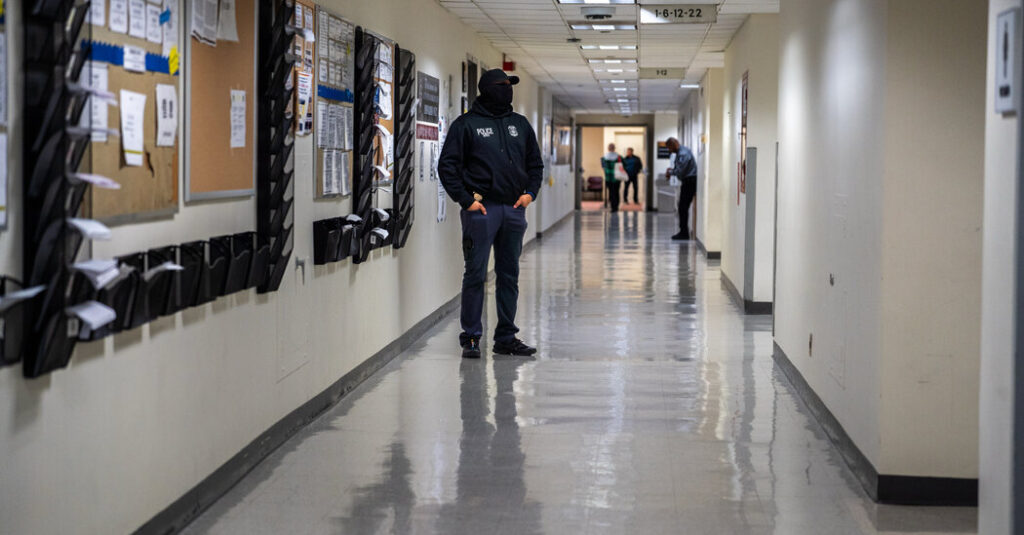
The arrest was made on Tuesday morning at 26 Federal Plaza, one of three immigration courthouses in Manhattan that a judge, P. Kevin Castel, had ruled on Monday were off limits for arrests.
Lawyers for the man, Vinely Alexander Castillo-Norales, said the arrest occurred despite an order that allowed the Immigration and Customs Enforcement agency to make courthouse arrests only in extremely limited circumstances, none of which appeared to apply on Tuesday.
“His arrest is in direct violation of an order in this court — issued just yesterday,” the man’s lawyers said in a petition filed on Tuesday in U.S. District Court in Manhattan.
But on Tuesday evening, after repeated inquiries from The New York Times, the federal government took two seemingly contradictory actions: They released Mr. Castillo-Norales from custody while simultaneously claiming he was a dangerous criminal.
Shortly after Mr. Castillo-Norales’s lawyers issued a statement Tuesday evening saying he had been released, the Department of Homeland Security responded to requests for comment, claiming Mr. Castillo-Norales was an active member of the Bloods street gang and had faced charges for burglary, robbery, larceny and possession of stolen property.
“ICE did NOT violate any court orders,” the statement said. “Nothing prohibits arresting a lawbreaker where you find them, especially illegal alien gang members.”
The department did not immediately respond when asked why Mr. Castillo-Norales had been released, nor did it clarify where he had been charged.
In their petition, lawyers for Mr. Castillo-Norales said only that he had never been convicted of a crime. Chloe Chik, a spokeswoman for their organization, the New York Legal Assistance Group, said that the department was “obviously grasping.”
“Arresting anyone on unfounded claims subverts the rule of law and could have a lasting impact on everyone’s civil liberties,” she said.
The Manhattan U.S. attorney’s office, which represented D.H.S. in court, declined on Tuesday to comment on the arrest.
On Tuesday, before Mr. Castillo-Norales was released, Judge John G. Koeltl, also of federal court in Manhattan, set a telephone hearing for Wednesday morning. That hearing could provide an opportunity for the government and the Honduran man’s lawyers to air their competing claims.
Since the early days of President Trump’s second term, his administration has taken an unusually belligerent posture toward the federal courts and federal district judges in particular. But open defiance of a judge remains rare.
If the Manhattan federal court were to determine that Mr. Castillo-Norales’s arrest violated Judge Castel’s order, it would be another chapter in a remarkable sequence of events: The federal government had acknowledged earlier that ICE had committed a legal error that enabled the arrest of thousands in violation of its own policy. That admission prompted Judge Castel to block the practice, the cornerstone of the Trump administration’s immigration crackdown in New York City.
The administration had said that courthouse arrests are simply a practicality, allowing agents to avoid the dangerous circumstances that might arise in the field. Their critics have responded that detentions at immigration court have a chilling effect on the entire system, leading immigrants to avoid routine hearings for fear of being arrested.
According to the petition filed on Tuesday, Mr. Castillo-Norales entered the United States with his father years ago and expressed a desire to apply for asylum. After being held briefly at that time, Mr. Castillo-Norales was released on his own recognizance, the petition says.
It says that he has never been detained previously by immigration courts. “He has simply gone about his business, building a life for himself and his father,” the petition says.
Benjamin Remy, the coordinating senior attorney at the New York Legal Assistance Group’s Immigrant Protection Unit, said in a statement Tuesday evening, “We’re thrilled that Alexander is swiftly returning home to his family where he belongs after his egregious and flagrantly illegal arrest.”
He added, “While we, as his attorneys, and his family are relieved that Alexander is no longer unlawfully detained as part of Trump’s horrific immigration dragnet, his arrest demonstrates ICE’s utter contempt for the rule of law.”
A longtime court watcher, Peter Melck Kuttel, said he witnessed the arrest and provided photos he took showing that it had taken place about 9:15 a.m. Tuesday. Mr. Kuttel works with an immigration assistance program at St. Peter’s Church in Midtown Manhattan.
Mr. Kuttel said that he sought to hand a paper copy of Judge Castel’s 15-page order from Monday to a group of ICE agents before the arrest. They refused to accept it, he said, and one told him that the agency did not care.
Judge Castel’s order barring most arrests in immigration courts covered 26 Federal Plaza and two other Manhattan locations: 201 Varick Street and 290 Broadway.
In his opinion, the judge cited an April 2021 ICE policy memo that allowed for few exceptions. Arrests at immigration court are permitted only if a national security threat exists; if there is an imminent risk of death, violence or physical harm; if it involves hot pursuit of someone who poses a threat to public safety; or if evidence material to a criminal case might be destroyed.
Agents may also arrest individuals who pose threats to public safety if there is no safe alternative location to make that arrest and the arrest was approved in advance by a high-ranking official, the judge noted.
Judge Castel’s decision on Monday came after the government made an unusual admission in March, saying it had mistakenly relied on a 2025 memo when arguing ICE had the power to detain noncitizens in immigration court. The Manhattan U.S. attorney’s office said that ICE had informed it that the policy in fact did not apply at immigration courthouses.
After the government’s surprising admission, the judge blocked ICE from making such arrests, a ruling he had previously avoided. His earlier decision, Judge Castel said, “relied upon the clearly erroneous premise that the 2025 policies applied to immigration courthouses.”
The issue came before the judge in a 2025 lawsuit filed by two nonprofit immigrant advocacy groups that challenged the courthouse arrests. The lawsuit noted that for decades, federal officers mostly refrained from carrying out civil immigration arrests at immigration courthouses. That restraint was formalized in the April 2021 ICE policy memo, and those restrictions were restored when Judge Castel ruled on Monday.
Madison Swart contributed reporting.
Jonah E. Bromwich covers criminal justice in the New York region for The Times. He is focused on political influence and its effect on the rule of law in the area’s federal and state courts.
The post ICE Makes Courthouse Arrest Despite Judge’s Order appeared first on New York Times.