Grilling is primal. Barbecue is primal. It is fire, smoke, and meat. It is the delicate sense for the proper placement of a pork butt, the soft give of a medium-rare steak, and the feel of a perfectly cooked brisket when you heft it with one hand.
It is a matter of perception, and Zen, to puzzle out how much you might need to vent your grill to feed the orange-red embers of your carefully pyramidal lump charcoal on a kettle- or kamado-style grill. It requires constant attention to keep this temperature stable, a balance between waning embers and nourishing oxygen. Perfection, over long cooks, might be the work of a life.
Or how about forget all that? How about you instead hook up some temperature probes and snuggle up an app-controlled fan to the bottom vent? How about you make perfect steak every time? Perfect pork belly, perfect pork butt, perfect ribs and chuck and loin and leg? What I want is for the meat to taste good, and I usually need as much help as I can get.
That’s how I found myself with wireless probes stuck up some party ribs, drinking a beer while my phone told me how soon they’d be ready to come out of a slightly overheating Kamado Joe.
A new world of aftermarket tech has made it possible to turn almost any grill into an app-connected smart grill that you can turn up and down like an oven—simply by using a phone app to modulate air moving across the coals. My favorite, the Venom digital temperature controller ($280), does this for the most ubiquitous grill in America, the Weber Kettle. Competitor ChefsTemp makes modular controllers and fans that can adapt to a good portion of the rest, including MasterKettle, Kamado Joe, Big Green Egg, Old Country Smoker, and Akorn.
It’s almost like I no longer have an excuse if I don’t cook perfect meat in my backyard. Or at least, this is the hypothesis my fellow reviewers and I put to the test this spring.
Jump to SectionLargeChevron
- Buy Dumb Grills. Make Them Smart.
- Upgrading a Weber Kettle: Spider Grills Venom
- Upgrading a Kamado: ChefsTemp ProTemp S1
- A Temperature Controller for All Grills: Connect Smart Grilling Hub
- Upgrading a Big Green Egg: Egg Genius
Buy Dumb Grills. Make Them Smart.
The team at WIRED has been testing grills for a decade or more. Many of my colleagues’ and my top grill picks are sophisticated, all-in-one smart cookers. They are beautiful, $1,000-plus machines, like our favorite Recteq 1600 pellet smoker with built-in probes, sensors, and venting systems.
But the more complicated something gets, the more failure points you introduce. Some smart grills can be black boxes or require a bit of troubleshooting with the manufacturer. Apps, like the one for the somewhat ironically named Lifetime grills, might be discontinued with little notice, leaving your grill no longer working as well as the one you bought. For grills whose longevity is heavily reliant on apps and sensors, I tend to stick with brands like Weber, Traeger, and Recteq, whose longevity is more assured.
But arguably the most resilient path is to keep your grill dumb but soup it up with new and upgradable tech—the same way you can turn an old Honda Civic into a street racer. This way, you can always upgrade your controller without having to swap out the grill itself.
In the beginning, smart grill tech was mostly an aftermarket phenomenon, as with Spider’s product line for the Weber Kettle. But Weber is unleashing a new line of smart grill upgrades this year that I’m looking forward to testing. Big Green Egg has hosted its own version of a digital temp controller for years. Among the most versatile, perhaps, is ChefsTemp’s modular line that can be adapted to around a dozen brands (though in some cases you’ll have to resort to drilling a hole).
The base technology is fundamentally the same for each of these digital controllers. First, there’s a probe to check the meat’s temperature, and a sensor to check the ambient temperature at the grill surface. Next, there’s a fan that can adjust airflow at the coals to control the amount of oxygen reaching the fire—and therefore the heat at the grill. The process is never as precise as I want it to be. But it’s a lot better than I would have managed by eyeballing it.
Upgrading a Weber Kettle: Spider Grills Venom
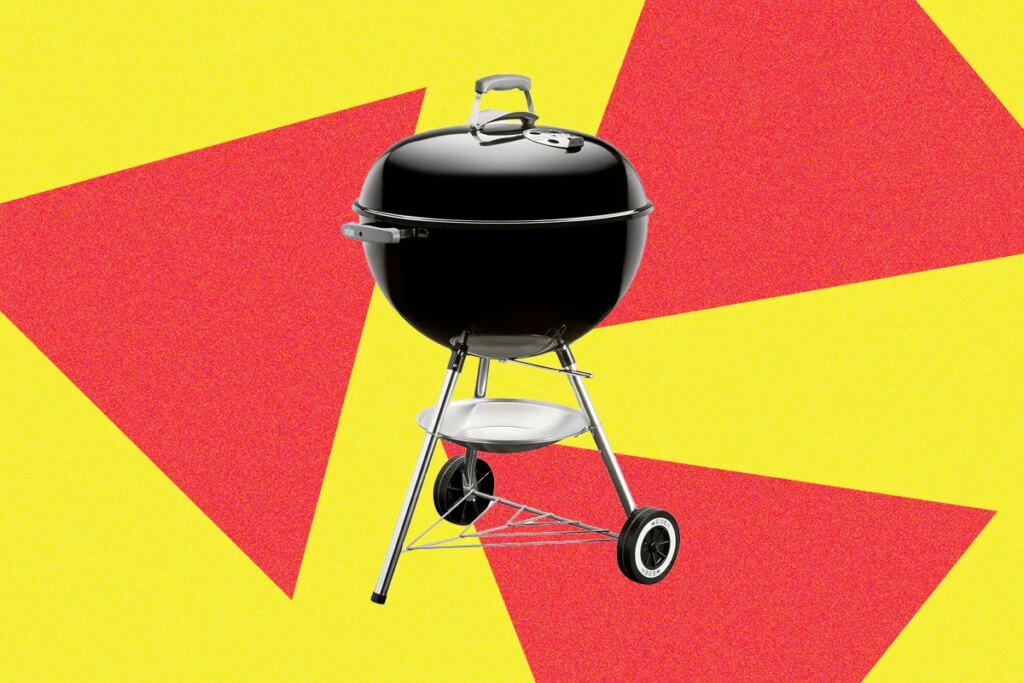
The original Weber Kettle ($149) is forever. It is a seemingly universal presence in American backyards and sheds. It is simple, and it is durable. Its mix of portability, value, and resilience might be unimprovable. But the grill itself can get better with a few smart-grill add-ons. It status as the best-selling charcoal grill in the world means there are multiple companies willing to fill the gaps. There’s also a reasonable chance you’ve got a Weber Kettle in your backyard or garage right now, same way I’ve got one in the side yard.
The Spider Grills Venom ($280) is quite simply the best aftermarket digital grill controller I’ve used on any grill, designed specifically for use on 22- or 26-inch Weber Kettles. (Spider uses the same tech integrated into its new Giant Huntsman Grill, which just began shipping .) The key to the Venom is the same style of PID temperature controller that creates temperature stability in a smart thermostat or my favorite espresso machine. Essentially, this lets the device measure temperature differentials moment by moment, and respond predictively—rather than swing wildly like more primitive thermostats.
Installation took about 10 minutes, and involved sliding the Venom somewhat awkwardly in place at the kettle’s bottom vent, plugging in the meat and grill probes, and downloading and pairing the Spider Grills phone app. Like pretty much all smart grill devices, the Venom only pairs to 2.4 GHz Wi-Fi signals, which are slower but have better range.
But pairing was more seamless with the Venom than with other smart grills I’ve tested. Unlike with some other smart grill devices, I was also able to use my phone’s hotspot rather than rely on my cruddy house signal. This has the drawback that Spider loses Wi-Fi when I wander too far away. I’ll have to install a mesh router system to get better outdoor coverage the rest of the summer.
Operation is simple: I set the target ambient and probe temps, and the app will inform me how far to manually open the top vent on the grill. The device then controls airflow via a fan at the bottom of the Weber to regulate temperature. This is quite accurate at the low temperatures you’ll likely use most often. But when I tried to get my coals up to the 475 Fahrenheit, I found that the Venom overshot by about 25 degrees before leveling out and holding remarkably steady thereafter. For charcoal, I consider this admirable accuracy. The steak was also damn delicious, with a hint of charcoal flavor and an admirable sear.
Basically, the Venom lets me treat a kettle grill like I treat my oven indoors: I set a temp and can reasonably expect that the grill will maintain this temp. For slow cooks, this is great. The app also alerts me when meat reaches target temperature, but does not try to tell me when to flip my steak or how long to cook my pork loin. What it does is work. The app pairs. The temperature holds. The pork loin is juicy and smoky, with a light sugar-bark.
As mentioned, the Venom works best for low-and-slow cooks, but I’ve used it to bring steaks to temp and monitor, while keeping the grill-top temperature predictable—which means I can experiment with which grill temps get the best results for my ribeye. (For the record, after cooking multiple discount grass-fed rib-eye steaks from Grocery Outlet, it turns out I like rib eye at the low end of searing for maximum rendering of interstitial tissues, about 450 degrees Fahrenheit.) Unless you buy a separate $50 battery pack that can be mounted on the device, the Venom does need to be plugged in, however. If you don’t want to buy a dedicated power bank just for one device, check out WIRED’s guide to the best power banks. I used an extension cord.
Upgrading a Kamado or Other Ceramics: ChefsTemp ProTemp S1
For any of a number of ceramic grills with a screw-in thermometer, the ChefsTemp ProTemp S1 system is a clever solution that works for a surprising range of grills. The ProTemp S1 is flexible because it’s completely modular, pairing up wireless probes, a separate fan called the Breezo that attaches to the bottom vent, and a ProTemp S1 temperature hub that screws into the same slot as a stock thermometer.
Because each part attaches wirelessly, the whole package is pretty flexible. ChefsTemp advertises bundles for Primo grills, every version of Kamado Joe, Big Green Egg, Akorn, Vision, Old Country Smoker, and a Weber Smokey Mountain. If you’re willing to drill a hole or two, you could even install the ProTemp into any classic kettle.
But what I had to play with was the big red egg of a Kamado Joe ceramic grill, known for building heat slowly and holding that heat for a long time. I rarely use ceramics, and so it turned out I was bad at getting the temperature right. I kept underestimating how good the Joe would be at holding heat, and so I let the temp get too high. The ProTemp helped me cook good ribs anyway.
The ProTemp S1 itself basically looks like a thermometer with a digital readout. That’s because this is precisely what it is. Unscrew the original thermometer from the Kamado Joe and screw in the ProTemp. This is the only permanent installation I had to do. Pair this with a ChefsTemp probe ($120) to offer app-supported monitoring of both meat and ambient temperatures. Add ChefsTemp’s Breezo fan ($80), released in 2025, and you can get reasonably accurate temperature control.
Beyond this, the fan is installed in the lower vent with a little metal adapter. Voila, the physical installation is done. But unlike the Venom, ChefsTemp’s devices require at least four devices to all be charged, and all pair up to Wi-Fi or Bluetooth and operate in concert: a digital controller, a fan, a phone, and at least one meat probe.
This can be a tall order if your signal is as weak as mine: You’ll potentially lose one component or another. And unfortunately, it isn’t very easy to switch back and forth between Bluetooth and Wi-Fi operation. To switch to Bluetooth, I needed to fully unpair the entire setup, then start over. So make sure you have a strong 2.4 GHz signal where you plan to use the grill. To test this, you may need to separate the 2.4 and 5 GHz bands on your router and test the range using your phone.
Once you have an adequate signal, the Breezo and the ProTemp sync automatically and reliably. The probes can be more persnickety, and you’ll have to mark them yourself with a pen to tell them apart. (Color coding would have been nice!)
The ChefsTemp app is fairly sophisticated if you want it to be: Choose your cut of meat and its thickness or weight, and the app will monitor the device and offer guidance on flip times—and the expected time until the meat reaches the desired doneness. I tested this on a low-cooked inch-thick ribeye and got surprisingly excellent results at 350 degrees Fahrenheit. For ribs, this worked even when I screwed up the temp and got rolling too high.
That was the big benefit of using the system, especially on a new grill I wasn’t used to yet. Even when I bunged up the cooking temp, I was able to react because I saw the temperature going off target—I could still judge whether the meat was done by monitoring the probes. I never had to sacrifice a half rack of ribs that had turned to jerky.
The Breezo fan wasn’t half as reliable in controlling temperature as the Venom—at least not on a kamado ceramic whose heat builds slowly and then won’t leave. But the ChefsTemp app was very good at responding, in real time, to the temperatures that actually occurred in the grill. In a pinch, that’s enough.
A Temperature Controller for All Grills: Connect Smart Grilling Hub
My colleague Scott Gilbertson is a former line cook and a skeptic of all things “smart” or app-connected or over-engineered when it comes to gills. He prefers to limit failure points and rely on tried-and-tested design. He’s been grilling with an ain’t-broke-why-fix 22-inch Weber Kettle for years, whether hot and fast or low and slow. But he’s granted one concession to the smart-grill era: a Weber Connect Smart Grilling Hub that can monitor his cooks. Because no fan is integrated, it works for any grill. And because it has wires, it’s not subject to the vagaries of Bluetooth or WiFi to register temps.
“If cooking is part science and part artistry, I definitely favor the latter,” Gilbertson wrote, when I asked what smart grill tech he is willing to accept. “But even a grilling Luddite such as myself can see the appeal of a system that alerts you when cooks are falling out of the ideal temperature range.”
The Weber Connect Smart Grilling Hub, released in 2020, was Weber’s first foray into adding smart tech to its classic grills. It’s basically an LED temperature readout with four slots for probes. If you pair it to Weber’s Smart Connect app, you can wander off and do yard work, then catch an alert if the grill temp goes too low. At that point, Gilbertson knows he has to wander back to the grill and add more charcoal to keep his ribs smoking at the right temp. Low fuss, no interference with the cook, high utility.
If you’re newer to grilling and want a little advice, the Smart Connect app can set timers and temps according to a number of recipes, depending on what meat’s on the grill. But for even the intentionally neolithic, the temperature alert is an amenity.
Upgrading a Big Green Egg: Egg Genius
Big Green Egg was the original kamado-style grill. Or at least, it was the one that first turned kamado grills into a cult item in the United States. Part of the appeal was the idea that you could turn your grill into something more like an oven, baking your food in radiant, indirect heat emanating off the ceramic. The cookers are big and sturdy, and hold heat the way we hope your mother holds you in her heart. This leads to both even cooks and efficiency.
But unlike an oven, the Big Green Egg does not come with a temperature controller by default. This Egg Genius was one of the earliest smart grill devices, launched in 2020. Attach it to the air vent on the front of the Big Green Egg and connect up to three meat probes. These will feed data into Big Green Egg’s app and then alert you when your temp hits pre-determined levels. A variable-speed fan on the device controls airflow and, therefore, helps hold the Egg at the ideal target temperature.
When WIRED commerce director Martin Cizmar first tested this out back in 2023, the app did not perform flawlessly. But in the meantime, he says, the issues have been fixed, and the device will now hold temperature over the course of long cooks. But as with other ceramic cookers, there’s no electric ignition to be found. You’ll want a box of Tumbleweeds ($38) to get your cook started. The simplicity and reliability make that a minor trade-off, Cizmar notes.
The post How to Upgrade Weber and Kamado Joe Into Smart Grills appeared first on Wired.