Warning: This post contains spoilers for The Boys Season 5 finale.
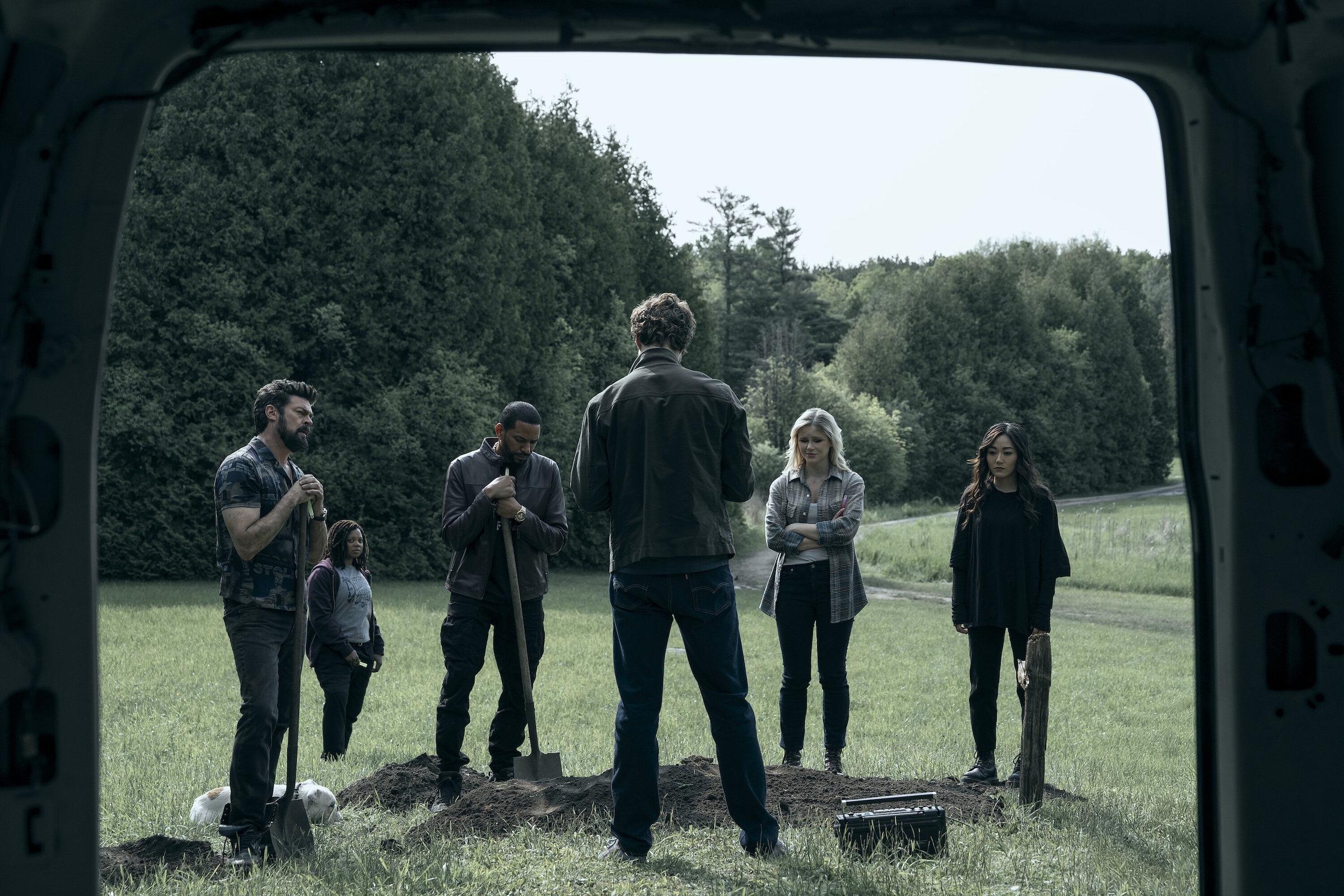
The series finale of The Boysopens not with a battle or a broadcast but with four people standing around a grave. Butcher (Karl Urban), Hughie (Jack Quaid), and Mother’s Milk (Laz Alonso) have shovels in their hands; Starlight (Erin Moriarty) and Kimiko (Karen Fukuhara) stand beside them in silence. The dirt is fresh. Frenchie (Tomer Capone) is in the ground, and a series known for moving at chaotic speed slows to a full stop to mark it. Across all that carnage and dark comedy, The Boys was never especially sentimental about its many casualties. Here, it gives one of the gang’s own the weight he deserves.
Then, Hughie unfolds a piece of paper and reads Frenchie’s will aloud, written, as Frenchie explains, on cardstock smuggled into a Homelander-branded freedom camp inside of a guard named Bert. Within seconds, the show accomplishes what it does better than almost anyone: making you laugh and gutting you at the same time. The eulogy is all Frenchie: profane and digressive, organized around the unshakable fact that he had quite literally seen each of their butts. Only when he finally gets to Kimiko—“mon cœur”—does the joke become a goodbye. Tears run down her face; she won’t take Starlight’s comfort.
From the beginning, The Boys followed a group of vigilantes trying to expose and destroy Vought, the corporation that manufactures superheroes as celebrities and political instruments, turning capes and corporate branding into a vehicle for examining propaganda and American mythmaking. By the finale, America has become the nightmare the series warned about all along: a country shaped around Homelander’s (Antony Starr) vanity and appetite for worship. But its real argument lived in the middle: not just whether Homelander can be stopped but what stopping him costs, the compromises made and refused along the way, and whether the people doing the breaking can still find their way back to each other.
Creator Eric Kripke says the opening was never really up for debate after Frenchie’s death in the penultimate episode. “We had to have our characters at their lowest, really mourn that character,” he says. He did, however, offer writers David Reed and Judalina Neira some direction: “I still want to feel Frenchie’s spirit. Even though he’s not there, I want to feel like he’s there.”
The son and the father
Cut to Homelander’s son Ryan (Cameron Crovetti) in a log cabin, watching a reverential black-and-white montage of his father on television, when Homelander himself walks through the door. In one of the finale’s most emotionally devastating scenes, Homelander reveals that he’s immortal and says he wants Ryan to come back home. “You and I, that’s all that matters,” he says. “I know you, because I am you, and you’re me.”
Ryan’s response is a long time coming. Raised mainly by Butcher’s late wife Becca (Shantel VanSanten), Ryan has spent much of his life watching his father throw tantrums for years. Finally, he calls it out.“Dad, get f—d,” he says. Scaring people into calling you God, Ryan tells him, doesn’t make you God. “Deep down, you know that.”
Homelander turns around, eyes watering. “You don’t know what’s going on. It’s okay,” he says. “But you will.”
Kripke notes that Crovetti grew up before the cameras over seven years of production, and he wanted the writing to honor that. “That scene was about Ryan really claiming his own adulthood, standing up to his father with what he ultimately believes,” he says. For much of the series, Ryan was treated as a prize to be won or a weapon to be aimed. Here, he becomes neither. “That young man is choosing his own life,” Kripke adds.
The false god who couldn’t say the word
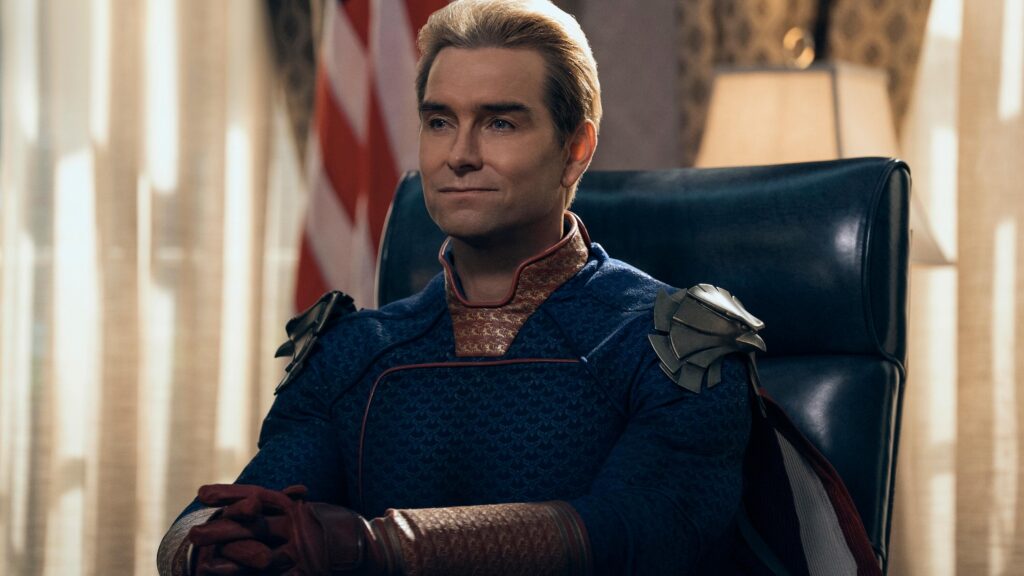
The broadcast Homelander worked toward all season—“Homelander Reboots the Universe,” the clock ticking down while the Boys scramble—is both the episode’s anchor and its most revealing portrait of the man. Seated behind the desk at the Oval Office, he delivers the opening section of his address with practiced ease: the second coming, the new golden dawn, America’s true lord and savior.
Then the teleprompter shows the word “Father,” and he stops.
The weight of that single word is the weight of the entire season. Kripke describes Homelander’s arc across the final episodes as a collision. Ryan rejected him. He brought back Soldier Boy (Jensen Ackles)—his biological father, a first-generation superhero he’d kept frozen for years—only to lose him again. “On one hand he tries to present himself as this god, and on the other hand he’s this needy, vulnerable person whose family keeps abandoning him, but he’s just too narcissistic to understand why,” he says. Now, staring at the one title he was never able to earn or keep, his composure breaks down in front of the camera. He abandons the script. The pleasant artifice falls away mid-sentence, replaced by talk of oblivion and burning the faithless down. “Those who seek to destroy me, you will die the most horrible of deaths,” he threatens.
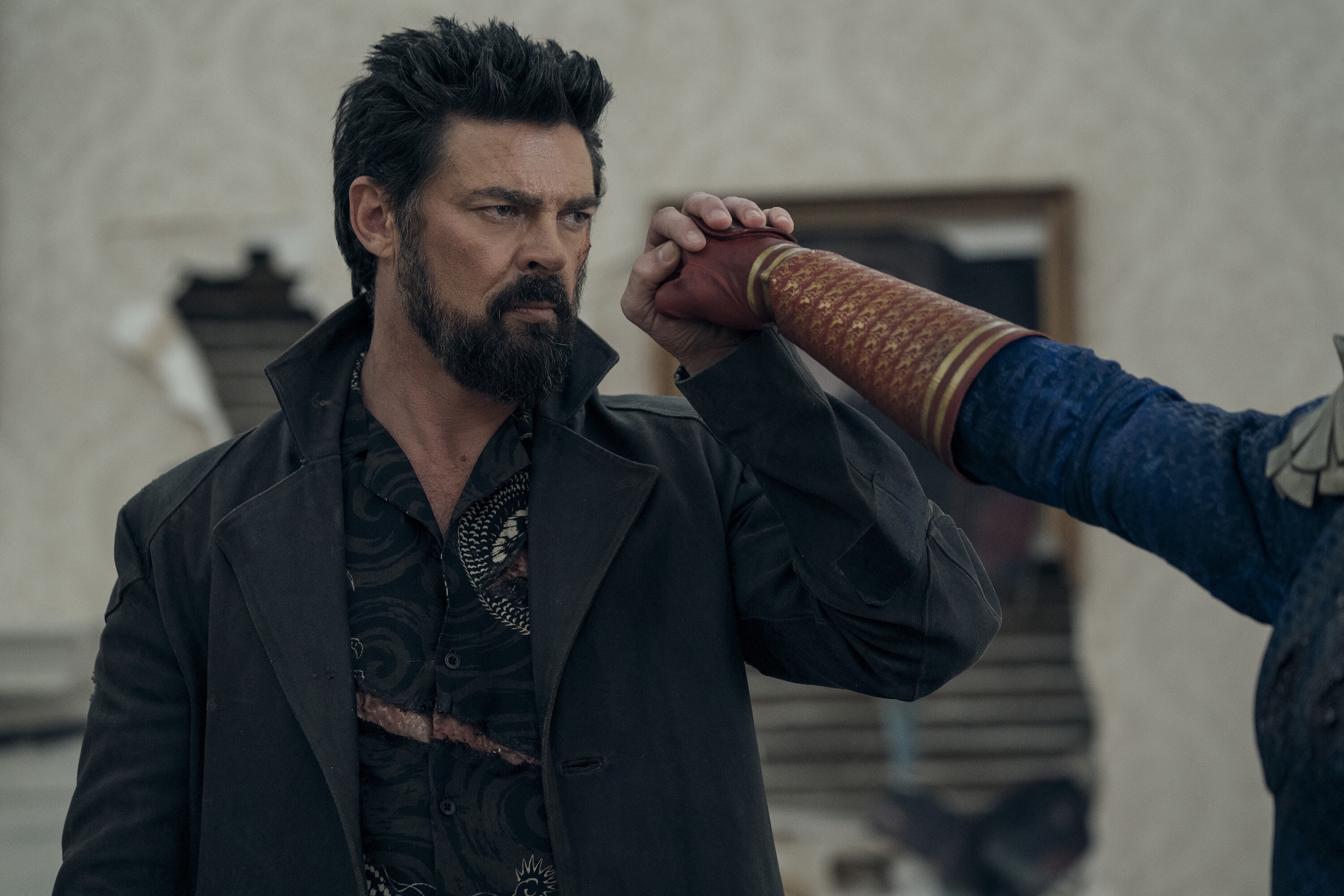
This is the moment Butcher waited for, not just tactically, but emotionally. Once a wall in the Oval Office explodes—a body crashing through it—he enters, crowbar in hand. “Daddy’s home,” Butcher says.
What victory looks like
After years of treating superhero culture as corporate power, media spectacle, and political violence in spandex, The Boys brings its final fight to the room where American power most likes to imagine itself orderly.
With Homelander effectively immortal after being dosed with V1, the Boys have turned to a last-resort plan: expose Kimiko to enriched uranium, hoping she’d absorb enough destructive power to neutralize him. Frenchie died while making that possible, which means the final battle begins with grief already wired into the strategy.
The Oval Office battle is the show at its most physical: Homelander’s lasers against Butcher’s tendrils, Kimiko hanging back, unable to fire. Then Ryan, whom Homelander earlier tried to reclaim as son and heir, comes crashing through the window and joins the fight against his father. Elsewhere in the White House, Hughie and Mother’s Milk take down Oh Father (Daveed Diggs), Homelander’s corrupt preacher and last loyal acolyte—Mother’s Milk turning Ashley’s gifted ballistic ball gag against him until his sonic powers backfire and finish the job.
As that battle ensues, Starlight dispatches the Deep (Chace Crawford)—the show’s preening, aquatic-powered sycophant—by sending him crashing into the ocean, where a giant octopus ensnares and impales him. That a man who spent five seasons boasting of his communion with sea creatures should meet his end at their tentacles is the show’s darkest punchline.
Back in the Oval Office, everything turns on Kimiko’s hesitation. She is the plan—the weapon Frenchie gave his life to build—and she cannot fire. In the vision she sees, an imagined Frenchie asks what’s wrong. “I can’t do it. I just feel sad,” she signs. The rage isn’t there. He places a hand on her heart. “It is never me, mon cœur,” he tells her. “It has always been yours.” What was always hers was not just the energy blast building inside her, but the strength to decide what her power means. Butcher wanted her fury, but Frenchie saw the person underneath it. Her eyes widen, and she fires.
When the light clears, Homelander is powerless—no lasers, no flight. Kripke wanted that reversal to register as both a personal reckoning and broader argument. “Take away your powers and you’re nothing,” he says. He also wanted it to land beyond one fictional villain’s unmasking. “Saddam Hussein, Mussolini, when finally faced with a rifle, they immediately become blubbering cowards,” Kripke adds. “It happens again and again. So goes all strong men.”
Butcher walks toward him with the crowbar, methodical and unhurried, landing blow after blow. When Homelander begins to beg, offering Butcher Vought as he weeps in front of the cameras, the room fills with a sensation that should be impossible in a show this cynical: justice, however ugly, brought down on a frightened, hollow man finally exposed for what he is.
The crowbar goes into Homelander’s head; he dies on live television, while America watches in horror.
The wound in the man
After Homelander’s death, Butcher briefly imagines another ending for himself. He tells Ryan there is nothing he can say to make the death of his father easier, but that Ryan did what he had to do. Then he offers the boy a fresh start: the two of them, his bulldog Terror, and the memory of Becca. Ryan refuses the shape of someone else’s redemption story. He knows Homelander is better gone, but he also knows Butcher is not the answer. Whatever future comes next, he wants it to be his own.
Then Butcher finds Terror dead in his bedroom, and the last fragile piece of the life he imagined collapses. Butcher’s pain has a specific origin the show traced carefully: the death of his younger brother Lenny, who died by suicide, a loss Butcher never fully processed and never stopped carrying. But the line Kripke is most proud of is what follows it, the idea that a small and stubborn ember in Butcher never fully went out. “We never forgot that there’s like this little candle in a hurricane that’s human,” Kripke says. This season, that candle was Terror. “When Terror dies, a big part of his humanity dies with him.”
The defeat of Homelander is not the finale’s real ending. That comes later, in a glass conference room at Vought Tower, with Billy Butcher holding a canister of virus.
Butcher, rather than setting the virus down, has dumped it into the building’s sprinkler system. All it takes is one trigger and, as he puts it, “kill juice” rains through all 99 floors. Within days, he says, the virus will be worldwide. As long as Vought exists, Butcher argues, there will be supes. And sooner or later, one of them becomes the next Homelander. The only answer is to end the whole notion, permanently.
Butcher recruited Hughie in the pilot after the boy watched a superhero kill his girlfriend and still could not bring himself to hate the world. Butcher needed exactly that: someone with enough decency left to stop him when he went too far. That reckoning arrives here, in a glass tower, with the city spread out below them. Hughie, the person Butcher brought in for this purpose, makes one last attempt. “You are not a monster, Butcher,” he says. “It just hurts to be human.”
Kripke says the line is doing precise work. “We were trying to boil down everything [Butcher’s] gone through into one line,” he says. He paraphrases a famous dictum attributed to 18th-century English writer Samuel Johnson that informed the writing: those who turn themselves into a beast can forget the pain of being a man. “[Butcher] was turning himself into this monster not just to stop Homelander, but because he was in such pain,” Kripke continues. “Hurt people hurt people.”
Butcher doesn’t put the virus down. He pulls a gun. Hughie pulls his own. They fight, and as Butcher moves to trigger the virus, he pauses, seeing a vision of a young Lenny. Hughie has always been, in some sense, the brother Butcher couldn’t save. In that pause, Hughie shoots him in the stomach. “I’m sorry,” Hughie says. “I didn’t want to do that.”
“It’s all right,” Butcher says. “I gave you no choice.”
Kripke says that pause—the moment Butcher almost stops himself—is the detail he finds “weird and noble” in the ending. “I think Butcher probably was not going to do the right thing. But he stayed his hand just long enough to let Hughie stop him,” he says. Whether it was mercy or the last functioning piece of his humanity, the effect is the same: Butcher specifically brought someone into his life to stop him, from the very first episode, and it worked, exactly as he intended. He reaches for Hughie’s hand; his grip relaxes. He is gone.
What they were, and what remains
The burial scene that follows recalls the episode’s opening. Hughie’s eulogy for Butcher is simpler and more honest than Frenchie’s was for the group. “He was nothing but flaws and bad choices, but he never gave up hope that he could stop Homelander, and then he actually did it,” he says. Ryan thinks it’s good he’s buried next to his mother. Kimiko simply says “Bye” and softly smiles.
Then Billy Joel’s “Piano Man” begins, and the montage that follows takes its time. Mother’s Milk marries Monique (Frances Turner); Ryan is beside them. Kimiko sits at a café in Marseille—Frenchie’s city, his happiest memories—eating a madeleine and petting a dog. The song ends. Hughie walks into a store with a new sign: Campbell Audio Visual. Starlight is behind the counter, pregnant, wearing Crocs because they’re the only shoes that fit. Hughie tells their unborn daughter—Robin, the name of Hughie’s girlfriend killed by A-Train (Jessie T. Usher) in the show’s very first episode, the death that pulled him into this world—to take care of her mom, then watches Starlight fly away into the sky, off to do more good, and can’t stop smiling, full of awe.
For Kripke, the ending was never meant to feel like victory. “This show is hopeful. I don’t think it’s cynical,” he says. “But it is honest about hope, which is: it’s really hard. You fail a lot and you sacrifice an incredible amount, and nothing will ever be perfect.” Ashley Barrett (Colby Minifie) is impeached from the presidency after her press conference; Stan Edgar (Giancarlo Esposito) is back at Vought as its interim CEO. The Bureau of Supe Affairs needs a new director, and the country’s new president is already calling Hughie about the job.
“We very much wanted to make a point that the world is messy,” Kripke says. “But when you get up every day and try to take care of your loved ones and show kindness, there’s hope for happiness in an imperfect, messy happiness.”
Kimiko in Marseille is the image that crystallizes this most honestly. Kripke says the scene was “intentionally melancholy.” “She has the dog [she and Frenchie] were talking about adopting,” he says. “She’s in his city, where he had his happiest memories. But nothing’s perfect.” She didn’t get what she wanted most. She got grief instead: grief with a shape to it, memory she can live inside, and the capacity to go on anyway.
The secret conflict
For all the blood, profanity, and political fury that defined The Boys, Kripke brought to a close a series that will be remembered not only for its audacity, but for the bruised, stubborn humanity underneath it. The Boys always announced itself as a show about superheroes and the violence institutions do to ordinary people. All of that is true, and the finale makes good on every count. Homelander dies humiliated on live television because his power was taken from him, and the point is deliberate: strip away the apparatus, and what’s left is a frightened, hollow man. Vought survives and reorganizes, because such systems often do. Their deeply imperfect world is not fixed.
But Kripke says the show’s real subject was always a more personal argument. “What I keep calling the secret conflict of the show is Butcher and Hughie,” he says. It wasn’t a superhero question, but a human one: whether a man who has ground down every human part of himself in the service of a righteous cause can be reached by someone who still believes in him. Whether the version of yourself you destroy to win is worth the winning.
Kripke brought in Hughie at the start knowing what Butcher was really asking for. “He knew he was never going to stop, but he specifically brought someone into his life to stop him,” he says. After all that time and one terrible bullet, it worked.
By the end, hope does not come from anyone being saved. It comes from what the characters refuse to become. Ryan rejecting the fathers who would define him; Kimiko refusing to let rage be the only source of her power; Hughie refusing to mistake Butcher’s pain for permission to let the world burn. In each case, the finale rejects the idea that salvation comes from the strongest person in the room.
“Beware of people who are too overly macho, who think they can save you, because they’re selling you something,” Kripke says of what he wants the series to leave behind. Homelander sold that fantasy until he died begging on the floor of the Oval Office. Butcher sold a version of it, too—and was slowly, painfully disabused. What remains, in the end, is not a hero’s death or a villain’s defeat but the quiet fact that it worked. A man who never believed he could be stopped was stopped, by the one person he’d brought in specifically for that purpose.
Landing this ending in this moment leaves Kripke in the same uncertain, hopeful territory as his own characters. “It’s surreal,” he says. “It’s been really 10 years of my life, from when I first started working on the idea till now. It’s a major chapter.” Offscreen, that sense of transition is personal, too: his son is heading to college in the fall, he’s moving into a new house after losing his old one in the Palisades fire in 2025. “There’s a lot going on in my life. There’s that excited but uneasy feeling of not really knowing what’s next,” Kripke adds. “Hopefully, like everyone in the show, I can take the lesson of the show and embrace it and react to it positively and have hope for the future.”
From the beginning, The Boys held a warped mirror to American politics, reflecting on the worship of strongmen, the theatrics of power, the gap between the myth a country tells about itself and the reality underneath. But the only honest note the series could leave on is the one it chose: America is still broken, Vought still standing. There is a baby on the way, and Hughie, despite all his old hurt, is still looking up. After all the blood and broadcast spectacle, The Boys ends not with a hero’s triumph, but with the ordinary, unspectacular work of caring for one another. Ten years in the making, the answer turns out to be that simple, and that hard.
The post Breaking Down the Brutal Series Finale of The Boys appeared first on TIME.