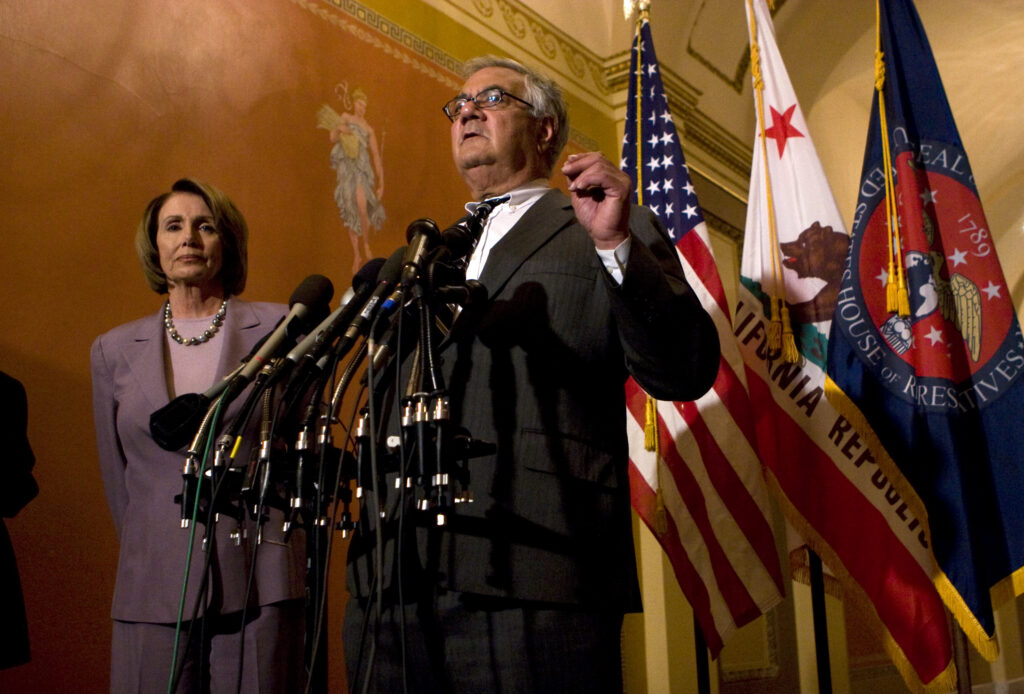
Barney Frank, a Massachusetts Democrat who brought his sharp intellect and irrepressible wit to the U.S. House of Representatives, where he led a sweeping overhaul of the financial industry after the Great Recession and advanced gay rights as one of the first openly gay congressmen in history, died May 19 at his home in Ogunquit, Maine. He was 86.
His death was confirmed by his sister Doris Breay. Mr. Frank revealed last month that he had entered hospice care for congestive heart failure. Interviewed by Politico, he said he was preparing to release a book that was critical of his party’s left wing, which he blamed for alienating moderates.
Progressive Democrats have “embraced an agenda that goes beyond what’s politically acceptable,” he said. “Until we separate ourselves from that agenda, we don’t win.”
Mr. Frank was a singular presence in the chambers and cloakrooms of Congress, where he served for 16 terms beginning in 1981, representing the Boston suburbs of Brookline and Newton. A self-described “left-handed, gay Jew,” he said he “never felt, automatically, a member of any majority.”
He traced his interest in politics to two formative events of his youth: the anti-communist witch hunts led by U.S. Sen. Joseph R. McCarthy (R-Wisconsin) and the lynching of Emmett Till, the 14-year-old African American who was almost exactly Mr. Frank’s age when he was killed in Mississippi in 1955 for allegedly flirting with a White woman. In politics, he said, he saw a way to bring about change.
After pumping gas at his father’s Jersey City truck stop, Mr. Frank won admission to Harvard University, where he studied government. In an era of pervasive antisemitism and homophobia, he long regarded public office as beyond his reach.
He concealed his sexual orientation as he made his way from Boston’s City Hall, where he served as chief of staff to Mayor Kevin H. White in the late 1960s and early 1970s, to the Massachusetts House of Representatives and then to Washington. Not until 1987, when his congressional seat was safe, did he come out publicly.
With his rumpled suits and rapid-fire manner of speech that blared his New Joisey upbringing, he little resembled the prototypical “gentleman from Massachusetts” conjured by the parliamentary honorific.
But by the end of his 32-year congressional career, Mr. Frank was regarded as an institution in the House, his name forever attached to the Dodd-Frank Wall Street Reform and Consumer Protection Act of 2010, the most significant piece of legislation governing the financial industry since the Great Depression.
“He is one of the great legislators of the Congress, certainly of his generation and ranking among the best in history,” Thomas E. Mann, a senior fellow in governance studies at the Brookings Institution, said in a 2021 interview for this obituary.
Mr. Frank exuded moral outrage at injustice — the cruelties he witnessed as a civil rights worker in the segregated South, the economic inequities that drove his interest in affordable housing, and the bigotry that forced him to spend decades in the closet.
But he also possessed a fundamental optimism that went hand in hand with his liberal ideals. He believed that social ills could be ameliorated through government intercession — provided, as he put it, that the often competing forces of “pragmatism and zealotry” were coordinated. He came to see such coordination as his chief role in advancing the causes that mattered to him.
“I don’t have the intellectual time and energy to come up with new policy ideas,” Mr. Frank told the Boston Globe, adding: “I am about the political process. I know the rules of the House as much as anybody. I am a wonk about how to get things done, more than about what to do.”
Mr. Frank was known for his biting humor. He could unleash it when discussing an arcane matter before the Financial Services Committee, which he chaired during the economic crisis of 2008, or when tweaking his nemesis, Newt Gingrich, during the Georgia Republican’s years as House speaker in the 1990s. It was said that when Mr. Frank was speaking on the House floor, Capitol Hill staffers, in their offices, unmuted C-SPAN to be entertained.
“Conservatives,” Mr. Frank observed, “believe that, from the standpoint of the federal government, life begins at conception and ends at birth.”
But he was also known as a pragmatist who worked closely with Republican colleagues including Spencer Bachus of Alabama, his longtime Republican counterpart on the Financial Services Committee.
Norman J. Ornstein, a congressional scholar at the American Enterprise Institute, compared Mr. Frank in that regard to Sen. Edward M. Kennedy, a fellow Massachusetts Democrat. They were liberal lions, Ornstein told The Washington Post in 2021, but they accepted “the give and take that is necessary to turn bills or ideas into laws.”
Mr. Frank’s legislative legacy rested principally on Dodd-Frank, as the 2010 act was known. “Dodd” referred to the bill’s champion in the Senate, the Banking Committee chairman Christopher J. Dodd (D-Connecticut). Mr. Frank rejected a move to name the legislation “Frank-Dodd.” “You can’t do that,” he quipped. “They will think it’s one guy.”
The legislation emerged from the financial catastrophe that began with the collapse of the subprime mortgage market in 2007 and eventually engulfed major Wall Street institutions and, with them, the U.S. and world economies.
Mr. Frank was a key advocate on Capitol Hill for the Troubled Asset Relief Program, or TARP, a government rescue package for the banking, automotive and insurance industries. Widely perceived as a bailout of well-heeled executives who had helped cause the economic crash with their risky maneuvers, TARP was intensely unpopular when it was enacted. But experts credited it with forestalling greater chaos in the economy.
In an effort to prevent a recurrence of such a disaster, Dodd-Frank created the federal Financial Stability Oversight Council to monitor threats to the U.S. financial system, including the emergence of institutions deemed “too big to fail.” It also established the Consumer Financial Protection Bureau and increased regulation of credit default swaps and other risky financial derivatives implicated in the subprime mortgage crisis that triggered the recession.
“Through this all, the quarterback for us is Barney,” House Speaker Nancy Pelosi (D-California) told the New Yorker in 2009. “He’s solution-oriented, respectful of different perspectives, and brilliant. And it’s brilliance that saves time, because he simplifies the complex for us. He is an enormously valuable intellectual resource for the Congress.”
Conservatives contended that the legislation burdened Wall Street with excessive regulation, while liberals railed that it should have gone further, breaking up big banks and placing greater capital requirements on financial institutions. But Mann, like many other observers, defended Dodd-Frank.
“I think most fair-minded analysts would see it as a really important piece of legislation,” he said. “The stability of our financial system was certainly strengthened as a consequence of it.”
A House reprimand
After Dodd-Frank, regarded as the crowning achievement of Mr. Frank’s career, the Democrats lost their House majority, and he announced in 2011 that he would not seek reelection in 2012.
There was a time when such longevity seemed in doubt: A decade into his career, Mr. Frank received an official House reprimand over his involvement with a male escort who had operated a prostitution service from Mr. Frank’s Washington residence.
Mr. Frank had previously confirmed his homosexuality in a 1987 interview with the Globe. He was not the first openly gay congressman; in 1983, another Massachusetts Democrat, Gerry E. Studds, had disclosed his homosexuality when he admitted having an earlier relationship with a 17-year-old page. But Mr. Frank, who did not disclose his sexuality under pressure from a scandal, was often described as the first member of Congress to voluntarily reveal that he was gay.
The reprimand stemmed from his relationship with Steve Gobie, a prostitute he had paid for a sexual encounter in 1985. Mr. Frank went on to employ him as a personal assistant, hoping, he later explained, to change the man’s troubled life.
But he eventually came to see Gobie as a “very good con man” and dismissed him after complaints about suspicious traffic at the residence when Mr. Frank was away. In 1989, in what Mr. Frank said was a bid for revenge, Gobie offered his story to the right-leaning Washington Times.
A House ethics committee investigation found no evidence that Mr. Frank knew of the prostitution operation in his home. But the panel determined that he had fixed 33 parking tickets for Gobie and used congressional letterhead to communicate with court officials overseeing Gobie’s probation. In 1990, after an emotional debate, the House voted 408 to 18 to reprimand Mr. Frank, a measure less severe than censure or expulsion.
Mr. Frank told the Globe that he was “overwhelmed with guilt at first.”
“I felt terrible that I had put at risk some of the things that I thought justified my public career,” he said. “And I knew that other gay people were going to suffer because of me.”
But he quickly rebounded, easily winning reelection and moving forward with his legislative agenda, which over the years included pushing for repeal of President Bill Clinton’s “don’t ask, don’t tell” policy” for gays in the military and working — cautiously — for the legalization of same-sex marriage.
Political influences
Barnett Frank — he legally changed his name to Barney — was born in Bayonne, New Jersey, on March 31, 1940, one of four siblings. His parents were children of Jewish immigrants from Eastern Europe. His mother was a legal secretary, which enabled her to support the younger children after her husband died of a heart attack when Mr. Frank was 20.
In an interview with the New Yorker, Mr. Frank described his father as living “on the fringes” amid the rampant corruption of the local Democratic machine. He became a middleman in a kickback scheme and, after refusing to testify against a brother, was jailed for a year.
But both parents were liberal Democrats engaged in civic affairs and committed to social justice, Mr. Frank said. He recalled that his father’s business served Black truckers at a time when other White truck stops did not.
Asked in an interview for this obituary about his favorite writers in his youth, Mr. Frank delivered a litany of crusading newspaper columnists from the era. He said he formed a special affection for the often sardonic New Yorker writer A.J. Liebling and traced his own sense of humor, at least in part, to comedians Milton Berle and Henny Youngman, masters of the one-liner.
Mr. Frank’s sister Ann Lewis, later a prominent Democratic strategist, was the first member of the family to attend college — at Radcliffe, Harvard’s former women’s college. He followed her to Cambridge, Massachusetts, and received a bachelor’s degree in government from Harvard in 1961.
In the early 1960s, Mr. Frank traveled to Mississippi, where he joined an effort to register Black voters and increase their political involvement. For the first time, he said, he saw firsthand the brutality visited upon African Americans in the South. He absorbed the strategy and ideals of the civil rights movement, which advocated the steady, incremental and nonviolent pursuit of change.
Mr. Frank stayed on at Harvard to pursue a PhD but set aside his studies in 1967 to work on White’s mayoral campaign and then in the mayor’s office. Mr. Frank’s portfolio in City Hall was so expansive — ranging from race relations to housing to the delivery of city services generally — that journalist J. Anthony Lukasdescribed him, still in his late 20s, as the city’s “de facto mayor.”
Mr. Frank said he saw academia as a “sheltered milieu” where he could hide his homosexuality, and he planned to return to Harvard, complete his doctoral degree and become a professor. But by his own account, he lacked the attention span needed to produce a dissertation and abandoned his studies when he was offered a job in the Washington office of Rep. Michael J. Harrington (D-Massachusetts).
Mr. Frank later returned to Harvard to study law, and he received a law degree in 1977.
He won his first elective office — a seat in the Massachusetts House representing Boston’s Back Bay — in 1972. His opportunity to run for national office came in 1980, when Democrat Robert Drinan, a member of the Jesuit order, vacated his U.S. House seat after Pope John Paul II barred priests from holding political office. Mr. Frank won the seat and was easily reelected through the rest of his career.
Champion of gay rights
On occasion, Mr. Frank threatened to expose what he considered the hypocrisy of closeted gay members of Congress who opposed gay rights.
One such occasion came in 1995, when Clinton signed an executive order abolishing a federal policy that prohibited gay people from holding security clearances. (The discriminatory policy, entrenched since the Cold War, assumed that closeted gays might be vulnerable to blackmail by foreign governments.)
“If the Republican Party gets through Congress a law that says that closeted gay people are a security risk, I will send a list to the Ethics Committee of all the closeted gay Republicans,” Mr. Frank told the New York Times, recalling his response to GOP opponents of Clinton’s move. “And they did back off.”
When Clinton was impeached in 1998 for lying about his affair with White House intern Monica S. Lewinsky, Mr. Frank, then a senior Democratic member of the Judiciary Committee, conceded that the president had “screwed up.” But he became one of Clinton’s most outspoken defenders, mocking the proceedings as an inquiry into “what did he touch and when did he touch it?” (Clinton was acquitted in the Senate.)
Mr. Frank became ranking minority member of the Financial Services Committee in 2003 and chairman four years later when Democrats took control of the House. He deepened his expertise in affordable housing, which he sought to promote particularly for low-income renters.
In his later years, Mr. Frank joined many other members of Congress in decrying the decline in bipartisanship in Washington. He also expressed frustration with liberals who pursued their goals through public demonstrations and other tactics that, in his view, served largely to energize themselves.
“If you care deeply about an issue, and are engaged in group activity on its behalf that is fun and inspiring and heightens your sense of solidarity with others,” Mr. Frank wrote in a memoir, “Frank” (2015), “you are almost certainly not doing your cause any good.”
Mr. Frank had witnessed enormous gains, particularly in the area of gay rights. These included the U.S. Supreme Court’s rejection in 2013 of the 1996 Defense of Marriage Act (DOMA), which defined marriage as between a man and a woman, and the court’s decision two years laterthat established a constitutional right to same-sex marriage.
But there were also setbacks.
“The same week in 2013 that they got rid of DOMA, they gutted the Voting Rights Act,” Mr. Frank told the publication CommonWealth in 2015, referring to the high court’s invalidation of a key component of landmark 1965 civil rights legislation. He said he would have sacrificed the victory over DOMA for the sake of the voting rights law.
In 2012, Mr. Frank became the first member of Congress to be joined in a same-sex union when he married Jim Ready, a carpenter and welder he met at a political fundraiser. A compete list of survivors was not immediately available.
In 1996, a New York Times reporter invited Mr. Frank to comment on what the reporter described as the “phoenixlike quality” of Mr. Frank’s career.
“Oh, I don’t think in those terms,” Mr. Frank replied. “I had one crisis in ’89. I do not take pleasure in having had that terrible experience.”
“As for being gay, I never felt I had much choice about anything,” he continued, adding: “So just go out and be the best you can be. You can’t make yourself a different person. I am who I am. I have no idea why. Maybe I’m more Popeye than phoenix: I am who I am.”
The post Barney Frank, influential congressman and gay rights hero, dies at 86 appeared first on Washington Post.